



view more
Credit: Gabriel Ugueto
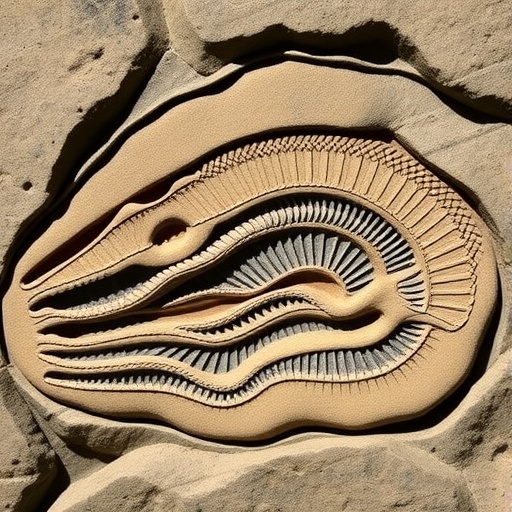
Scientists from China, Europe, and the USA, including Dr. Stephan Spiekman, a paleontologist at the State Museum of Natural History Stuttgart and the University of Hohenheim, have described a remarkable fossil of the long-necked marine reptile Austronaga minuta from China. Although this reptile descended from land-dwelling reptiles, it was already superbly adapted to life in the water around 245 million years ago. This almost completely preserved fossil provides the first detailed view of this prehistoric animal’s entire skeleton and large parts of its digestive system. Various internal organs, such as the stomach, liver and intestines, have been clearly identified using modern analytical methods. This is the oldest known example of a largely complete digestive system in a reptile to date. The research results on this extraordinary find have now been published in the journal “Science Advances”.
Early adaptations to life in water
Long-necked marine reptiles were not uncommon in the seas of what is now China during the Triassic period, and several species have been found as fossils. However, the Austronaga minuta fossil is unique in many ways. Despite being only 60 centimetres long, the animal had a strikingly long neck and tail. Impressively, Austronaga was highly adapted to life in the water, using its long tail for propulsion and its elongated, fin-like front legs for steering and stabilisation. Its hind legs, on the other hand, were greatly reduced and played hardly any role in swimming. This unusual body shape is surprising given that Austronaga is not at all closely related to the other famous fossil sea reptiles, including ichthyosaurs or giant mosasaurs that share this method of swimming. Instead, Austronaga is closely related to land-dwelling archosaurs, a group that includes crocodiles and dinosaurs.
“The archosaurs and their ancestors were the most diverse group of reptiles on land during the time of the dinosaurs, but we always thought that their adaptation to life in the sea was limited. However, the discovery of Austronaga shows that early representatives of this lineage had already developed complex adaptations to life in the oceans, comparable to those of other, better-known groups of fossil marine reptiles,” says Dr Stephan Spiekman, a specialist in long-necked marine reptiles, who is also the co-author of the study.
The oldest known digestive track of any reptile
Between the ribs of the fossil, the researchers came across a dark region which, upon closer inspection, turned out to be remnants of a largely intact digestive tract. Using various examination methods, including UV light photography and mass spectrometry, the scientists were able to clearly identify several internal organs for the first time.
“Compared with the highly specialized body shape of Austronaga, its internal organs seem less modified. The preserved organs include a large, sac-like stomach at the front, followed by a strikingly red liver in which traces of haemoglobin can still be detected. Behind this is a long, simple tube forming the small and large intestines. The overall arrangement shows that the digestive system of Austronaga was relatively simple in structure,” says Dr Wei Wang, lead author of the study and marine reptile expert at the Institute of Vertebrate Palaeontology and Palaeoanthropology in Beijing. “This fossil is the oldest known example of a largely complete digestive system in a reptile.”
“While today’s birds and crocodiles have a two-part stomach, Austronaga had only a single stomach chamber. This shows that the stomachs of archosaurs were initially quite simple and only evolved later in the evolutionary process,” explains Dr Nick Fraser of the National Museums Scotland, one of the study’s authors. “It is also striking that Austronaga had a fairly short and uncomplicated digestive tract, very similar to that of today’s fish-eating reptiles.”
Further research on the evolution and ecology of marine reptiles
This study was conducted by researchers, from the Institute of Vertebrate Paleontology and Paleoanthropology in Beijing (China), the National Museums Scotland (UK), the State Museum of Natural History Stuttgart (Germany), the University of Hohenheim (Germany), The Field Museum in Chicago (USA), the Luoping Biota National Geopark (China) and the University of Zurich (Switzerland). It is part of a comprehensive analysis of the early history of modern reptile groups and their diversity in the Triassic seas. The researchers hope to make further significant discoveries in the future that will shed light on the evolutionary history of marine reptiles and their terrestrial relatives.
The fossil is located in Beijing.
BACKGROUND:
State Museum of Natural History Stuttgart:
The State Museum of Natural History Stuttgart is a forward-looking research and communication institute. The museum’s scientific collection comprises more than 12 million objects. The museum researches the evolution of life, analyzes the biodiversity of various ecosystems, and communicates research findings to the general public.
www.naturkundemuseum-bw.de
University of Hohenheim:
Founded in 1818 in response to devastating famines, the University of Hohenheim is Stuttgart’s oldest university. Even 200 years later, this highly specialised university remains true to its founding mission: to make innovative contributions to solving global challenges through research and teaching. Today, it is Germany’s number one institution for agricultural research and food sciences, and is also a leading and unique centre for the natural, economic, social and communication sciences. The University of Hohenheim conducts teaching and research on topics such as the bioeconomy, sustainability, climate protection, species conservation, food security and alternative energy and raw material sources.
www.uni-hohenheim.de
Journal
Science Advances
Method of Research
Case study
Subject of Research
Animals
Article Title
Highly aquatic marine stem archosaur with soft tissue preservation
Article Publication Date
29-Jul-2026
Related News Releases
- Spectacular discovery provides insight into the internal organs of a marine reptile
(Staatliches Museum für Naturkunde Stuttgart)
Meike Rech
Staatliches Museum für Naturkunde Stuttgart
meike.rech@smns-bw.de
Office: ++49/(0)711/8936/107
Journal
Science Advances
Method of Research
Case study
Subject of Research
Animals
Article Title
Highly aquatic marine stem archosaur with soft tissue preservation
Article Publication Date
29-Jul-2026
Related News Releases
- Spectacular discovery provides insight into the internal organs of a marine reptile
(Staatliches Museum für Naturkunde Stuttgart)
Cite Scienmag News
Violet Maxwell. (July 29, 2026). Spectacular discovery provides insight into the internal organs of a marine reptile. Scienmag. https://scienmag.com/spectacular-discovery-provides-insight-into-the-internal-organs-of-a-marine-reptile/
Violet Maxwell. "Spectacular discovery provides insight into the internal organs of a marine reptile." Scienmag, 29 July 2026, https://scienmag.com/spectacular-discovery-provides-insight-into-the-internal-organs-of-a-marine-reptile/. Accessed 4 September 2026.
Violet Maxwell. "Spectacular discovery provides insight into the internal organs of a marine reptile." Scienmag. July 29, 2026. https://scienmag.com/spectacular-discovery-provides-insight-into-the-internal-organs-of-a-marine-reptile/

