


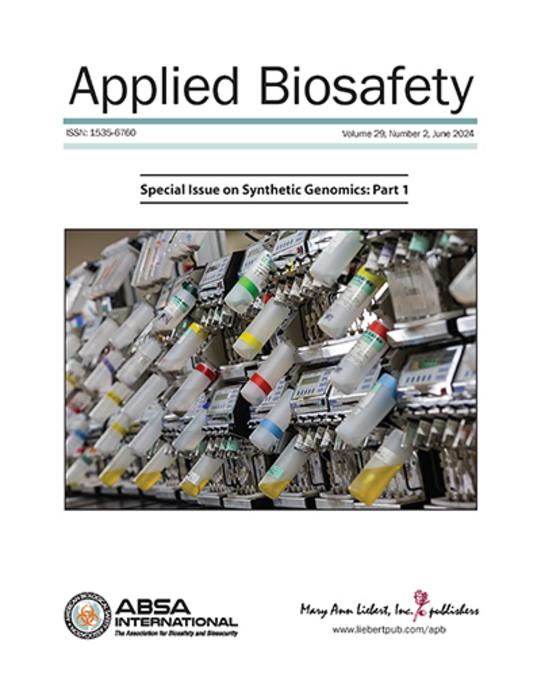
In its first special issue on Biosafety and Biosecurity Considerations of Synthetic Genomics, the first part of a two-part special issue of the peer-reviewed journal Applied Biosafety focuses on the growing availability of customizable nucleic acid sequences and genomes from commercial sources. The issue also describes the advancements in desktop synthesis devices that enable the creation of on-demand nucleic acids. Click here to read the special issue now.

Credit: Mary Ann Liebert, Inc.
In its first special issue on Biosafety and Biosecurity Considerations of Synthetic Genomics, the first part of a two-part special issue of the peer-reviewed journal Applied Biosafety focuses on the growing availability of customizable nucleic acid sequences and genomes from commercial sources. The issue also describes the advancements in desktop synthesis devices that enable the creation of on-demand nucleic acids. Click here to read the special issue now.
The rapid technological advancements described in part one of this two-part special issue are raising concerns among biosecurity experts and policymakers. The manuscripts in this issue explore the challenges, opportunities, and lessons learned in managing the risks associated with synthetic genomics.
Included in the special issue is a Review Article titled “Enhancing Gene Synthesis Security: An Updated Framework for Synthetic Nucleic Acid Screening and the Responsible Use of Synthetic Biological Materials, which reviews the U.S. government’s 2023 revised dsDNA screening framework, which now includes all entities handling synthetic nucleic acids with pathogenic or toxic sequence.
The issue also includes the Review Article titled “Developing a Common Global Baseline for Nucleic Acid Synthesis Screening, which introduces the Common Mechanism for DNA Synthesis Screening, which provides baseline capabilities to address screening challenges, facilitating broader international adoption.
Other Review Articles in the special issue include “Safeguarding Mail-Order DNA Synthesis in the Age of Artificial Intelligence”; “Screening State of Play: The Biosecurity Practices of Synthetic DNA Providers”; “Biosecurity Risk Assessment for the Use of Artificial Intelligence in Synthetic Biology”; and “A Methodology for the Assessment and Prioritization of Genetic Biocontainment Technologies for Engineered Microbes.”
“We are excited to present two Special Issues of Applied Biosafety focused on synthetic genomics, addressing the critical intersection of groundbreaking scientific advancements and the imperative for robust biosecurity measures,” said David Gillum, Associate Editor. “These two issues offer essential insights and practical solutions to ensure that scientific innovations are both safe and secure, fostering a future where scientific progress and biosecurity go hand in hand.”
About the Journal
Applied Biosafety (APB) is a peer-reviewed, scientific journal committed to promoting global biosafety awareness and best practices to prevent occupational exposures and adverse environmental impacts related to biohazardous releases. APB provides a forum for exchanging sound biosafety and biosecurity initiatives by publishing original articles, review articles, letters to the editors, commentaries, and brief reviews. APB informs scientists, safety professionals, policymakers, engineers, architects, and governmental organizations. The Journal is committed to publishing on topics significant in well-resourced countries as well as information relevant to underserved regions, engaging and cultivating the development of biosafety professionals globally.
Applied Biosafety is under the editorial leadership of Coeditors-in-Chief Karen B. Byers, MS, CBSP(ABSA), Dana-Farber Cancer Institute and Barbara Johnson, PhD, Biosafety Biosecurity International, and other leading investigators.
About the Publisher
Mary Ann Liebert, Inc. is a global media company dedicated to creating, curating, and delivering impactful peer-reviewed research and authoritative content services to advance the fields of biotechnology and the life sciences, specialized clinical medicine, and public health and policy. For complete information, please visit the Mary Ann Liebert, Inc. website.
About ABSA International
ABSA International was founded in 1984 to become a global leader for providing professional and scientific expertise in the practice of biosafety and biosecurity. ABSA’s core purpose is to promote and expand biosafety and biosecurity expertise through training, standards, publications, networking, resources, advocacy, annual biosafety/biosecurity conference, and professional credentials.
Journal
Applied Biosafety
Method of Research
Commentary/editorial
Subject of Research
People
Article Title
Introduction to Applied Biosafety’s Special Issue on Synthetic Genomics: Part 1
Article Publication Date
26-Jun-2024
Cite Scienmag News
Drew Townsend. (June 26, 2024). Special Issue of Applied Biosafety focuses on synthetic genomics. Scienmag. https://scienmag.com/special-issue-of-applied-biosafety-focuses-on-synthetic-genomics/
Drew Townsend. "Special Issue of Applied Biosafety focuses on synthetic genomics." Scienmag, 26 June 2024, https://scienmag.com/special-issue-of-applied-biosafety-focuses-on-synthetic-genomics/. Accessed 5 September 2026.
Drew Townsend. "Special Issue of Applied Biosafety focuses on synthetic genomics." Scienmag. June 26, 2024. https://scienmag.com/special-issue-of-applied-biosafety-focuses-on-synthetic-genomics/

