


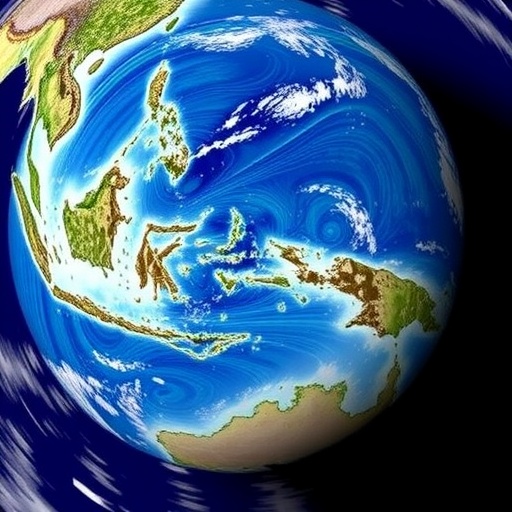
In a groundbreaking study published in Nature Communications, researchers have unveiled a significant Southern Hemisphere contribution to the Indonesian Throughflow (ITF) spanning the last 800,000 years. This revelation challenges long-standing notions that predominantly attributed ITF variability and dynamics to Northern Hemisphere drivers. By integrating advanced paleoceanographic proxy records with state-of-the-art climate modeling, the team has provided a nuanced understanding of how southern hemisphere climatic conditions have actively influenced this crucial oceanic gateway.
The Indonesian Throughflow is a key component in the global ocean circulation system. It acts as a conduit, channeling warm, low-salinity waters from the Pacific Ocean into the Indian Ocean via the complex archipelago of Indonesia. ITF modulates regional climate, impacts marine biodiversity, and plays a pivotal role in global heat and salt redistribution. Understanding its evolution over geological timescales is essential for predicting its future response to climate change and for refining models of global climate dynamics.
Historically, most research has focused on Northern Hemisphere climatic oscillations, such as glacial-interglacial cycles driven by variations in insolation and ice sheet dynamics, as primary regulators of the ITF. However, the data synthesized in this study reveals a prominent and previously underappreciated influence stemming from the Southern Hemisphere. This includes shifts in the Southern Ocean’s temperature, salinity, and circulation patterns that cascade into changes in the ITF strength and structure.
The researchers employed sediment core analyses from the Timor Sea and adjacent basins to reconstruct past salinity and temperature gradients. These proxies, such as foraminiferal isotopic measurements, have enabled the authors to visualize temporal changes in water mass properties that are consistent with altered Southern Hemisphere oceanic conditions. Their findings suggest that fluctuations in the Antarctic Circumpolar Current and associated sub-Antarctic fronts have had a lasting impact on Indonesian Throughflow dynamics.
Complementing proxy data with an ensemble of climate models, the team simulated ocean-atmosphere interactions across glacial cycles. The models revealed that Southern Hemisphere climatic drivers exert greater control over thermohaline circulation patterns feeding into the ITF than previously thought. For instance, shifts in the position and intensity of the Southern Westerly Winds modulated upwelling in the Southern Ocean, which, in turn, affected salinity distributions and meridional overturning circulation that ultimately reflected on throughflow pathways.
This interdisciplinary approach bridging paleoceanography, modeling, and climatology yields fresh insights into how the tropical Indonesian region is dynamically linked to high-latitude processes in the Southern Hemisphere. The implications are vast – as climate change perturbs Southern Ocean dynamics today, it could trigger complex feedbacks impacting not only the regional maritime environment but also broader Indo-Pacific climate systems.
Another striking aspect of the study is its temporal scope. By extending analyses over 800,000 years, the research captures multiple glacial-interglacial cycles highlighting persistent Southern Hemisphere modulation of the ITF well before and during major Northern Hemisphere ice sheet expansions. This undermines the assumption that Northern Hemisphere glaciation was the sole driver of ocean circulation shifts influencing the region.
Furthermore, the study elucidates the role of sea level changes imposed by ice volume fluctuations in controlling the ITF. While previous research underscored sea level lowering during glaciations as pivotal for restricting the Throughflow, this work suggests that Southern Hemisphere oceanographic and atmospheric variability can amplify or dampen these physical constraints in ways that reshape flow intensity and water mass composition.
Detailed geochemical fingerprinting of intermediate and surface waters affirms phase relationships between Southern Hemisphere climatic signals and ITF variability. For example, during periods when Antarctic ice melts and Southern Ocean upwelling intensifies, warmer and less saline waters appear to propagate northward, enhancing Throughflow strength. Conversely, cold glacial conditions correspond to a subdued ITF state.
The study also highlights feedback mechanisms involving Indonesian archipelagic morphology and ocean currents. As fluctuating throughflow volumes adjust circulation patterns, they affect nutrient delivery and biogeochemical cycles, ultimately influencing regional ecosystems. Understanding these links is critical for projecting future biodiversity and fisheries productivity in the Indo-Pacific realm.
Experts in climate modeling have welcomed these revelations as they emphasize the necessity to incorporate Southern Hemisphere dynamics explicitly when simulating ITF responses under future warming scenarios. Models lacking this complexity may underestimate or misrepresent critical ocean-atmosphere teleconnections which govern monsoon systems, precipitation patterns, and even global heat distribution.
The implications for modern climate change adaptation strategies are profound. If Southern Hemisphere variability holds strong sway over the Indonesian Throughflow, shifts in Antarctic and Southern Ocean processes influenced by anthropogenic warming could cascade into marked alterations to maritime climate, coastal sea levels, and tropical weather regimes downstream.
As the Indonesian Throughflow connects two vast ocean basins, unraveling its multifaceted controls over deep timescales enhances our capacity to predict how ocean gateways may evolve. This informs not only academic understanding but policymaking related to marine resource management and climate resilience efforts in vulnerable coastal communities.
Moving forward, the team advocates for enhanced sediment core sampling combined with emerging proxy methodologies to further refine spatial and temporal resolution of ITF paleoceanographic reconstructions. Integrating satellite remote sensing and autonomous underwater vehicle data could also shed light on current Southern Hemisphere impacts and their instantaneous imprint on throughflow hydraulics.
This landmark research paves the way for more holistic assessments of ocean circulation that transcend hemispheric boundaries, appreciating the interconnectedness of Earth’s climate machinery. By unraveling the Southern Hemisphere’s significant yet hidden influence on the Indonesian Throughflow, scientists open a new chapter in understanding the complexity of global ocean systems during past and future climates.
The study, authored by Kienast, Hollstein, Lehmann, and colleagues, reflects a multidisciplinary collaboration that harnesses the potential of geological archives and computational techniques. Their findings will inspire a reevaluation of how we conceptualize ocean gateways’ roles in mediating climatic and environmental change across geological epochs.
In essence, the Southern Hemisphere emerges not just as a passive backdrop but as an active driver sculpting one of the planet’s most influential interoceanic currents. This revelation challenges researchers to rethink prior assumptions and underscores the importance of comprehensive global perspectives in climate science moving forward.
Cite Scienmag News
Violet Maxwell. (April 14, 2026). Southern Hemisphere Shapes Indonesian Throughflow for 800,000 Years. Scienmag. https://scienmag.com/southern-hemisphere-shapes-indonesian-throughflow-for-800000-years/
Violet Maxwell. "Southern Hemisphere Shapes Indonesian Throughflow for 800,000 Years." Scienmag, 14 April 2026, https://scienmag.com/southern-hemisphere-shapes-indonesian-throughflow-for-800000-years/. Accessed 5 September 2026.
Violet Maxwell. "Southern Hemisphere Shapes Indonesian Throughflow for 800,000 Years." Scienmag. April 14, 2026. https://scienmag.com/southern-hemisphere-shapes-indonesian-throughflow-for-800000-years/


