


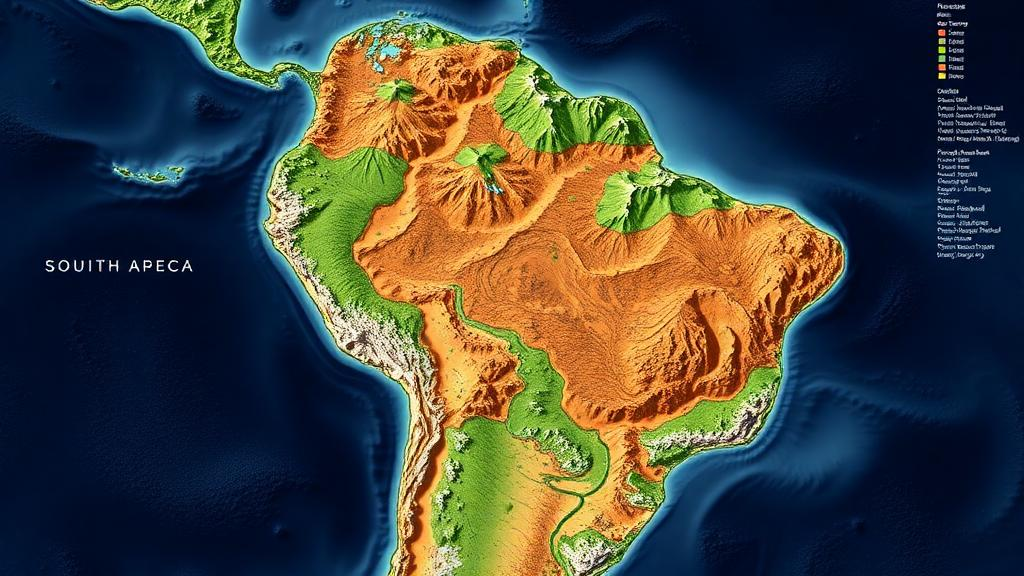
For more than half a century, the way ecologists carve up South America into biomes has rested on a deceptively simple idea: find the dominant vegetation type, match it to the regional climate, and draw a boundary around it. A new study published in Vegetation Classification and Survey argues that this approach fundamentally misrepresents how nature actually works on the ground. Led by Gerrit Navarro, with Francisco Luebert and José Ángel Molina as co-authors, the research proposes that biomes should be understood not as discrete patches of vegetation but as integrated landscape complexes, or geocomplexes, in which zonal, azonal and intrazonal plant communities are spatially linked and mutually interacting across every territory.
The conceptual shift has deep roots. The classic Walterian framework, developed by Heinz Ellenberg’s contemporary Heinrich Walter, distinguished zonobiomes defined by zonal vegetation from pedobiomes on special substrates and orobiomes in mountains. While elegant, this scheme creates awkward scale-dependent problems: some azonal communities also depend on regional climate, blurring the line between azonal and intrazonal categories. The authors draw instead on the Russian landscape, edaphic and geochemical schools of Gerasimov, Perel’man and Glazovskaya, on Milne’s soil catena concept, and on Sukachev’s biogeocenosis, integrating these with European dynamic-catenal phytosociology as formalized by Salvador Rivas-Martínez, to whom the paper is dedicated in memoriam.
At the heart of the proposal are two hierarchical units. The geocatenal biome occupies a regional area sharing the same geoseries within one bioclimate and biogeographic unit, on the same ecological belt and geoform. It includes both the potential natural zonal plant formation and the azonal or intrazonal vegetation types that recur in a repetitive pattern across the landscape. Above it sits the geocomplex biome, a broad geographic area occupied by the same macrogeoseries, integrating horizontal catenas and vertical altitudinal catenas into a single spatial model that can be extrapolated to analogous areas. A geocomplex may contain one or more geocatenal biomes, and above both levels lies the macrobiome, defined by macrobioclimate and dominant plant formation, roughly equivalent in scale to Walter’s zonobiome but without the zonality-azonality segregation.
Methodologically, the work is grounded in more than three hundred field transects surveyed by the authors across Argentina, Bolivia, Brazil, Chile, Paraguay, Perú and Venezuela from 1990 to the present, supplemented with literature data for Colombia and Uruguay. Transects, sometimes several kilometres long, were laid out in areas internally homogeneous in biogeography, geomorphology, lithology and bioclimate, and terminated where substantial spatial discontinuities appeared. Systematic visual comparison between transects revealed repetitive patterns, which the authors generalized into hand-drawn phytotopographic zonation models. These schematic profiles, oriented west to east, are explicitly interpretative models rather than realistic pictures, graphically representing how vegetation types change along topographic, edaphic and hydrological gradients.
The results are striking in scope: thirty-three geocomplex biomes for South America, grouped into sixteen macrobiomes across four macrobioclimates. The tropical neotropical macrobiomes alone account for twenty-nine geocomplexes, ranging from the subnival and high-montane xerophytic geocomplex of the Bolivian and Chilean Puna at 4400 to 5150 metres, through the evergreen páramo geocomplex of the Colombian Andean Province, down to the lowland flooded savanna and woodland geocomplexes of the Beni, Pantanal and Llanos. Mediterranean, temperate and austroboreal macrobioclimates contribute the remaining units, from central Chile’s sclerophyllous woodlands to the Valdivian and Magellanian rainforests and the wet woodland and peatbog geocomplex of Isla Navarino at 55 degrees south.
Each geocomplex is characterized synoptically through a graphic zonation profile accompanied by biogeographic reference, representative type locality, altitudinal range, bioclimate, known analogous distribution areas, approximate IUCN Global Ecosystem Typology affinities and selected references. The profiles reveal the internal architecture of each biome. In the subnival Puna geocomplex, for example, cryomorphic open vegetation on strongly cryoturbed stony soils gives way downslope to xeromorphic bunch-grasslands on volcanic sandy piedmonts, phreatophytic shrublands on saline plains with shallow water tables, cushion-like peatbogs on seasonally flooded saline soils, and high-montane aquatic vegetation, all within a single repeating catena.
The Amazonian lowland geocomplexes illustrate the approach’s power to unify seemingly disparate vegetation. The lowland evergreen forest geocomplex of the West Amazonian Province integrates peneplain forests on lateritic tertiary materials, flooded riparian forests along clear-water and black-water streams, sclerophyllous Amazonian caatinga woodland on podsolized white-sand paleochannels, dystrophic black-water swamps, and saxicolous vegetation on Paleozoic sandstone plateaus. Similarly, the várzea geocomplex traces the successional sequence from riparian reed-grasslands on muddy river beaches through immature flooded forests on unstable point-bars to mature fluvial várzea forest on stabilized levees, finally reaching the zonal terra firme peneplain forest.
A particularly intriguing contribution is the concept of homoplasic geobiomes. Geographically separated biomes with putatively different phylogenetic and biogeographic origins but analogous structure, physiognomy and catenal ecological relationships, derived from convergent evolution in homologous bioclimates, can be named homoplasic biomes. The lowland deciduous thorn woodland geocomplex, for instance, recurs with independent floristic composition in the Chaco, the Caatinga, the Guajira, the Guayaquil province and the Peruvian-Equatorian desert, each shaped by the same infratropical xeric dry and semiarid macrobioclimate. This framing connects biome analogy to concepts of homoplasy in cladistic biogeography and panbiogeography.
The authors position their framework against the IUCN Global Ecosystem Typology, acknowledging general coincidences while noting substantial conceptual differences. They argue the IUCN system lacks a consistent nomenclature, an objective protocol for delimiting and naming units, and an explicit landscape ecological approach, and that some relevant Neotropical biomes, such as the extensive Cerrado woodlands and wooded savannas, are not represented. The geocomplex proposal instead adheres to the bioclimatic and biogeographic frameworks of Rivas-Martínez, though the authors note that alternative systems such as Köppen’s climate classification or Morrone’s biogeographic regionalization could be applied within the same conceptual scheme.
The number of geocomplex biomes declines from tropical to boreal macrobioclimates and from north to south, mirroring classic latitudinal diversity gradients related to global thermal and humidity patterns. The authors emphasize that their results likely represent most of South America’s geocomplex biome diversity, though additional surveys in poorly known or inaccessible areas may increase the count. Transect data and geolocations are being processed for inclusion in the GIVD database. The authors expect the approach will provide a more precise basis for integrated and holistic conservation strategies in a continent facing strong and increasing threats, offering for the first time thirty-three standardized ecosystem zonation models that graphically capture the continent’s biome diversity as interconnected, repeating landscape complexes.
Subject of Research: A geobotanical landscape study identifies 33 geocomplex biomes and 16 macrobiomes across South America using more than 300 field transects.
Article Title: South American terrestrial biomes as geocomplexes: a geobotanical landscape approach
Article References: Navarro, G., Luebert, F., & Molina, J. A. (2023). South American terrestrial biomes as geocomplexes: a geobotanical landscape approach. Vegetation Classification and Survey, 4, 75-114. https://doi.org/10.3897/vcs.96710
Image Credits: AI Generated
DOI: 10.3897/VCS.96710
Keywords: biomes, geocomplexes, South America, vegetation classification, landscape ecology, phytosociology, bioclimate, catena, macrobiomes, geobiomes, South, American
Cite Scienmag News
Gavin Prescott. (October 19, 2026). South America’s Biomes Rethought as Interconnected Landscape Geocomplexes. Scienmag. https://scienmag.com/south-americas-biomes-rethought-as-interconnected-landscape-geocomplexes/
Gavin Prescott. "South America’s Biomes Rethought as Interconnected Landscape Geocomplexes." Scienmag, 19 October 2026, https://scienmag.com/south-americas-biomes-rethought-as-interconnected-landscape-geocomplexes/. Accessed 19 October 2026.
Gavin Prescott. "South America’s Biomes Rethought as Interconnected Landscape Geocomplexes." Scienmag. October 19, 2026. https://scienmag.com/south-americas-biomes-rethought-as-interconnected-landscape-geocomplexes/


