


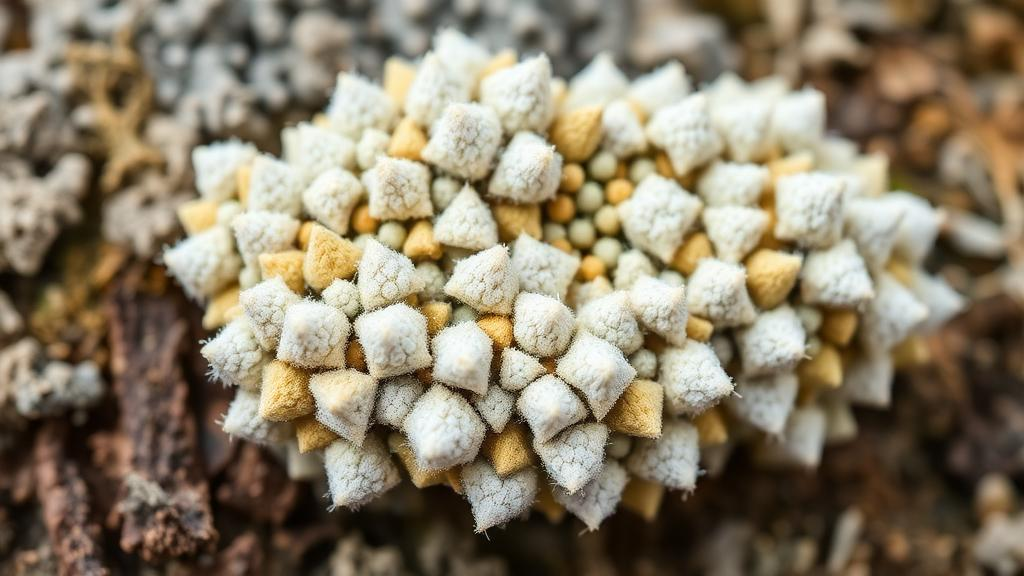
Deep in the arid mountains of northwestern China, a team of lichenologists has uncovered a surprising wealth of fungal diversity hiding beneath a frosty white coating. In a study published in MycoKeys, researchers described three new species of pruinose lichens in the family Acarosporaceae — Sarcogyne bayingolinensis, Sarcogyne parasitica, and Sarcogyne yiliensis — along with one species newly recorded for China, Acarospora iqbalii. The findings, based on a combination of morphology, chemistry, and molecular phylogenetics, bring the number of pruinose Acarosporaceae species known from China to 22 and offer fresh insight into how these frosty lichens have evolved.
The white pruina that characterizes these species is more than a cosmetic feature. Its main component is calcium oxalate, the same compound that gives the lichen a frosty, snow-like appearance under a hand lens or microscope. That white surface reflects sunlight like snow, absorbing less heat, while it also retains moisture within the thallus and protects the algal photobiont — the photosynthetic partner that sustains the lichen in some of the planet’s harshest terrestrial environments. For taxonomists, the distribution of pruina on the thallus surface, on the margins of areoles, or on the apothecial discs has long served as a diagnostic character for separating species within Acarospora and Sarcogyne.
Before this study, 18 pruinose species of Acarosporaceae had been reported from China, most of them recorded from northwestern China, particularly the Xinjiang Uyghur Autonomous Region. The researchers, working with specimens deposited in the Lichen Section of the Botanical Herbarium at Shandong Normal University in Jinan, examined material collected from sunny slopes, river valleys, and roadside outcrops across Xinjiang, Gansu, Inner Mongolia, Qinghai, and Yunnan. Their fieldwork focused on calcareous rock — limestone and other calcium-rich substrates — where pruinose species are most commonly encountered at elevations ranging from roughly 700 to 4,200 meters.
To identify the specimens, the team combined classical anatomical study with modern chemical and molecular techniques. Morphological characteristics were observed under stereoscopic and compound microscopes, and anatomical features such as cortex thickness, algal layer structure, hymenium height, and ascus dimensions were measured in micrometers. The hymenial gel and subhymenium were tested for amyloid reaction with fresh undiluted Lugol’s iodine solution (IKI), a stain that reveals whether the gel turns blue and remains blue (euamyloid) or turns blue and then red (hemiamyloid). Secondary metabolites were analyzed by thin-layer chromatography with solvent C, a standard method for detecting lichen products such as gyrophoric acid.
For the molecular work, genomic DNA was extracted from dried, uncontaminated lichen thalli and apothecia using a commercial plant PCR kit. The researchers amplified three genetic loci — the internal transcribed spacer (ITS), the nuclear large subunit rDNA (nuLSU), and the mitochondrial small subunit rDNA (mtSSU) — using standard primer sets and carefully controlled thermal cycling conditions. The PCR products were sequenced commercially, and the resulting sequences were assembled, edited, and aligned with MAFFT software. The combined matrix included 2,149 aligned characters: 595 base pairs from ITS, 689 from mtSSU, and 865 from nuLSU.
Phylogenetic analyses were performed using both maximum likelihood, implemented in IQ-TREE with 1,000 non-parametric bootstrap pseudo-replicates, and Bayesian inference, implemented in MrBayes with two independent runs of 2,000,000 generations each. The best-fit model for each partition was determined using PartitionFinder 2, and the SYM+I+G model was applied to all three loci. The resulting tree included 327 sequences from 65 species, of which 43 sequences were newly generated in this study. Bootstrap support values of at least 70 percent and Bayesian posterior probabilities of at least 0.95 were interpreted as strong support. Pycnora sorophora served as the outgroup.
The phylogenetic results confirmed that all three new species form single lineages within the Sarcogyne clade with high support values. Sarcogyne bayingolinensis and S. parasitica each received maximum support (bootstrap support 100, posterior probability 1), while S. yiliensis was strongly supported (96/0.97). Sarcogyne bayingolinensis, collected at 2,503 meters beside a national highway in Bayingolin Mongol Autonomous Prefecture, is characterized by a lobate thallus margin and no pruina surrounding the apothecial disc. Its dark brown thallus and absence of secondary metabolites distinguish it from the similar Acarospora tintickiana, which is usually pale brown and produces gyrophoric acid.
Sarcogyne parasitica, found at 1,929 meters in Donggou Village near Urumqi, exhibits a parasitic lifestyle — the first Acarosporaceae species reported to parasitize Acarospora bohlinii. Its areoles bear deep fissures surrounding the apothecial disc, and its tall hymenium (90–150 micrometers) and long, narrow asci (60–90 × 10–12 micrometers) separate it from the similar Acarospora aeginaica, which has a lower hymenium (50–85 micrometers), shorter and wider asci, and parasitizes species of Aspicilia rather than A. bohlinii. Sarcogyne yiliensis, collected at 731 meters in Yili Prefecture, is characterized by a thin hymenium (50–60 micrometers) and a tall subhymenium (50–80 micrometers), features that distinguish it from Acarospora succedens and other bullate squamule species.
In addition to the three new species, the researchers recorded Acarospora iqbalii for the first time in China. Originally described from calcareous rock in cold semiarid Pakistan at 2,000 meters, the species was found in Xinjiang at 1,958 meters, growing on similar calcareous substrates. The Chinese specimens closely resemble the Pakistani material but differ in having an epruinose apothecial disc and smaller asci (50–55 × 10–15 micrometers versus 110–160 × 28–40 micrometers). The team also discovered that Acarospora tianshanica, originally described as producing gyrophoric acid, exhibits two chemical types — with or without gyrophoric acid — based on thin-layer chromatography of numerous Xinjiang specimens. Roughly equal numbers of specimens produced the acid and produced no secondary metabolites. The species was also reported to grow only on siliceous granite, but the researchers collected specimens on calcareous rock as well, suggesting it is more ecologically flexible than previously thought.
Perhaps the most conceptually significant finding concerns the evolution of pruina itself. Although pruinose species in Acarosporaceae have traditionally been divided into morphological groups — such as the heavily pruinose A. strigata group with deep fissures cleaving the cortex, and the A. glaucocarpa group with brown squamules, white margins, and large pruinose apothecia — molecular phylogenetic analyses show that these groups do not form distinct clades. The pruinose morphology has evolved multiple times independently, likely as a result of convergent adaptation to the harsh, sun-exposed, arid environments where these lichens live. The researchers also supplemented the molecular data of Acarospora glaucocarpa from China, which had been identified only by morphology when first reported, by recollecting the species in Yunnan Province at 4,211 meters and generating new sequences. To help future researchers navigate this diversity, the team provided an identification key to all 22 pruinose Acarosporaceae species now known from China, organized by substrate, chemistry, hymenial gel reaction, hymenium height, and ascospore morphology.
Subject of Research: Taxonomy and phylogenetics of pruinose lichens (Acarosporaceae) in China
Article Title: Discovering the diversity of Acarosporaceae with pruina in China
Article References: Liang, F., Wang, J., Hu, L., Miao, C., Si, H., Chang, R., Zhang, L., Wang, X., Wang, L., & Zhao, Z. (2026). Discovering the diversity of Acarosporaceae with pruina in China. MycoKeys, 137, 175-197. https://doi.org/10.3897/mycokeys.137.201158
Image Credits: AI Generated
DOI: 10.3897/mycokeys.137.201158
Keywords: Discovering, diversity, Acarosporaceae, pruina, China, scientific research
Cite Scienmag News
Drew Townsend. (October 19, 2026). Frosty lichens reveal hidden diversity in China’s Acarosporaceae. Scienmag. https://scienmag.com/frosty-lichens-reveal-hidden-diversity-in-chinas-acarosporaceae/
Drew Townsend. "Frosty lichens reveal hidden diversity in China’s Acarosporaceae." Scienmag, 19 October 2026, https://scienmag.com/frosty-lichens-reveal-hidden-diversity-in-chinas-acarosporaceae/. Accessed 19 October 2026.
Drew Townsend. "Frosty lichens reveal hidden diversity in China’s Acarosporaceae." Scienmag. October 19, 2026. https://scienmag.com/frosty-lichens-reveal-hidden-diversity-in-chinas-acarosporaceae/


