


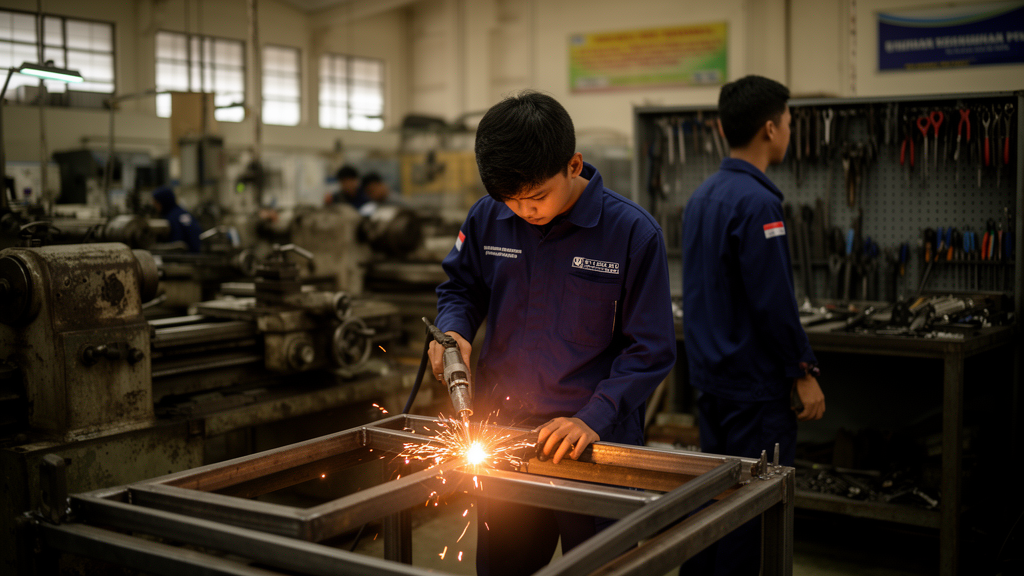
Vocational higher education in Indonesia is caught in a quiet crisis of confidence. Polytechnics and applied academies are meant to supply the technicians, engineers, and digitally fluent workers that a rapidly industrialising economy needs, yet families continue to steer their children toward conventional universities. A new study published in SN Social Sciences by Ida Hayu Dwimawanti, Annisa Hasibuan, and Yarra Waninda Permanasari of Diponegoro University argues that the problem is not simply one of funding or curriculum design. It is a problem of public value: the vocational sector has failed to convince society, government, and employers simultaneously that it delivers what each of them wants.
To unpack this failure, the researchers turned to the Strategic Triangle, a framework developed by Harvard public management scholar Mark Moore in the 1990s. The triangle holds that any public institution creates value only when three conditions align: the initiative must be publicly valuable, meaning it reflects what citizens actually want; it must be operationally and administratively feasible, meaning institutions can actually deliver it; and it must be politically and legally sustainable, meaning it retains support from the governing regime. When one corner of the triangle lags behind the others, the whole enterprise wobbles. Applied to vocational higher education, the framework offers a diagnostic lens that goes beyond the usual complaints about outdated equipment or weak industry links.
The team conducted a qualitative document analysis of twenty-one sources, spanning national policy documents, regulations, statistical reports, and institutional materials. Document analysis of this kind treats policy texts as evidence of how a state frames its own ambitions and priorities, and it is a recognised method in educational leadership research. By reading these documents against the three corners of the Strategic Triangle, the researchers could trace where Indonesian vocational higher education is winning support and where it is quietly losing it.
On the first corner, societal preferences, the picture is stark. Indonesian families and students remain concentrated on universities and government-affiliated academies because both are perceived to offer stronger credentials, better career prospects, and higher social prestige. National admission data reflect this tilt: the distribution of applicants in the 2025 state university entrance selection shows far more candidates competing for academic programmes than for vocational ones. Prestige, in other words, is not a cosmetic problem. It shapes who enrols, which graduates employers trust, and ultimately whether the sector can attract the investment it needs to modernise.
The second corner, the political regime, reveals a different kind of stagnation. The study finds that successive regime changes in Indonesia have produced only relatively slow progress in building public value for vocational higher education. Policies have been written and reorganisations announced, but the underlying political commitment has not translated into the sustained legitimacy the sector requires. This matters because vocational education is unusually dependent on state signalling: when governments treat polytechnics as second-tier institutions, employers and families read that signal and act accordingly, reinforcing the very hierarchy the policies claim to want to change.
The third corner, operational capacity, may be the most technically alarming. The researchers conclude that Indonesian vocational higher education institutions remain dominated by an Industry 2.0-based skills orientation, a model rooted in mechanised mass production and standardised manual competencies. Meanwhile, the global economy has moved through Industry 3.0 and 4.0, defined by digitalisation, automation, and data-driven manufacturing, and is now entering Industry 5.0, which emphasises human-centric production, collaborative robotics, and sustainable, resilient systems. A curriculum calibrated to the second industrial revolution cannot credibly prepare graduates for factories that are already deploying digital twins, machine learning, and human-machine collaboration on the shop floor.
The consequences ripple outward. Indonesia’s own statistical agency reports persistent open unemployment among graduates, and comparative studies of vocational versus general school graduates show that labour market advantages fluctuate sharply between stable and crisis conditions. International comparisons sharpen the point. Germany’s dual vocational training system, in which apprentices alternate between classroom and paid workplace learning under strong employer co-governance, and Singapore’s SkillsFuture programme, which has steered adult learners toward career-relevant training, both demonstrate that vocational pathways can command genuine prestige when industry involvement is structural rather than ceremonial. Indonesia’s sector, by contrast, still struggles with the so-called pilot trap, in which promising technology adoption projects in manufacturing fail to scale beyond demonstration sites.
Perhaps the study’s most original contribution is conceptual. The authors identify what they call differential velocity: a condition in which public value, operational capacity, and political legitimacy develop at different speeds within the same system. In Indonesia, societal preferences and institutional capacity have drifted far apart, with legitimacy moving slowly while the industrial world races ahead. This insight extends Moore’s Strategic Triangle into the context of vocational higher education in developing countries, where the triangle’s corners are not merely unbalanced but moving on different clocks. It suggests that policy fixes aimed at any single corner, such as new funding streams or rebranding campaigns, are likely to fail unless the velocity gap itself is addressed.
What would closing that gap require? The study points to structured policy interventions, broad industry involvement, and institutional capacity building that actively supports the formation of legitimacy. In practical terms, that means aligning curricula with Industry 5.0 competencies such as digital employability skills, human-machine collaboration, and adaptive problem solving; embedding employers in programme design and certification rather than consulting them after the fact; and building credential systems that signal genuine labour market value to skeptical families. Research on vocational graduates in Indonesia has already shown that recognised competency certification measurably improves graduate acceptance in sectors such as machining, hinting that credibility can be engineered rather than merely hoped for.
The stakes extend well beyond campus gates. With Indonesia’s undergraduate population projected to reach roughly 8.2 million by 2025 and tertiary enrolment expanding across Southeast Asia, the composition of the future workforce depends on whether applied institutions can compete for talent. The OECD’s skills strategy for the region warns that post-pandemic recovery depends on reskilling at scale, and Indonesia’s push to move factories past the pilot trap into full industrial digitalisation will fail without technicians trained for that environment. The Diponegoro team’s analysis offers policymakers a sobering but useful map: the triangle of public value can be rebalanced, but only if society’s aspirations, the state’s commitment, and the institutions’ capabilities are pulled forward together, and pulled forward fast.
Subject of Research: Public value and legitimacy of vocational higher education in Indonesia analysed through the Strategic Triangle framework
Article Title: Examining public value toward vocational education in Indonesia: a strategic triangle analysis
Article References: Dwimawanti, I. H., Hasibuan, A., & Permanasari, Y. W. (2026). Examining public value toward vocational education in Indonesia: a strategic triangle analysis. SN Social Sciences, 6(9), Article 400. https://doi.org/10.1007/s43545-026-01692-2
Image Credits: AI Generated
DOI: 10.1007/s43545-026-01692-2
Keywords: vocational education, Indonesia, public value, Strategic Triangle, higher education, Industry 5.0, policy analysis, labour market, social legitimacy, Diponegoro University, industrial transformation, developing countries
Cite Scienmag News
Courtney Benton. (October 19, 2026). Why Indonesia’s Vocational Colleges Struggle to Win Public Trust. Scienmag. https://scienmag.com/why-indonesias-vocational-colleges-struggle-to-win-public-trust/
Courtney Benton. "Why Indonesia’s Vocational Colleges Struggle to Win Public Trust." Scienmag, 19 October 2026, https://scienmag.com/why-indonesias-vocational-colleges-struggle-to-win-public-trust/. Accessed 19 October 2026.
Courtney Benton. "Why Indonesia’s Vocational Colleges Struggle to Win Public Trust." Scienmag. October 19, 2026. https://scienmag.com/why-indonesias-vocational-colleges-struggle-to-win-public-trust/


