


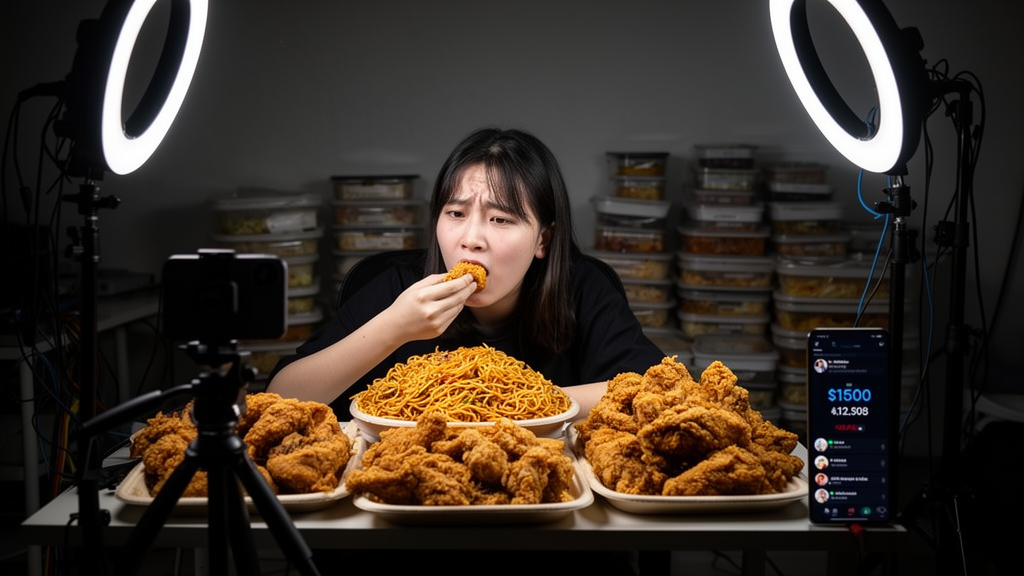
Mukbang, the spectacle of watching strangers eat enormous quantities of food on camera, has become one of the defining genres of the short-video era. Now a new study argues that the format’s increasingly disturbing turns — binge eating staged for views, fake eating performed with hidden containers, and other unhealthy dietary performances — are not merely individual lapses in taste or judgment. Writing in Humanities and Social Sciences Communications, Juan Tang and Shuangsheng Yan of China Pharmaceutical University in Nanjing contend that mukbang’s aberrations are structural, rooted in the profit-seeking logic of platform capitalism and best understood through Karl Marx’s concept of alienated labor.
The theoretical stakes of the argument rest on a claim about twenty-first-century capitalism’s organizational form. Platforms, the authors argue, have become the dominant vehicle through which capital accumulates in the digital economy. Their power derives from monopolizing data, which they treat as a core factor of production on par with land, labor, and machinery in industrial capitalism. Every click, pause, replay, and scroll generates data that platforms mobilize to serve capital accumulation, refining recommendation algorithms and selling targeted attention to advertisers. In this arrangement, the platform owns the means of digital production while content creators and audiences supply the labor that makes the data valuable in the first place.
For mukbang streamers, the study argues, eating itself is transformed into digital labor. What Marx described as the most basic human activity — the consumption of food to sustain the body and express bodily needs — becomes a performance calibrated to algorithmic reward. Streamers must eat excessively to stand out in a saturated market, or fake eating entirely while concealing the deception, because the platform’s recommendation system rewards spectacle rather than nourishment. The streamer’s body becomes an instrument of production, and the natural instinct of hunger becomes a resource to be exploited or suppressed on camera.
This transformation produces what the authors call a dual estrangement for streamers. The first estrangement is from bodily instincts: the streamer must override satiety signals, eat past discomfort, or simulate the act of eating altogether, severing the natural connection between hunger, food, and health. The second estrangement is from creative autonomy. Although streaming appears to be self-directed work, the platform’s algorithms, monetization thresholds, and traffic distribution effectively dictate what content gets seen and rewarded. The streamer’s apparent freedom masks a dependence on platform infrastructure that shapes every creative decision, from portion sizes to presentation style.
Audiences, meanwhile, are not passive spectators in this arrangement but participants in what the study calls playbour — a fusion of play and labor. Viewing mukbang feels like leisure, yet every moment of watching generates data that platforms harvest and monetize. The audience’s attention becomes a productive force, and the pleasure of consumption becomes indistinguishable from unpaid work. The authors argue that this data-producing playbour constitutes a distinct form of alienation for viewers, who experience their own activity as something external to themselves, serving capital accumulation rather than their own fulfillment.
The Marxist framework underlying the analysis holds that labor dominated by capitalism is inevitably alienated labor. Marx identified four dimensions of alienation: estrangement from the product of one’s work, from the activity of work itself, from one’s species-being or human nature, and from other people. Tang and Yan apply this schema to the digital context, arguing that mukbang streamers are alienated from the products of their labor — the videos and data they generate — because platforms appropriate and monetize them. Streamers are alienated from the activity of eating, which becomes a means of production rather than an expression of life. They are alienated from their species-being, as bodily needs are distorted into spectacle. And they are alienated from audiences, whose relationship is mediated by platform metrics rather than genuine human connection.
The study’s most provocative claim concerns the scope of mukbang’s harms. The authors argue that the damage extends beyond the commonly cited problems of food waste and cybersecurity risks to human dignity itself. When eating — an activity essential to human survival and culture — is systematically distorted for profit, the distortion strikes at something fundamental to human life. Excessive eating on camera normalizes disordered relationships with food, while fake eating introduces deception into a genre built on apparent authenticity. Both practices, the authors contend, reflect the platform’s structural incentive to reward extremity and spectacle rather than health or honesty.
The analysis situates mukbang within a broader pattern of digital labor exploitation that scholars have documented across the platform economy. From gig workers navigating opaque algorithms to influencers performing intimacy for engagement metrics, the platform’s capacity to extract value from everyday activities has expanded the frontier of what can be commodified. Mukbang represents an extreme case because it commodifies not creative output or social connection but the biological act of eating itself. The genre’s popularity on short-video platforms, where attention spans are measured in seconds and competition for visibility is fierce, intensifies the pressure toward aberrant practices that can cut through the noise.
The authors’ argument carries implications for how mukbang’s problems might be addressed. If the aberrations are structural rather than individual, then solutions targeting streamer behavior alone — content warnings, eating-disorder resources, or platform guidelines against excessive eating — address symptoms rather than causes. The root of the problem, in the authors’ account, lies in platform capital’s profit-seeking logic and its monopolization of data. Meaningful reform would require rethinking the incentive structures that reward extremity, the data arrangements that extract value from viewers’ attention, and the traffic distribution systems that determine which content thrives.
The study contributes to a growing literature that applies classical critical theory to digital culture, testing whether nineteenth-century concepts can illuminate twenty-first-century phenomena. The authors suggest that Marx’s framework remains analytically powerful precisely because the underlying logic of capital accumulation persists across technological change, even as its organizational forms evolve from factory to platform. Mukbang, in this account, is not an isolated curiosity of internet culture but a vivid illustration of how digital capitalism penetrates the most intimate corners of human life, transforming eating, watching, and even hunger into sites of labor and extraction.
Subject of Research: Alienated labor in mukbang on short-video platforms: a Marxist perspective
Article Title: Alienated labor in mukbang on short-video platforms: a Marxist perspective
Article References: Tang, J., & Yan, S. (2026). Alienated labor in mukbang on short-video platforms: a Marxist perspective. Humanities and Social Sciences Communications. https://doi.org/10.1057/s41599-026-09472-2
Image Credits: AI Generated
DOI: 10.1057/s41599-026-09472-2
Keywords: Alienated, labor, mukbang, short-video, platforms, Marxist, perspective, scientific research
Cite Scienmag News
Courtney Benton. (October 18, 2026). Alienated labor in mukbang on short-video platforms: a Marxist perspective. Scienmag. https://scienmag.com/alienated-labor-in-mukbang-on-short-video-platforms-a-marxist-perspective/
Courtney Benton. "Alienated labor in mukbang on short-video platforms: a Marxist perspective." Scienmag, 18 October 2026, https://scienmag.com/alienated-labor-in-mukbang-on-short-video-platforms-a-marxist-perspective/. Accessed 18 October 2026.
Courtney Benton. "Alienated labor in mukbang on short-video platforms: a Marxist perspective." Scienmag. October 18, 2026. https://scienmag.com/alienated-labor-in-mukbang-on-short-video-platforms-a-marxist-perspective/


