


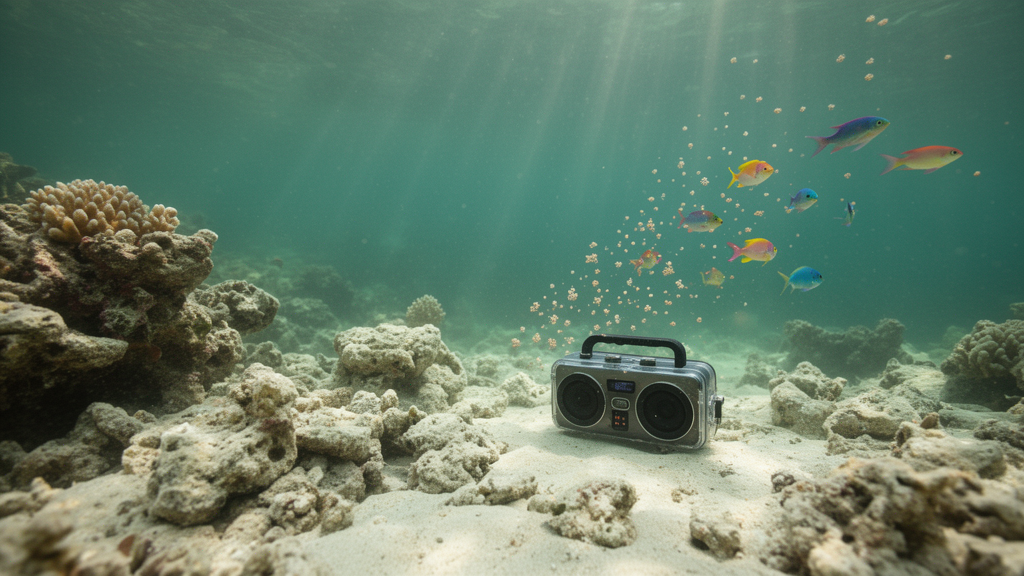
Coral reefs are among the most acoustically rich environments on the planet. Snapping shrimp crackle from crevices, fish grunt, purr and chatter, and the combined chorus travels through seawater in ways that drifting larvae can detect. Two new field studies led by researchers at the University of California San Diego’s Scripps Institution of Oceanography now provide some of the strongest evidence yet that this natural soundscape can be harnessed as a restoration tool. By broadcasting recordings of healthy reef sound onto artificial structures placed on a sandy seafloor in Hawaii’s Kāne’ohe Bay, the team significantly increased both coral larval settlement and the arrival of fish larvae, demonstrating in a single coordinated set of experiments that underwater sound can help jump-start the recovery of degraded reef ecosystems.
The research, conducted over multiple spawning events in 2023 and 2024, is the first to field test the effects of underwater sound on fish and coral larvae simultaneously, alongside other emerging restoration technologies including living surface materials and 3D-printed settlement surfaces. The work formed part of Rapid Resilient Reefs for Coastal Defense, or R3D, a consortium project led in collaboration with the University of Hawai’i and focused on nature-based strategies to reduce wave energy, protect coastlines and improve coral resilience. The studies and the broader R3D effort were funded by the Defense Advanced Research Projects Agency, DARPA. The newest study, published October 8 in Communications Biology, examines how acoustic enrichment affects coral larval settlement, the critical stage when free-drifting larvae search for a place to attach and begin building a reef.
“We have demonstrated in a single set of field studies that acoustic enrichment works in increasing the presence of both fish larvae and coral larvae on artificial reef structures,” said Aaron Thode, a Scripps Oceanography researcher who heads the Scripps Environmental Acoustics Lab and served as lead author of the coral larvae study. According to Thode, the findings suggest that drifting organisms use reef sound as an informational cue about habitat quality. “Our data indicate that when these drifting organisms detect a lot of sound from a reef, it signals to them that this is a good place to settle,” he said. The analysis also produced strong evidence that synthetic chemical cues can attract these organisms to reefs, pointing to a potential multi-sensory approach to restoration.
The experimental design began with sound collection. The team deployed a recorder at a healthy reef environment off O’ahu, Hawaii, capturing the acoustic signature of the reef across a full lunar cycle. The recordings contained the sounds of fish as well as numerous other organisms, including shrimp and crustaceans that produce distinctive snapping noises. These recordings were then broadcast from an underwater speaker at the study site, a flat, sandy area off the small island of Moku o Lo’e. For two weeks, the speaker played the reef soundscape continuously from sunset to sunrise, mimicking the natural rhythm of reef activity during the hours when many larvae are on the move.
Around the speaker, the researchers placed 37 artificial structures on the seafloor at a depth of 4.5 meters, roughly 15 feet, at distances ranging from 1 to 42 meters, about 3 to 138 feet, from the sound source. The structures varied in design and surface properties and included engineered microhabitats developed in the Coral Reef Ecophysiology and Engineering Lab of Scripps researcher Daniel Wangpraseurt. These microhabitats were enhanced in two distinct ways. Their physical architecture created complex, protected settlement spaces with crevices where larvae could attach, and their surfaces were coated with a living material called BRINK, a bioactive “reef ink” containing living bacteria, developed by former Scripps postdoctoral researcher Natalie Levy and colleagues in Wangpraseurt’s lab.
Across three experiments conducted over two years, scientific divers measured coral larval settlement one and two weeks after the new moon, when spawning occurs. Using a handheld blue light and yellow filter, a technique that makes settled coral larvae fluoresce, they counted the individual larvae that had attached to each structure. The results showed a clear spatial pattern: structures closest to the speaker had the highest levels of coral settlement, and among those, the structures treated with BRINK performed best. “The acoustics help, and with the living biofilm, it’s a lot better,” said Thode. “When combined with structures that had crevices, acoustic enrichment worked very well for the coral larvae settlement.” The study also noted that specialized 3D-printed structures developed by colleagues at the Hawai’i Institute of Marine Biology performed well, though those were tested with sound alone and not in combination with BRINK. For future experiments, the team recommends pairing acoustic enrichment with the more complex structures coated with the living biofilm to maximize settlement success.
“We now have evidence that several of these technologies can work in the field, which is a major step forward,” said Wangpraseurt, who is UC San Diego’s lead principal investigator for the R3D project and a co-author of the study. “It brings us closer to the vision of hybrid reefs, a new class of living coastal infrastructure that combines engineering and biology to protect our shores while supporting the growth and recovery of reef ecosystems.” The hybrid reef concept represents a shift away from purely hard engineering solutions such as concrete seawalls, toward structures that actively support biological communities while still performing coastal defense functions.
The companion study, published in Scientific Reports and led by Scripps PhD candidate Océane Boulais, addressed the fish side of the equation. Fish are important components of healthy coral reefs because certain species feed on smothering microalgae that would otherwise make it difficult for coral larvae to settle and grow. Monitoring young fish, however, is notoriously difficult, since their behavior is easily disturbed by human presence. Thode likened the problem of counting fish while scuba diving to “Godzilla trampling through a city and trying to get an accurate count of all the humans scurrying away.” To solve it, Boulais developed an array of low-power autonomous cameras capable of continuously detecting and counting fish larvae for up to three weeks without any diver in the water.
Boulais positioned the cameras near the entrances of complex, 3D-printed structures that functioned as “fish hotels,” documenting fish as they entered and left while also tracking the presence of larvae. “By developing these non-invasive cameras, we can essentially spy on the fish and observe a lot of their natural behavior,” she said. “The autonomy and long-term monitoring design of these cameras enable us to observe which animals show up, and how long they stay.” The cameras were deployed at two sites: one near the underwater speaker providing acoustic enrichment, and one at a control site where an identical speaker emitted no sound. Larval counts at both sites peaked around the new moon, but the acoustically enriched site attracted 4 to 14 times more fish larvae overall, a promising indication that the added sound helped draw young fish to the structures. The results held even when the team swapped the locations of the active speaker and the control speaker, ruling out site-specific effects. “The cameras are relatively new, but they’re already helping us learn so much about the early life stages of reef fish, and how sound might enhance their presence on a reef,” Boulais said.
The findings arrive at a moment when coral reefs worldwide face mounting pressure from warming waters, pollution and coastal development, and restoration scientists are increasingly looking to combine biological, chemical and engineering approaches. The next major test of the technologies validated in Kāne’ohe Bay is already scheduled. DARPA plans to install a $22 million hybrid reef structure off O’ahu this fall, with corals likely to be outplanted in late 2026 or early 2027. The Kalaeloa Hybrid Reef will span 50 meters, about 164 feet, and will incorporate technologies tested through the R3D program, including the Scripps-developed microstructures and an acoustic enrichment system. After installation, DARPA will transition ownership of the prototype living breakwater to the Hawai’i Department of Transportation, a transition partner for the R3D program. More than 50 researchers and R3D consortium members contributed to the studies as co-authors, and samples of the reef sounds used in the experiments are featured at Birch Aquarium’s Living Seas Tropical Pacific exhibit, offering the public a chance to hear the soundscapes that may soon help rebuild reefs along Hawaii’s shores.
Subject of Research: Acoustic enrichment to enhance coral and fish larval settlement for coral reef restoration
Article Title: Healthy reef sounds can boost coral and fish recovery efforts
Article References: Healthy reef sounds can boost coral and fish recovery efforts. (n.d.). Original publication
Image Credits: AI Generated
DOI: Not provided
Keywords: coral reefs, acoustic enrichment, larval settlement, reef restoration, Kāne'ohe Bay, Scripps Oceanography, 3D-printed structures, living materials, fish larvae, hybrid reefs, DARPA, marine acoustics
Cite Scienmag News
Gavin Prescott. (October 8, 2026). Sounds of Healthy Reefs Draw Coral and Fish Larvae Back to Degraded Waters. Scienmag. https://scienmag.com/sounds-of-healthy-reefs-draw-coral-and-fish-larvae-back-to-degraded-waters/
Gavin Prescott. "Sounds of Healthy Reefs Draw Coral and Fish Larvae Back to Degraded Waters." Scienmag, 8 October 2026, https://scienmag.com/sounds-of-healthy-reefs-draw-coral-and-fish-larvae-back-to-degraded-waters/. Accessed 8 October 2026.
Gavin Prescott. "Sounds of Healthy Reefs Draw Coral and Fish Larvae Back to Degraded Waters." Scienmag. October 8, 2026. https://scienmag.com/sounds-of-healthy-reefs-draw-coral-and-fish-larvae-back-to-degraded-waters/


