


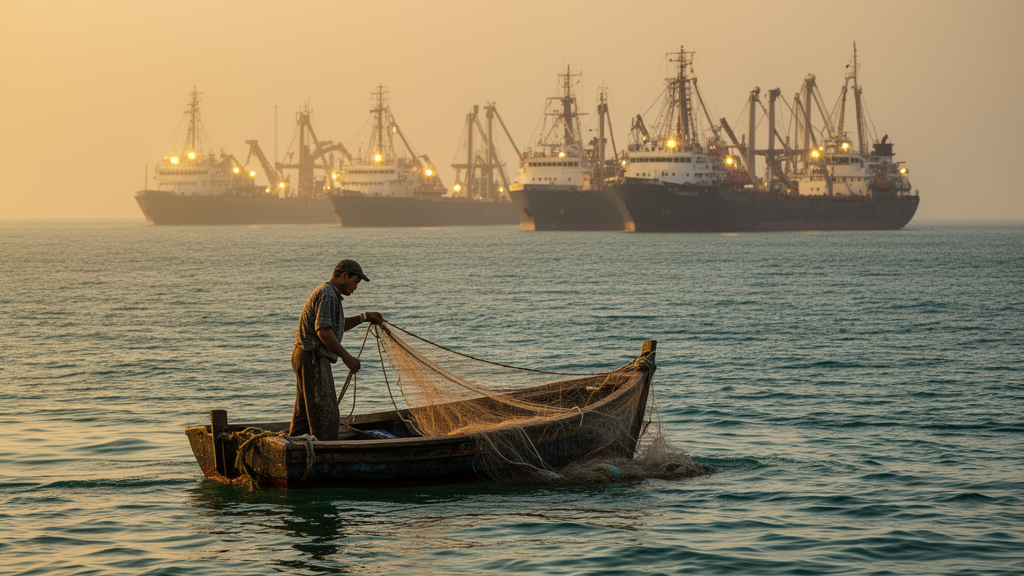
Every day, industrial fishing vessels from wealthy nations sweep through the waters of some of the world’s poorest countries, hauling away tuna, mackerel, and other fish that could otherwise feed malnourished coastal populations. A new study published in npj Ocean Sustainability argues that this trade-off has been systematically overlooked in fisheries policy, and that the moment is ripe to change it. Led by Rachel Zuercher of the University of Rhode Island and the Monterey Bay Aquarium, together with colleagues including Mialy Andriamahefazafy, Kelvin D. Gorospe, Lora L. Iannotti, and Austin T. Humphries, the research builds a framework for understanding exactly how distant water fleets, often abbreviated as DWFs, interact with the food security of the nations that grant them access to their waters.
The core problem the researchers set out to address is one of scale and asymmetry. Distant water fleets are industrial operations that fish far from their home ports, frequently in the exclusive economic zones of developing coastal states. Governments in those states have repeatedly identified these fleets as a threat to ecosystem health, to domestic economic opportunity, and to food security. Yet the same governments often rely on the revenue generated by access agreements, licensing fees, and related payments, creating a tension between short-term income and long-term nutritional well-being. The new work does not simply restate that tension; it dissects the mechanisms through which distant water fishing either undermines or, in some configurations, could actually support domestic food security.
What makes the study methodologically interesting is its two-stage design. The team first conducted a literature review combined with expert interviews to construct a conceptual framework of the relationships linking distant water fleets to food security outcomes. This framework then served as an analytical lens for three case studies, each chosen to illuminate different pathways of interaction. By moving from a general model to specific national contexts, the researchers were able to describe the concrete mechanisms underlying DWF-food security interactions rather than stopping at broad generalizations about foreign fishing being good or bad.
The nutritional stakes are considerable. In many of the countries where distant water fleets operate, undernutrition and micronutrient deficiencies are widespread, and aquatic foods are among the most valuable sources of bioavailable micronutrients such as iron, zinc, vitamin B12, and omega-3 fatty acids. Fish caught by industrial vessels in these waters therefore represent what the authors describe as a vital opportunity: if policy were shifted so that a greater share of these catches, or the benefits derived from them, flowed to local populations, nutrition outcomes could improve substantially. The study frames aquatic foods not merely as a commodity to be sold to the highest bidder but as a critical component of public health infrastructure in nutritionally vulnerable nations.
One of the study’s central findings is that there is no single, uniform relationship between distant water fishing and food security. Instead, the framework reveals diverse policy pathways to improved food and nutrition outcomes. The three case studies demonstrate that the same basic activity, foreign industrial vessels fishing in domestic waters, can produce very different consequences depending on the structure of access agreements, the species targeted, the fate of the catch, and the strength of domestic fisheries management. This variability is precisely why the authors argue for case-specific analysis rather than blanket prescriptions.
The technical heart of the paper lies in how it connects fisheries governance to nutrition metrics. Traditional licensing negotiations between coastal states and distant water fishing nations typically focus on financial compensation, catch limits, and enforcement provisions. Food security considerations, when they appear at all, tend to be implicit rather than measured. The researchers propose integrating food systems expertise and explicit nutrition metrics into both the day-to-day management of these fisheries and the high-stakes licensing negotiations themselves. Doing so, they argue, would illuminate the true tradeoffs of granting DWF access, making visible the nutritional costs that currently remain hidden in spreadsheets dominated by license fees and export earnings.
This reframing has significant implications for equity. The study emphasizes steering policy to ensure an equitable flow of benefits to local communities, a goal that requires understanding who currently captures value from distant water fishing. In many access arrangements, the fish are landed in foreign ports, processed abroad, and sold in international markets, while the coastal state receives a fee that may bear little relation to the nutritional value of the extracted biomass. By quantifying what those fish would mean in terms of local diets, policymakers could negotiate from a far stronger evidentiary position, potentially demanding landing requirements, domestic processing, or compensation schemes that reflect nutritional opportunity costs.
The research also arrives at a moment of growing international attention to aquatic foods within food security debates. The authors situate their work within a broader scientific conversation about the role of fish in feeding the world, and the study’s publication in npj Ocean Sustainability places it alongside related research on distant-water fisheries governance and on the impact of distant water bottom trawl fisheries on nutrient supplies in nutritionally vulnerable countries. Together, this body of work signals a shift in the field: away from viewing fisheries purely through the lenses of conservation and economics, and toward treating them as integral components of food systems whose outputs must be evaluated in nutritional terms.
The study was conducted through funding from the United States Agency for International Development via the Feed the Future Innovation Lab for Fish at Mississippi State University, reflecting a development-policy interest in the intersection of fisheries and nutrition. The authors are careful to note that the views expressed are their own. Their collaborative composition, spanning institutions in the United States, Switzerland, Chile, and the Philippines, mirrors the transnational nature of the problem itself, since distant water fishing inherently links distant economies and food systems into a single web of cause and effect.
For coastal states weighing their options, the message of the research is ultimately constructive rather than purely critical. Distant water fleets are not inherently incompatible with domestic food security; the outcome depends on how access is negotiated, how catches are tracked, and whether nutrition is treated as a metric that matters. The framework developed by Zuercher and colleagues offers governments a practical tool for mapping those dependencies before signing the next access agreement. As the authors conclude, integrating food systems expertise and nutrition metrics into management and licensing negotiations could serve to illuminate the true tradeoffs of DWF access and steer policy toward an equitable flow of benefits to the communities who live alongside the richest fishing grounds on Earth.
Subject of Research: The effects of distant water fishing fleets on domestic food security and nutrition in coastal developing nations
Article Title: Distant water fishing and its effects on domestic food security
Article References: Zuercher, R., Andriamahefazafy, M., Gorospe, K. D., Gozzer-Wuest, R., Iannotti, L. L., Uychiaoco, A. J., & Humphries, A. T. (2026). Distant water fishing and its effects on domestic food security. npj Ocean Sustainability. https://doi.org/10.1038/s44183-026-00245-7
Image Credits: AI Generated
DOI: 10.1038/s44183-026-00245-7
Keywords: distant water fishing, food security, nutrition, fisheries governance, aquatic foods, coastal states, licensing agreements, micronutrient deficiency, ocean sustainability, fisheries policy, equity, food systems
Cite Scienmag News
Violet Maxwell. (October 8, 2026). Distant Water Fleets and the Hidden Cost to Local Food Security. Scienmag. https://scienmag.com/distant-water-fleets-and-the-hidden-cost-to-local-food-security/
Violet Maxwell. "Distant Water Fleets and the Hidden Cost to Local Food Security." Scienmag, 8 October 2026, https://scienmag.com/distant-water-fleets-and-the-hidden-cost-to-local-food-security/. Accessed 8 October 2026.
Violet Maxwell. "Distant Water Fleets and the Hidden Cost to Local Food Security." Scienmag. October 8, 2026. https://scienmag.com/distant-water-fleets-and-the-hidden-cost-to-local-food-security/


