


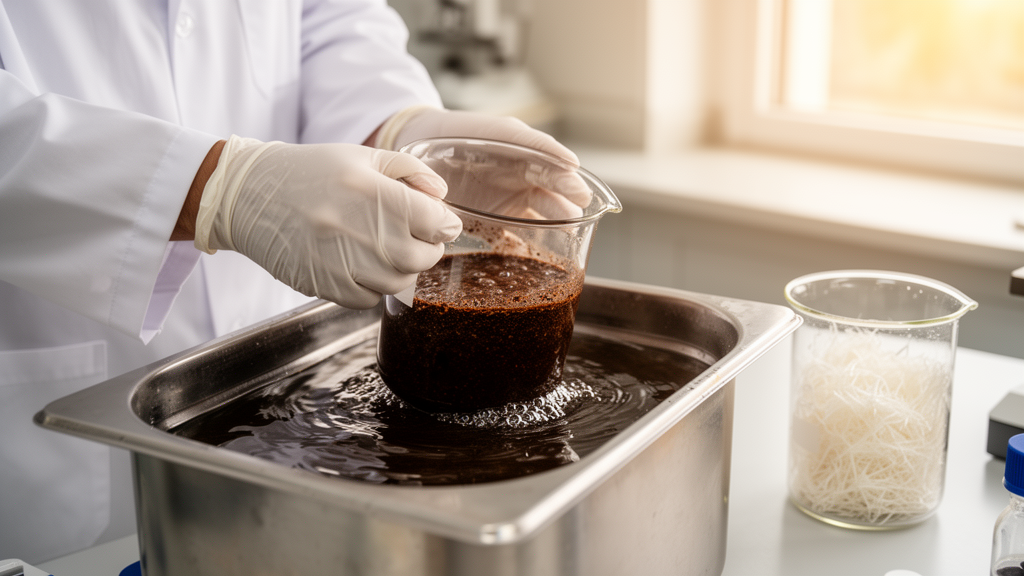
Every year, humanity drinks more than 500 billion cups of coffee, and behind each brew lies a mountain of overlooked biomass. In Ethiopia, the birthplace of Coffea arabica and the fifth-largest coffee producer in the world, the industry generates vast quantities of coffee parchment, the papery endocarp stripped away during drying and hulling. This residue makes up roughly 6 to 10 percent of the dry weight of the coffee cherry, and most of it is simply burned in open fields, releasing smoke and wasting a cellulose-rich resource. Now, researchers at Addis Ababa Science and Technology University have shown that this humble waste stream can be transformed into high-purity microfibrillated cellulose, a versatile biomaterial prized for reinforcing composites, films and coatings, using a process that combines sound waves with a carefully staged chemical sequence.
The study, published in Case Studies in Chemical and Environmental Engineering, tackles a stubborn chemical problem. Coffee parchment is packed with cellulose, around 54 percent by weight in the Ethiopian samples tested, but it is also loaded with lignin, the tough aromatic polymer that glues plant cell walls together. Lignin forms strong lignin-carbohydrate complexes that shield the cellulose and resist conventional processing. Ordinary alkaline treatment with sodium hydroxide can strip away some of this lignin, but it demands long reaction times and heavy chemical doses, and even then it leaves behind stubborn residues that discolor and weaken the final product.
The researchers’ solution was to bombard the biomass with high-intensity ultrasound while it soaked in the alkaline solution. When an ultrasonic probe submerged in a liquid operates, it generates cavitation: the rapid birth, growth and violent collapse of microscopic bubbles. Each collapse releases a burst of localized energy, producing microjets and shear forces that erode particle surfaces, break open cell walls and dramatically improve the penetration of chemicals into the fibrous matrix. Crucially, the acoustic energy also cleaves the chemical bonds linking lignin to carbohydrates through homolysis, freeing the lignin for dissolution.
The numbers are striking. Conventional treatment with 4 percent sodium hydroxide at 90 degrees Celsius for four hours removed only about 29 percent of the lignin. When the same alkaline solution was assisted by 60 minutes of sonication, delignification climbed to roughly 50 percent, and the cellulose content of the treated material rose from 54.3 percent to 71.8 percent, while preserving 96.3 percent of the original cellulose. Notably, a milder 4 percent alkali dose with ultrasound outperformed a stronger 8 percent dose without it in terms of cellulose recovery, meaning less chemical consumption for comparable or better results.
But delignification alone was not enough to unlock the pure white cellulose the team was after. The pretreated fibers still carried residual lignin locked within insoluble complexes, so the researchers applied a two-stage bleaching sequence targeting different lignin substructures under complementary pH conditions. The first stage used alkaline hydrogen peroxide, stabilized with sodium silicate and Epsom salt, which generates hydroxyl radicals that attack nonphenolic lignin structures. The second stage employed sodium chlorite buffered in acetic acid at pH 4.5, the classic Wise method, in which chlorite oxidatively opens the aromatic rings of lignin, converting them into water-soluble acidic fragments that simply wash away.
The contrast between the two processing routes was dramatic. The conventional route, without ultrasound, reached an overall delignification of 72.5 percent after both bleaching stages, leaving the final material at 83.3 percent cellulose. The ultrasound-assisted route pushed delignification to 93 percent and delivered a final microfibrillated cellulose of 91.8 percent purity, with residual lignin slashed from an initial 25.5 percent down to just 3.5 percent. After three bleaching cycles, the fibers displayed the characteristic whiteness of purified cellulose, a visual proxy for its chemical purity.
A battery of analytical techniques confirmed the transformation. Scanning electron microscopy revealed raw parchment as a dense, rigid matrix of tightly packed fiber bundles, which yielded after the full treatment to discrete, elongated, ribbon-like fibrils roughly 10 to 12 micrometers wide. The ultrasound route produced slightly thinner and more fragmented fibrils, evidence that acoustic cavitation disrupts the hydrogen-bonded interfaces between microfibrils. Infrared spectroscopy showed the disappearance of peaks associated with lignin and hemicellulose, while X-ray diffraction confirmed that the cellulose crystal structure, of the cellulose I type, remained intact throughout.
Perhaps most impressive was the gain in crystallinity and thermal stability. The crystallinity index, a measure of the ordered crystalline fraction of the material, rose from 60.4 percent in raw parchment to 80.8 percent in the final product, as amorphous lignin and hemicellulose were stripped away. Thermogravimetric analysis showed that the purified cellulose resisted decomposition up to 264 degrees Celsius, with peak degradation at 367 degrees, well above the raw material, and left only 4 percent char residue compared with over 25 percent for untreated parchment. These properties matter because thermally stable, highly crystalline cellulose can survive the high processing temperatures of polymer compounding, making it suitable as reinforcing filler in plastics and biopolymers.
Particle measurements added a further endorsement. Suspensions of the ultrasound-derived cellulose showed smaller apparent hydrodynamic diameters, about 1,623 nanometers versus 2,367 nanometers for the conventional route, and zeta potentials of minus 37 millivolts, comfortably beyond the threshold for colloidal stability. In plain terms, the fibers disperse well in water without clumping, a property essential for forming uniform films, coatings and composite materials.
The authors are careful to note the caveats. The process still requires substantial energy and chemical inputs, including multiple bleaching cycles, extensive washing, oven drying and freeze-drying, and its environmental and economic advantages cannot be confirmed without full life-cycle and techno-economic analysis. Scaling ultrasound systems from laboratory flasks to industrial batch or continuous operation remains a significant engineering challenge. Even so, the study demonstrates a credible pathway for turning a burned waste product into a material of growing commercial importance, and future work on surface modification could broaden its use in advanced sustainable materials. For a country whose coffee sector discards thousands of tonnes of parchment each year, the idea that sound waves could help convert that waste into high-value cellulose is a compelling glimpse of the circular bioeconomy in action.
Subject of Research: Ultrasound-assisted isolation of microfibrillated cellulose from Ethiopian coffee parchment waste
Article Title: Impact of combined ultrasound-assisted alkaline delignification and two-stage bleaching for efficient microfibrillated cellulose isolation from Ethiopian coffee parchment
Article References: Kidanu, B. T., Sibhatu, A. K., & Tizazu, B. Z. (2026). Impact of combined ultrasound-assisted alkaline delignification and two-stage bleaching for efficient microfibrillated cellulose isolation from Ethiopian coffee parchment. Case Studies in Chemical and Environmental Engineering, 14, Article 101504. https://doi.org/10.1016/j.cscee.2026.101504
Image Credits: AI Generated
DOI: 10.1016/j.cscee.2026.101504
Keywords: coffee parchment, microfibrillated cellulose, ultrasound, delignification, bleaching, biomass valorization, Ethiopia, lignocellulose, crystallinity, biorefinery, Impact, combined
Cite Scienmag News
Bethany Barker. (October 19, 2026). Sound waves turn Ethiopian coffee waste into high-grade cellulose. Scienmag. https://scienmag.com/sound-waves-turn-ethiopian-coffee-waste-into-high-grade-cellulose/
Bethany Barker. "Sound waves turn Ethiopian coffee waste into high-grade cellulose." Scienmag, 19 October 2026, https://scienmag.com/sound-waves-turn-ethiopian-coffee-waste-into-high-grade-cellulose/. Accessed 19 October 2026.
Bethany Barker. "Sound waves turn Ethiopian coffee waste into high-grade cellulose." Scienmag. October 19, 2026. https://scienmag.com/sound-waves-turn-ethiopian-coffee-waste-into-high-grade-cellulose/


