


European agriculture is facing a reckoning with water. Maize, the continent’s dominant cereal for livestock feed, has just posted one of its weakest harvests in years, with the most recent European Union estimate falling to 49.1 million tonnes—the first time in sixteen years that production has slipped below the 50-million-tonne mark. The decline is not an anomaly but a symptom: maize is a water-hungry crop, and across much of France it depends on irrigation, accounting for 38 percent of the country’s irrigated cropland. As heatwaves intensify and summer rainfall becomes less reliable, the question confronting agronomists is no longer whether maize-centric feeding systems can continue as before, but what can realistically take their place. A new peer-reviewed study published in the journal Earth’s Future offers a carefully quantified answer, and it points to an old crop with a new role: sorghum.
Sorghum is hardly a novelty in global agriculture. It is already a staple in the world’s arid and semi-arid belts, with African countries producing roughly 47 percent of the global harvest and the United States a further 17 percent. Its reputation rests on a robust physiological profile: the crop tolerates high temperatures and sustained low water availability far better than maize, which makes it a frequent choice in regions where cereal farming must contend with chronic drought. Yet in Europe, sorghum remains marginal. It currently occupies just 0.1 percent of the continent’s cropland, and its potential role in European livestock feed has never been systematically examined at the continental scale—nor has its relationship with the changing European climate been rigorously mapped. That gap is precisely what the new research, led by scientists at France’s National Research Institute for Agriculture, Food and Environment (INRAE), set out to close.
The methodological core of the study is a machine-learning model designed to predict grain sorghum yields from a set of key climate parameters, including relative humidity, temperature, and precipitation. Rather than relying on experimental plots or theoretical crop simulations alone, the researchers grounded their model in observational reality: historical yield records of grain sorghum collected across departments and counties in France, Italy, Spain, and the United States between 2000 and 2020. The dataset comprised 11,644 individual data points spanning a wide range of climatic zones, giving the model an unusually broad empirical foundation. Training on real, geographically diverse yield data means the model captures how sorghum actually responds to weather variability under commercial growing conditions, not just how it behaves in idealized trials.
Once trained, the model was coupled with forward-looking climate data to generate yield projections for two target periods: the mid-century and the late twenty-first century. To ensure the conclusions were not hostage to any single vision of the future, the team drew on twenty distinct climate change scenarios, themselves generated using five different climate models. This ensemble approach is a standard but crucial safeguard in climate-impact research. Climate models—mathematical and computational representations of the climate system built on the laws of physics, fluid dynamics, and chemistry and calibrated with real observational data—inevitably differ in their regional projections. By averaging across many scenarios, the researchers could distinguish robust signals from model-specific noise and arrive at conclusions that hold up across a range of plausible futures.
The headline finding is striking: within Europe, climate change is projected to have a positive overall impact on sorghum yields. Under current climatic conditions, mean sorghum production across the continent sits at approximately 3 tonnes per hectare. Depending on the specific climate scenario, that figure is expected to climb to between 3.4 and 3.8 tonnes per hectare under future conditions spanning 2050 to 2100. The picture is not uniform, however. The projections reveal meaningful regional variation, with yields increasing in northern Europe while declining slightly in southern Europe—a pattern consistent with the general expectation that warming will lengthen growing seasons at higher latitudes while intensifying heat and water stress in the Mediterranean zone.
Perhaps more consequential than the yield averages is the change in the geography of reliable production. The study found that the geographical areas characterized by high and stable sorghum output are predicted to expand substantially, growing from 22 percent of European cropland under current climatic conditions to between 29 and 34 percent by the end of the century. In other words, as the climate warms, a larger share of the continent becomes not merely suitable for sorghum but reliably productive. For a crop that today occupies a token fraction of European fields, this projected expansion of the viable production zone represents a significant opportunity for agricultural planning: the places where sorghum could be grown with confidence are set to multiply precisely as the places where maize struggles continue to grow as well.
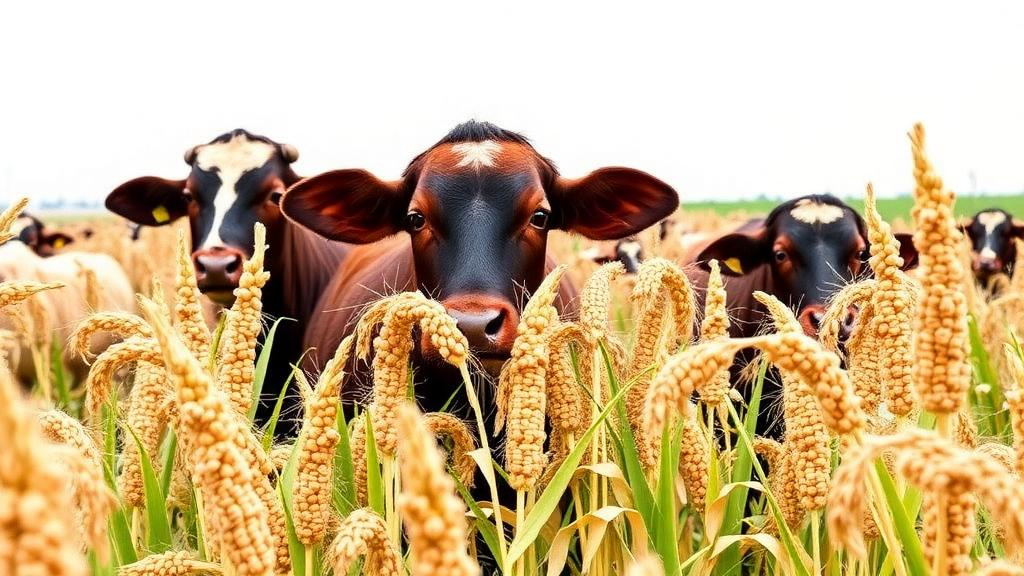
The implications for livestock feeding are where the study’s numbers become genuinely transformative. According to the researchers’ analysis, if sorghum were grown one year out of three in a rotational system, it could potentially replace around 90 percent of the maize currently used in European livestock feed. That figure reframes sorghum from a niche drought-tolerant curiosity into a plausible backbone of a climate-resilient feeding strategy. The logic rests on sorghum’s demonstrated robustness under high temperatures and scarce water—the very conditions that are becoming the norm rather than the exception across much of the continent. Maize, by contrast, remains heavily dependent on irrigation, a dependency that grows more costly and contested with every dry summer.
The water dimension deserves particular emphasis, because it connects the agronomic findings to a broader resource-management challenge. In France, where maize dominates irrigated agriculture, shifting a substantial share of feed production to a crop that requires little or no irrigation would free up water that could be redirected to other uses. The study’s authors highlight this explicitly: within France, expanding sorghum production and incorporating the grain into livestock feed could help address major challenges such as the management of water resources, with the water saved potentially allocated to other crops. The stated goal of such reallocation is to increase feed self-sufficiency in France—a pressing concern for a country whose livestock sector depends on feed supplies that climate change is making progressively harder to sustain.
The timing of the research lends it urgency. The most recent official French statistics on agriculture, food, forestry, and fisheries, compiled by the Agreste statistical service, put maize production at 49.1 million tonnes—the first dip below 50 million tonnes in sixteen years, a milestone reported by AFP in September 2026. For a crop that anchors European livestock feeding, such a decline forces a strategic conversation. Sorghum’s case is strengthened by the fact that it is not a speculative substitute: it is a proven cereal with established global production systems, and the new study provides the first continental-scale, data-driven assessment of how it would fare under European climate futures. The researchers conclude that their results highlight sorghum’s potential to help European agriculture adapt to climate change, offering a quantified, scenario-tested foundation for what has until now been a largely intuitive argument. As heat and water scarcity reshape the continent’s farmland, the crop that thrives where maize falters may be moving from the margins of European agriculture toward its center.
Subject of Research: Projected expansion of sorghum production in Europe under climate change and its potential to replace maize in livestock feed
Article Title: Sorghum may help European agriculture face climate change
Article References: Sorghum may help European agriculture face climate change. (n.d.). Original publication
Image Credits: AI Generated
DOI: Not provided
Keywords: sorghum, maize, climate change, European agriculture, livestock feed, machine learning, crop yields, water resources, irrigation, INRAE, Earth's Future, food security
Cite Scienmag News
Alan Morgan. (October 6, 2026). Sorghum Could Replace Most Maize in European Livestock Feed as Climate Warms. Scienmag. https://scienmag.com/sorghum-could-replace-most-maize-in-european-livestock-feed-as-climate-warms/
Alan Morgan. "Sorghum Could Replace Most Maize in European Livestock Feed as Climate Warms." Scienmag, 6 October 2026, https://scienmag.com/sorghum-could-replace-most-maize-in-european-livestock-feed-as-climate-warms/. Accessed 6 October 2026.
Alan Morgan. "Sorghum Could Replace Most Maize in European Livestock Feed as Climate Warms." Scienmag. October 6, 2026. https://scienmag.com/sorghum-could-replace-most-maize-in-european-livestock-feed-as-climate-warms/


