


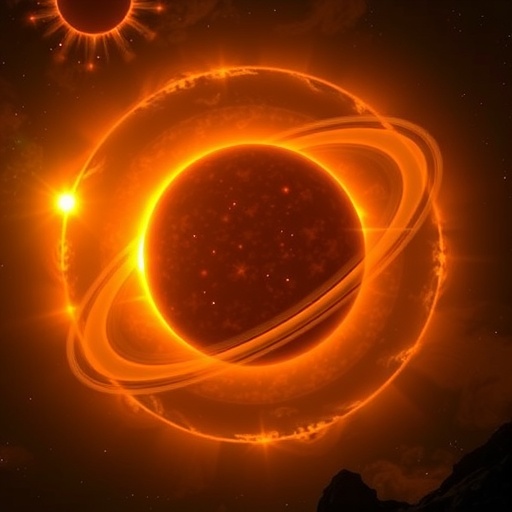
Researchers from several prestigious institutions, including UC Santa Barbara and Yale University, have made groundbreaking discoveries about the formation of sun-like stars and their associated protoplanetary disks. These disks, composed of gas and dust, are the cradle for solar systems and have long been studied to understand how they align with the stars they encircle. The project involved an intricate analysis of star-disk orientations, revealing that a notable proportion of these stars emerge with their rotational axes misaligned with the protoplanetary disks. This finding poses significant questions about the traditional understanding of stellar formation and planetary system evolution.
The study, led by Brendan Bowler, a renowned associate professor of physics at UC Santa Barbara, marks a significant shift in astrophysical perspectives. Bowler, who specializes in planetary formation, emphasizes that for years the scientific community has held a prevailing assumption: that stars and their planet-forming disks exist in almost perfect alignment. This belief stemmed mainly from the alignment observable in our own solar system, where the sun’s rotational axis aligns closely with the orbits of the planets.
However, the recent research challenges this long-held notion, suggesting that not all stars adhere to this alignment principle during their formative years. Since the discovery of exoplanets—planets orbiting stars beyond our solar system—scientists have been intrigued and puzzled by variations in the orientations of these planetary systems. Some exoplanets exhibit remarkably inclined orbits, which raises questions about their origins and the dynamics at play in their evolution.
The study’s lead author, Lauren Biddle, a postdoctoral researcher at UT Austin, expresses the surprise many researchers felt upon discovering that certain planets have orbits significantly inclined compared to their host stars’ rotational axes. This creates a complex puzzle regarding how such misalignments occur initially or whether they developed through gravitational interactions with companion stars or other celestial bodies after the planets were already formed. Possible scenarios involve massive outer planets affecting the trajectories of inner planets, leading to a misalignment that would persist over trillions of years.
To unravel this enigma, the researchers harnessed data from several cutting-edge astronomical tools, including the Atacama Large Millimeter/submillimeter Array (ALMA) and the Transiting Exoplanet Survey Satellite (TESS). These technologies enabled a detailed analysis of the inclinations of both stars and their respective disks across a diverse sample of 49 young isolated stars. Their findings revealed that around two-thirds of the stars and their protoplanetary disks were indeed found to be aligned, but critically, a third of them exhibited notable misalignments.
This observation suggests a compelling new trajectory for understanding how planetary systems can evolve directly from their formation processes. The existence of a third of stars born with tilted rotational axes indicates that such orientations may not solely be the byproduct of post-formation dynamics but rather an intrinsic characteristic present at the stars’ inception. Bowler elaborates on this, positing that the research suggests a simpler model of formation: rather than relying on complex interactions over billions of years, some stars are simply born misaligned, thus reorienting the scientific narrative around star and planet formation.
The implications of this study are profound. The orientation of a star’s axis relative to its planetary disk can influence a myriad of factors, including potential habitability conditions on the planets within that solar system. Understanding these orientations, therefore, becomes not just a matter of academic interest but a foundational step toward grasping the broader cosmic narrative. In essence, if one-third of stars can be misaligned by default, it invites questions about the formation of life-sustaining planets in such systems, thereby broadening the canvas of astrobiological research.
Bowler points out that certain solar systems may display significant dynamical interactions that cannot be easily explained by simple models, adding layers of complexity to planetary system architecture. Nonetheless, the researchers suggest that their findings are crucial in contextualizing our own solar system, which features a misalignment of about six degrees between the sun and its planets. This lays down a framework for a better understanding of our cosmic position and the broader statistical nature of solar systems throughout the galaxy.
As the scientific community reflects on these discoveries, future research is set to delve deeper into the mechanisms driving these variants in star and disk orientations during the initial moments of solar system formation. While the study has established that at least one-third of star-disk pairs are inclined, it opens the door to further inquiries into the underlying causes for such tilted alignments. The quest to understand the nuances of stellar formation continues to push the frontiers of astrophysical knowledge.
In summary, the findings catalyze a shift in the perceptions surrounding stellar formation and planetary system dynamics. They urge scientists to reconsider historical assumptions and to embrace the complexity and variety inherent in star and planet systems across the universe. As more studies emerge and methods of observation advance, a clearer picture of how solar systems develop over their lifetimes will likely come into focus, revealing the rich tapestry of the cosmos.
Keywords
Stellar formation, exoplanets, protoplanetary disks, astrophysics, planetary alignment, misalignment, cosmic dynamics, UC Santa Barbara, Nature Journal, scientific research.
Cite Scienmag News
Grant Pearson. (August 6, 2025). Some Young Suns Align with Planetary Disks, While Others Are Born Tilted. Scienmag. https://scienmag.com/some-young-suns-align-with-planetary-disks-while-others-are-born-tilted/
Grant Pearson. "Some Young Suns Align with Planetary Disks, While Others Are Born Tilted." Scienmag, 6 August 2025, https://scienmag.com/some-young-suns-align-with-planetary-disks-while-others-are-born-tilted/. Accessed 3 September 2026.
Grant Pearson. "Some Young Suns Align with Planetary Disks, While Others Are Born Tilted." Scienmag. August 6, 2025. https://scienmag.com/some-young-suns-align-with-planetary-disks-while-others-are-born-tilted/


