


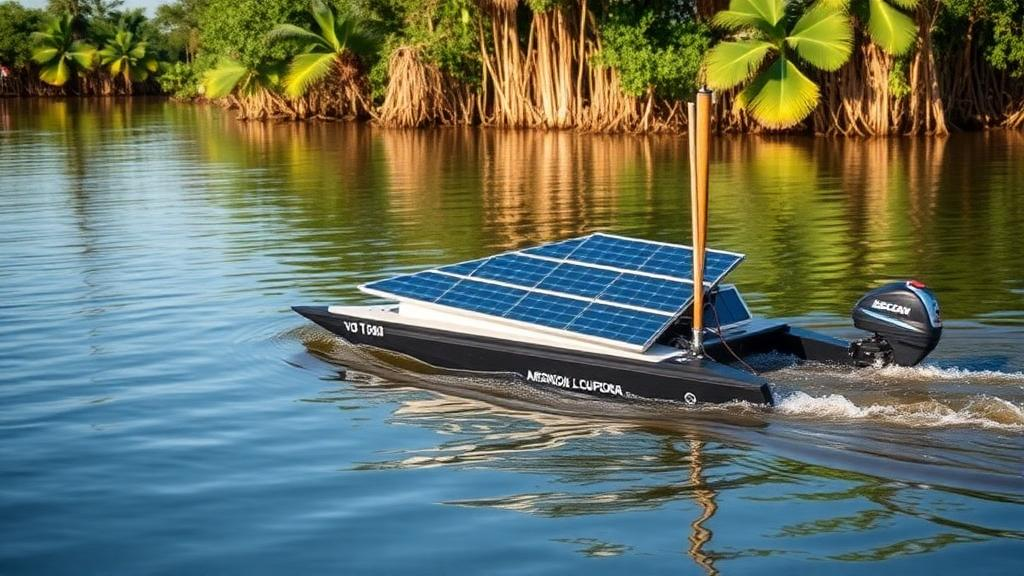
Deep in the Brazilian Amazon, on the vast Intermediate Reservoir of the Belo Monte Hydroelectric Power Plant, a small solar-powered vessel recently completed a task that would normally require a crewed boat, a team of technicians, days of logistics, and a laboratory backlog measured in weeks. The unmanned surface vehicle autonomously navigated roughly 10 kilometers in about three hours, stopped at designated monitoring stations, lowered its sensors to profile the water column from surface to depth, and beamed the results to the cloud. Within minutes, an artificial intelligence module had converted the raw measurements into a Water Quality Index, and the number appeared on an interactive web dashboard. The demonstration, described in the journal Environmental Monitoring and Assessment, marks a significant step toward fully autonomous, near-real-time water quality surveillance in some of the most remote and logistically hostile aquatic environments on Earth.
The team behind the system, led by Lorenzo Cardoso de Souza of USSV Tech and Marcelo Pedroso Curtarelli of Fundação CERTI, together with collaborators from Instituto CERTI Amazônia and the energy company Norte Energia, set out to tackle a problem that has long frustrated environmental agencies and reservoir operators alike. Conventional water quality monitoring depends on manual sampling campaigns: technicians travel to a site, collect water at various depths, preserve the samples, and ship them to laboratories for analysis. The approach is accurate but slow, expensive, and often impractical in places like Amazonian hydropower reservoirs, which can span hundreds of square kilometers of drowned forest, far from paved roads and well-equipped labs. By the time results come back, the water conditions they describe may have changed entirely.
The timing problem is not trivial. Research cited by the authors, including classic comparisons of instantaneous sampling against near-continuous phosphorus time series, has shown that sporadic grab samples can miss the very events that matter most, such as algal blooms, sediment pulses after storms, or the stratification changes that follow cold fronts moving across tropical reservoirs. In large reservoirs, physical processes like river inflow, wind-driven circulation, and thermal stratification create strong spatial heterogeneity, meaning a single sampling point can misrepresent the state of the whole water body. Satellite remote sensing helps by covering wide areas, but persistent cloud cover over the Amazon frequently blocks optical observations, and satellites cannot profile the vertical structure of the water column at all.
The new platform is designed to fill that gap. The vessel itself is solar-powered, an engineering choice that allows extended autonomous operation without refueling in environments where support infrastructure is scarce. Its sensor payload combines a multiparameter probe capable of profiling the water column with monitoring cameras for situational awareness and a single-beam echosounder that supports navigation by measuring water depth beneath the hull. The echosounder serves a dual purpose: it helps the vessel avoid shallow hazards while also contributing bathymetric context to the data stream. Together, these instruments let the boat move safely through the reservoir, position itself at monitoring stations, and record how parameters change with depth, not just at the surface.
The real innovation, however, lies in what happens after the data leave the vessel. Measurements are transmitted to a cloud-based system that stores, processes, and visualizes them, and an artificial intelligence module estimates integrated water quality indicators, most notably the Water Quality Index, a composite metric widely used by environmental regulators to summarize the overall condition of a water body. The AI component was developed to reduce reliance on laboratory analyses, which are typically the bottleneck in traditional monitoring workflows. A companion study by team member Bashir Zeimarani and colleagues, published in IEEE Access, details a spatio-temporal graph neural network for predicting the Water Quality Index in autonomous aquatic monitoring systems, illustrating the machine learning architecture underpinning this capability.
Field demonstrations at the Belo Monte Intermediate Reservoir validated the concept end to end. The vessel navigated autonomously along a planned route, successfully collected vertical water quality profiles at the designated stations, and transmitted everything to the cloud. The WQI was then estimated automatically and displayed on an interactive dashboard within a few minutes of acquisition. That turnaround time, from in-water measurement to actionable indicator, is transformative compared with the days or weeks required by conventional laboratory workflows. For reservoir operators who must manage hydropower generation, downstream releases, and environmental compliance simultaneously, near-real-time information changes the decision-making calculus fundamentally.
The choice of Belo Monte as a testbed is significant in its own right. The Belo Monte complex on the Xingu River is one of the largest hydropower facilities in the world, and Brazilian regulators require ongoing monitoring of reservoir water quality as a condition of operation. Tropical reservoirs are ecologically sensitive systems: flooded vegetation decomposes and releases greenhouse gases, nutrient loading can trigger cyanobacterial blooms, and stratification can lead to oxygen depletion in deeper layers. Studies of reservoirs such as Tucuruí have documented the complex environmental consequences of Amazonian dam construction, and researchers have repeatedly called for better monitoring tools to understand and manage these effects. An autonomous platform that can repeatedly and cheaply profile the water column offers exactly the kind of dense, spatially distributed data that environmental models of these systems need.
The framework also fits into a broader technological trend. Unmanned surface vehicles have matured rapidly, with recent reviews cataloguing market-ready solutions for oceanographic and inland water applications, and prior projects have demonstrated low-cost, open-source autonomous boats equipped with IoT sensors for real-time water quality reporting. What distinguishes the Brazilian system is its integration: autonomous solar-powered sampling, cloud processing, AI-driven estimation of regulatory-grade indicators, and near-real-time visualization are combined into a single operational pipeline rather than existing as separate prototypes. The work was funded through the Research and Development Program of the National Electric Energy Agency (ANEEL), project PD-07427-0323/2023, financed by Norte Energia, reflecting a regulatory model that channels utility investment into technological innovation.
The authors are careful to position the platform as a complement to, not a replacement for, conventional monitoring. Multiparameter probes measure physical and chemical parameters in situ, but certain regulatory analyses still require laboratory work, and AI-estimated indices must be validated against reference measurements to maintain trust. Long-term method consistency is also a concern in aquatic science, as researchers have noted when switching between techniques in multi-decadal datasets. Nevertheless, the demonstrated ability to slash the latency between observation and indicator, while cutting the cost per profile, suggests that autonomous vessels could dramatically increase sampling density in places where data are currently scarce.
Future development is already on the roadmap. The team plans to integrate additional sensors, including meteorological instruments, which would let the platform correlate water quality dynamics with the weather systems that drive them, such as the cold fronts known to induce rapid physical changes in tropical reservoirs. Expanded sensing could also support applications beyond compliance monitoring, including greenhouse gas flux studies, bloom early warning, and calibration of satellite-based water quality retrieval algorithms. If the Belo Monte demonstration is any indication, the future of water quality monitoring in remote environments may look less like a field expedition and more like a quiet solar boat gliding across the reservoir, thinking for itself, and reporting the health of the water within minutes.
Subject of Research: Autonomous solar-powered surface vehicle and artificial intelligence framework for near-real-time water quality monitoring in Amazonian hydropower reservoirs
Article Title: An integrated framework for autonomous near-real-time water quality monitoring using a solar-powered unmanned surface vehicles and artificial intelligence
Article References: de Souza, L. C., Curtarelli, M. P., do Nascimento Melo, D., Faria, D., Di Lello Jordão, M., de Andrade, R. H. R., Zeimarani, B., Penz, D., Menendez, E., Maia, M. G., Galvão, M. O., Rocha, V. C., Carneiro, R., & Lobato, A. A. C. (2026). An integrated framework for autonomous near-real-time water quality monitoring using a solar-powered unmanned surface vehicles and artificial intelligence. Environmental Monitoring and Assessment, 198(10), Article 1059. https://doi.org/10.1007/s10661-026-15912-y
Image Credits: AI Generated
DOI: 10.1007/s10661-026-15912-y
Keywords: unmanned surface vehicle, water quality, artificial intelligence, solar power, Amazon, Belo Monte, hydropower reservoir, Water Quality Index, environmental monitoring, machine learning, remote sensing, cloud computing
Cite Scienmag News
Violet Maxwell. (October 12, 2026). Solar-Powered Robot Boat Uses AI to Monitor Water Quality in the Amazon in Near Real Time. Scienmag. https://scienmag.com/solar-powered-robot-boat-uses-ai-to-monitor-water-quality-in-the-amazon-in-near-real-time/
Violet Maxwell. "Solar-Powered Robot Boat Uses AI to Monitor Water Quality in the Amazon in Near Real Time." Scienmag, 12 October 2026, https://scienmag.com/solar-powered-robot-boat-uses-ai-to-monitor-water-quality-in-the-amazon-in-near-real-time/. Accessed 12 October 2026.
Violet Maxwell. "Solar-Powered Robot Boat Uses AI to Monitor Water Quality in the Amazon in Near Real Time." Scienmag. October 12, 2026. https://scienmag.com/solar-powered-robot-boat-uses-ai-to-monitor-water-quality-in-the-amazon-in-near-real-time/


