


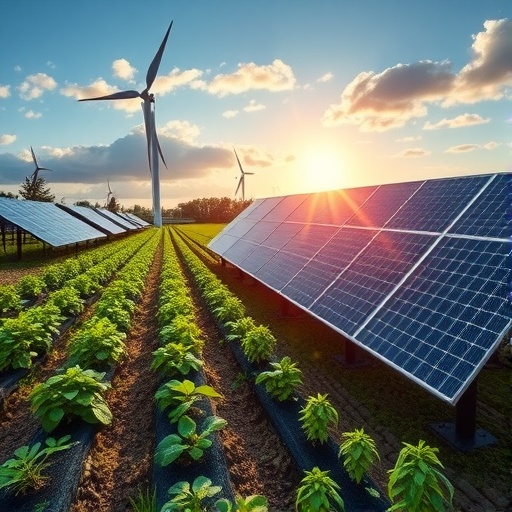
Methanol sits at the heart of modern industry. It is a platform chemical from which countless products are derived, a shipping fuel in its own right, and a promising carrier for hydrogen storage. Today, nearly all of it is made from fossil natural gas, and its production and use release carbon that has been locked underground for millions of years. As governments and companies search for ways to defossilize sectors that cannot simply switch to batteries—aviation, shipping, heavy machinery, and much of the chemical industry—green methanol produced from atmospheric carbon dioxide and sunlight has become one of the most intensely pursued options. But a fundamental question has remained largely unanswered: given the physics and chemistry involved, how efficiently can sunlight actually be converted into methanol, and which route to the molecule wins the energy race?
A team at the Institute of Environmental Technology and Energy Economics at Hamburg University of Technology has now provided one of the most rigorous answers yet. Marvin Scherzinger, Wolfram Tuschewitzki, Stefan Bube and Martin Kaltschmitt systematically traced every conversion step from the solar spectrum striking the Earth’s surface to finished methanol, comparing three complete production pathways: one powered entirely by photovoltaic electricity with carbon captured directly from air, and two rooted in photosynthesis, in which biomass is grown, converted to synthesis gas, and then transformed into methanol. The study, published open access in Clean Technologies and Environmental Policy, calculates both the theoretical maximum efficiency for each step—grounded in thermodynamic limits that no engineering can surpass—and the efficiencies that present-day technology actually achieves.
The headline result is stark. Under ideal, physically achievable conditions, the power-based pathway converts 23.5 percent of incoming solar energy into the chemical energy of methanol. The biomass-based pathways manage only 3.8 percent when the synthesis gas is produced by anaerobic digestion, and 4.4 percent when thermochemical gasification is used. With realistic, present-day efficiencies, the gap widens dramatically: the power-based route achieves 7.5 to 9.4 percent overall, while the biomass routes fall to between roughly 0.28 and 0.56 percent. The villain of the biomass story is not the downstream chemistry but photosynthesis itself, which sets the ceiling for the entire route.
The reason lies in the cascade of unavoidable losses inside a green leaf. Only about 43 percent of the solar energy reaching the ground falls within the photosynthetically active region, the band between 400 and 700 nanometers that chlorophyll can exploit. Reflection and transmission strip away another 11.4 percent of that, based on measured absorption spectra across 22 plant species. Within the two photosystems, the pigment pairs P680 and P700 can only use photons at their specific excitation energies—about 176 and 171 kilojoules per mole respectively—so the surplus energy of higher-energy photons is lost as heat and fluorescence, erasing nearly a fifth of the absorbed energy. Building glucose itself demands 48 photons per molecule, so only a third of the energy captured in the reaction centers ends up stored in chemical bonds. Then come two biological taxes: photorespiration, in which the enzyme RuBisCO occasionally grabs oxygen instead of carbon dioxide and the cell must spend energy to recover the product, and cellular respiration, through which the plant burns a substantial fraction of its own sugars to fuel growth and maintenance. Stacked together, these losses cap theoretical photosynthetic efficiency for C3 plants at about 5.2 percent of incident sunlight, and measured field efficiencies for actively growing plants sit at only around 1 to 2 percent. At 15 degrees Celsius and today’s atmospheric carbon dioxide concentration of roughly 420 parts per million, photorespiration alone removes about 27 percent of the fixed carbon energy; at 30 degrees the penalty rises to nearly 49 percent.
The power-based route plays an entirely different game. Here sunlight is harvested by single-junction silicon solar cells, whose ultimate limit is set by the detailed-balance framework first derived by Shockley and Queisser and later refined to include Auger recombination and free-carrier absorption. Photons below silicon’s 1.12-electronvolt band gap are never absorbed—about 19 percent of incident energy—while the excess energy of hotter photons is thermalized away, another 32 percent. The refined practical limit for silicon hovers just below 30 percent, and the experimental record now stands at 27.4 percent, with commercial monocrystalline modules reaching about 22 percent. Electricity from the cell then splits water into hydrogen by electrolysis—ideally running at the thermoneutral voltage of 1.48 volts, where the electrical input exactly matches the enthalpy of water formation—while direct air capture extracts carbon dioxide from the 420-parts-per-million dilute soup of the atmosphere. The thermodynamics here are unforgiving: the minimum reversible work for complete carbon dioxide separation from air at 298 kelvin is 21.75 kilojoules per mole, and once the energy to move air through the capture unit is included, the theoretical floor rises to 53.43 kilojoules per mole, equivalent to 338 kilowatt-hours per tonne. Even so, the combined synthesis gas provision—three moles of hydrogen per mole of carbon dioxide—runs at 94.1 percent theoretical efficiency, and the final direct methanol synthesis, converting carbon dioxide and hydrogen over a catalyst at 200 to 300 degrees Celsius and 40 to 100 bar, retains 84.6 percent of the feedstock energy in the ideal case.
With today’s hardware, electrolysis systems achieve 54 to 71 percent on a higher-heating-value basis, and low-temperature direct air capture demands roughly 2,000 kilowatt-hours of energy per tonne of carbon dioxide—about six times the thermodynamic minimum—because regenerating the sorbents and blowing vast volumes of air are inherently costly. The result is that synthesis gas provision drops to 45 to 56 percent efficiency in practice. Direct methanol synthesis, which produces water as a by-product and therefore demands extra distillation, and whose per-pass conversion is thermodynamically capped below 45 percent so that unconverted gases must be recycled, runs at around 76 percent in modern plants. Yet because the solar cell dominates the loss budget—accounting for more than 70 percent of all losses in the theoretical case—the power-based pathway still outperforms biomass by a factor of fifteen or more under real-world conditions.
But the picture inverts when the starting material is not a growing plant but organic waste. If photosynthesis is excluded from the balance—because food-processing residues, straw, or biodegradable municipal waste are simply available—the biomass routes leap to theoretical efficiencies of 74.3 to 83.9 percent and present-day efficiencies of 27.4 to 47.4 percent, depending on whether the biomass is converted through anaerobic digestion of wet feedstocks or the thermochemical gasification of dry lignocellulosic material. Anaerobic digestion hands the carbon over to methane and carbon dioxide at up to 88.3 percent theoretical efficiency, after accounting for the heat released and the energy microbes spend on their own metabolism; autothermal tri-reforming and gas conditioning then convert biogas into a synthesis gas with a stoichiometric number of two, and conventional methanol synthesis closes the chain at 85 percent theoretical efficiency. Gasification, in which drying, pyrolytic decomposition, and oxygen-limited conversion at 800 to 1,100 degrees Celsius transform solid biomass into carbon monoxide and hydrogen, is theoretically loss-free when run autothermally, with conditioning via water–gas shift and carbon dioxide separation costing only a few percent. In practice, gasifiers reach 60 to 75 percent and conditioning 85 to 95 percent—enough to make the waste route competitive with, and often superior to, the all-electric pathway.
From these numbers the authors derive what they call the specific energetic value of biomass, a quantity that quantifies how much energy humanity saves by letting nature do part of the work. Because plants already perform the energy-intensive tasks of concentrating dilute atmospheric carbon dioxide and chemically reducing it into storable carbon–hydrogen–oxygen compounds—work that a technical system would otherwise have to pay for through electrolysis and direct air capture—waste biomass carries an embedded value that its heating value alone cannot express. In the theoretical ideal, using organic waste for synthesis gas production saves 2.9 to 3.1 kilojoules per kilojoule of methanol compared with the power-based reference route; under present-day efficiencies, because the power route’s synthesis gas provision is still far from its theoretical maximum, the savings balloon to between 7.1 and 11.5 kilojoules per kilojoule of methanol. In other words, routing waste biomass through digestion or gasification and conventional synthesis can cut the external energy input for methanol production by up to a factor of about 7.4 relative to the purely electricity-driven route. Biomass also stores itself: it can sit in a barn or a pile without degradation, whereas the power-based pathway must pay for batteries or hydrogen storage to bridge the gap between sunshine and synthesis.
The study is careful about its boundaries. It assumes a standardized reference spectrum, the ASTM G-173 air mass 1.5 irradiance normalized to 1,000 watts per square meter, which smooths away the daily and seasonal rhythms of real sunlight. It excludes the embodied energy of building the plants, land requirements, capital costs, water consumption, and greenhouse gas accounting, and it models direct air capture as purely electricity-driven, although many real systems use low-temperature heat—a limitation that integration of waste heat from the exothermic methanol synthesis could substantially improve. The authors also note that multi-junction solar cells, already demonstrating 47.6 percent efficiency in the laboratory, could push the power route well beyond the single-junction silicon benchmark, while efforts to engineer more efficient photosynthesis—such as introducing novel chlorophylls to widen the usable spectrum—would lift the biomass route only modestly, perhaps from 5.2 to around 6.8 percent theoretically.
The conclusions are correspondingly clear-eyed. Growing energy crops specifically to make methanol is, from a pure energy standpoint, a poor proposition: photosynthesis is simply too lossy a first conversion step. Power-based production with direct air capture is a viable and efficient route that should not be dismissed, and hybrid schemes—combining biomass-derived carbon with electrolytic hydrogen to avoid venting excess carbon dioxide as oxygen is stripped away, while sharing downstream synthesis plants—offer further gains. But the most energetically prudent strategy, the authors argue, is to treat organic residues and wastes as the carbon feedstocks of a closed carbon cycle, using them ahead of both energy crops and pure power-to-methanol wherever they are available. By fixing theoretical ceilings of 3.8 to 4.4 percent for photosynthesis-based production, 23.5 percent for the power-based route, and 74.3 to 83.9 percent for waste-based conversion, the study establishes physical benchmarks that no future solar-fuel technology can exceed—coordinates on the map against which every emerging green methanol project, from direct-air-capture pilot plants to biorefineries, must now be measured.
Cite Scienmag News
Sloane Callahan. (September 10, 2026). Solar and biomass pathways compared for green methanol energy efficiency. Scienmag. https://scienmag.com/solar-and-biomass-pathways-compared-for-green-methanol-energy-efficiency/
Sloane Callahan. "Solar and biomass pathways compared for green methanol energy efficiency." Scienmag, 10 September 2026, https://scienmag.com/solar-and-biomass-pathways-compared-for-green-methanol-energy-efficiency/. Accessed 10 September 2026.
Sloane Callahan. "Solar and biomass pathways compared for green methanol energy efficiency." Scienmag. September 10, 2026. https://scienmag.com/solar-and-biomass-pathways-compared-for-green-methanol-energy-efficiency/


