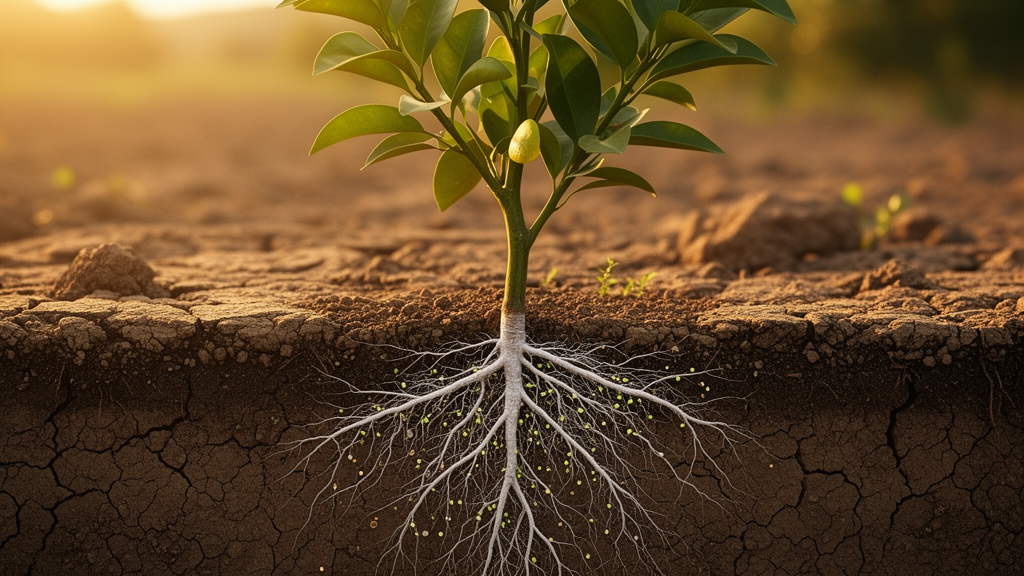
A glasshouse study has found that co-inoculating citrus rootstock seedlings with arbuscular mycorrhizal fungi (AMF) and mycorrhizal helper bacteria (MHB) significantly changed how the young trees responded to water stress, including shifts in leaf abscisic acid (ABA) concentration, relative water content and other physiological traits.
The researchers tested two AMF strains, Glomus intraradices and a mixed strain combination of Gigaspora decipiens plus Glomus mosseae, applied either alone or in combination with phosphate solubilising bacteria and other helper bacteria including Azospirillum and Providencia. The hypothesis behind the experiment was that AMF and MHB might influence ABA accumulation in citrus leaves, thereby altering the physio-biochemical response of the plants as soil water status declined.
Seedlings that received dual inoculation of AMF and MHB showed significantly higher relative water content in both leaves and rhizospheric soil compared with other treatments. Under water-stress conditions, Glomus intraradices combined with phosphate solubilising bacteria or with Azospirillum led to higher concentrations of osmolytes, including phenols, proline and total soluble sugars, as well as antioxidant metabolites such as glutathione and carotenoids in the leaves.
Leaf tissue ABA accumulation was significantly altered in the dual inoculated treatments. For Troyer citrange, the combination of Glomus intraradices and Azospirillum produced an ABA concentration of 3.517 micrograms per gram fresh weight under water stress, while for Cleopatra mandarin seedlings the combination of G. intraradices and phosphate solubilising bacteria reached 3.079 micrograms per gram fresh weight. Both figures were recorded under water-stress conditions and compared against other microbial inoculants including an uninoculated control.
The authors report that these water-deficit-induced physiological and biochemical response pathways could be modified by AMF and MHB. Under the specific experimental conditions of this glasshouse study, Troyer citrange seedlings showed higher relative water content, photosynthetic activity and stomatal conductance under drought conditions than Cleopatra mandarin seedlings. The researchers suggest the findings point to a potential microbial intervention strategy for mitigating osmotic stress in semi-arid environments.
The study relied heavily on the premise that plants depend on root-associated microflora to mitigate environmental stresses such as drought, and that using AMF as a biological instrument to enhance plant drought tolerance through mutualistic associations could offer a novel strategy for sustainable agriculture. As a glasshouse experiment with two rootstock species and a defined set of microbial combinations, the results describe responses under controlled conditions rather than field-verified outcomes, and the reported effects apply to the rootstocks, strains and moisture regimes tested.
Subject of Research: Effects of co-inoculating citrus rootstocks with mycorrhizal fungi and helper bacteria on drought-related physiological and biochemical responses.
Article Title: Arbuscular mycorrhizal fungi and mycorrhizal helper bacteria co-inoculation alters drought-associated physiological traits and leaf abscisic acid concentration in citrus rootstocks
Article References: Barman, P., Singh, S. K., Kumar, R., Mishra, D. S., Shukla, A., Pandey, A. K., Khadivi, A., & Tunç, Y. (2026). Arbuscular mycorrhizal fungi and mycorrhizal helper bacteria co-inoculation alters drought-associated physiological traits and leaf abscisic acid concentration in citrus rootstocks. PLOS One, 21(10), e0361406. https://doi.org/10.1371/journal.pone.0361406
Image Credits: AI Generated
DOI: 10.1371/journal.pone.0361406
Keywords: arbuscular mycorrhizal fungi, mycorrhizal helper bacteria, citrus rootstocks, drought stress, abscisic acid, water stress, Troyer citrange, Cleopatra mandarin, osmolytes, antioxidants, sustainable agriculture, glasshouse study
Cite Scienmag News
Roger Howard. (October 27, 2026). Soil Fungi and Bacteria Team Up to Help Citrus Rootstocks Cope with Drought. Scienmag. https://scienmag.com/soil-fungi-and-bacteria-team-up-to-help-citrus-rootstocks-cope-with-drought/
Roger Howard. "Soil Fungi and Bacteria Team Up to Help Citrus Rootstocks Cope with Drought." Scienmag, 27 October 2026, https://scienmag.com/soil-fungi-and-bacteria-team-up-to-help-citrus-rootstocks-cope-with-drought/. Accessed 28 October 2026.
Roger Howard. "Soil Fungi and Bacteria Team Up to Help Citrus Rootstocks Cope with Drought." Scienmag. October 27, 2026. https://scienmag.com/soil-fungi-and-bacteria-team-up-to-help-citrus-rootstocks-cope-with-drought/