


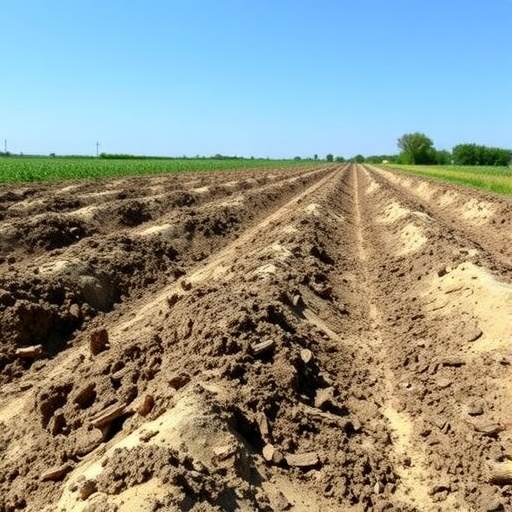
Ukraine’s agricultural legacy as the “breadbasket of Europe” faces an unprecedented threat, not merely from the ongoing conflict but from a hidden crisis beneath its soil. Recent research indicates that the war has accelerated an alarming trend of nutrient depletion, jeopardizing the long-term viability of Ukraine’s farms. Vital elements such as nitrogen, phosphorus, and potassium are being extracted from the soil faster than they can be replenished, primarily due to disruptions in fertiliser supply chains and compromised farming practices amid conflict.
A comprehensive study led by the UK Centre for Ecology & Hydrology (UKCEH), in collaboration with Ukrainian and Dutch scientists, reveals that the balance between nutrient removal and input has been skewed dramatically. Ukraine’s rich agricultural landscapes, historically sustained through consistent fertilisation, now suffer from a deficit as the supply of synthetic fertilisers diminishes. Fertiliser scarcity arises not only from wartime logistics challenges but also from inefficiencies in nutrient management on the ground, compounded by the direct physical damage wrought by military operations, including soil erosion and contamination.
Published in the journal Communications Earth & Environment, the study utilises 40 years of official fertiliser usage and crop yield data to chart nutrient flows related to wheat, maize, and sunflower cultivation. These three staple crops, which make up two-thirds of Ukraine’s agricultural output, anchor the country’s export economy, especially sunflower oil—a product for which Ukraine ranks as the world’s top producer. The findings expose a troubling nutrient asymmetry; more minerals are harvested and exported than are replaced, locking the country into a cycle of soil degradation that threatens future harvests and global food security.
The core issue lies in both input insufficiency and imbalanced application. During the Soviet era, fertiliser use was excessive, leading to nutrient runoff and environmental damage. However, since independence, a steep decline in phosphorus and potassium fertiliser use—mostly imported—has left soils critically deficient. In contrast, nitrogen fertiliser application, once reduced, surged again due to domestic production but was uneven and often excessive regionally. The war’s impact has since caused a sharp decline across all nutrient applications, plunging Ukraine’s soils into deficit territory.
Addressing this crisis requires a nuanced, integrated nutrient management framework. Dr Sergiy Medinets, leading the investigation, underscores the necessity of balancing synthetic and organic fertiliser use, incorporating animal manure, and adopting crop rotations that include legumes. Legumes naturally capture atmospheric nitrogen, enriching soils sustainably. This approach not only restores nutrient levels but also mitigates environmental harm caused by fertiliser overuse, such as groundwater contamination and air pollution from nitrogen compounds.
Soil nutrient management has long been complicated by the separation of livestock and crop operations across Ukraine. The decline in livestock numbers has minimized farmers’ access to animal manure, a valuable organic fertiliser, with an estimated 90% of manure produced currently wasted. This represents a multi-billion-dollar loss in fertiliser value and a missed opportunity for sustainable agricultural rejuvenation.
Revitalising the synergy between crop and livestock farming systems is a key recommendation. The study advocates for localized manure collection and redistribution systems that enable farms lacking livestock to benefit from organic inputs. Alongside this, precision applications of fertilisers—both synthetic and organic—are essential to optimize nutrient use efficiency, minimizing environmental losses and reducing costs for producers.
Further innovations include establishing a detailed national inventory quantifying nutrient removals by various crops, forming the basis for ‘smart fertiliser planners.’ These digital tools would empower farmers with tailored nutrient management plans, ensuring precise application rates that meet crop demands without excess.
The global implications of Ukraine’s agricultural decline are profound. As a critical supplier of wheat, maize, and sunflower products, Ukraine’s diminished production could trigger food insecurity and price escalations, especially in import-dependent regions such as North Africa and the Middle East. Maintaining soil fertility is thus not merely a national concern but a pivotal element of global food systems resilience.
International cooperation and support will be indispensable. The study calls for financial assistance through mechanisms like the Ukraine Recovery and Reconstruction Fund to facilitate investments in machinery for efficient fertiliser application and facilities for manure handling and storage. Cross-border knowledge exchanges and capacity-building initiatives could accelerate the adoption of best practices among Ukrainian farmers.
This crisis, set against a background of geopolitical turmoil, serves as a stark reminder that agricultural sustainability hinges on more than just land and climate. It demands a meticulous balance of soil chemistry, technological innovation, and integrated management—elements now threatened by conflict but recoverable with informed, coordinated action.
With these measures, Ukraine can not only protect but rejuvenate its vital croplands, securing its position as a global agricultural powerhouse. This requires urgency, innovation, and solidarity, both within Ukrainian borders and across the international community, as the interplay of environment, economy, and geopolitics continues to evolve.
News Publication Date: 4-Nov-2025
Web References:
https://doi.org/10.1038/s43247-025-02826-9
Cite Scienmag News
Alan Morgan. (November 4, 2025). Soil Depletion in Ukraine Poses Risks to Global Food Security Long-Term. Scienmag. https://scienmag.com/soil-depletion-in-ukraine-poses-risks-to-global-food-security-long-term/
Alan Morgan. "Soil Depletion in Ukraine Poses Risks to Global Food Security Long-Term." Scienmag, 4 November 2025, https://scienmag.com/soil-depletion-in-ukraine-poses-risks-to-global-food-security-long-term/. Accessed 3 September 2026.
Alan Morgan. "Soil Depletion in Ukraine Poses Risks to Global Food Security Long-Term." Scienmag. November 4, 2025. https://scienmag.com/soil-depletion-in-ukraine-poses-risks-to-global-food-security-long-term/


