


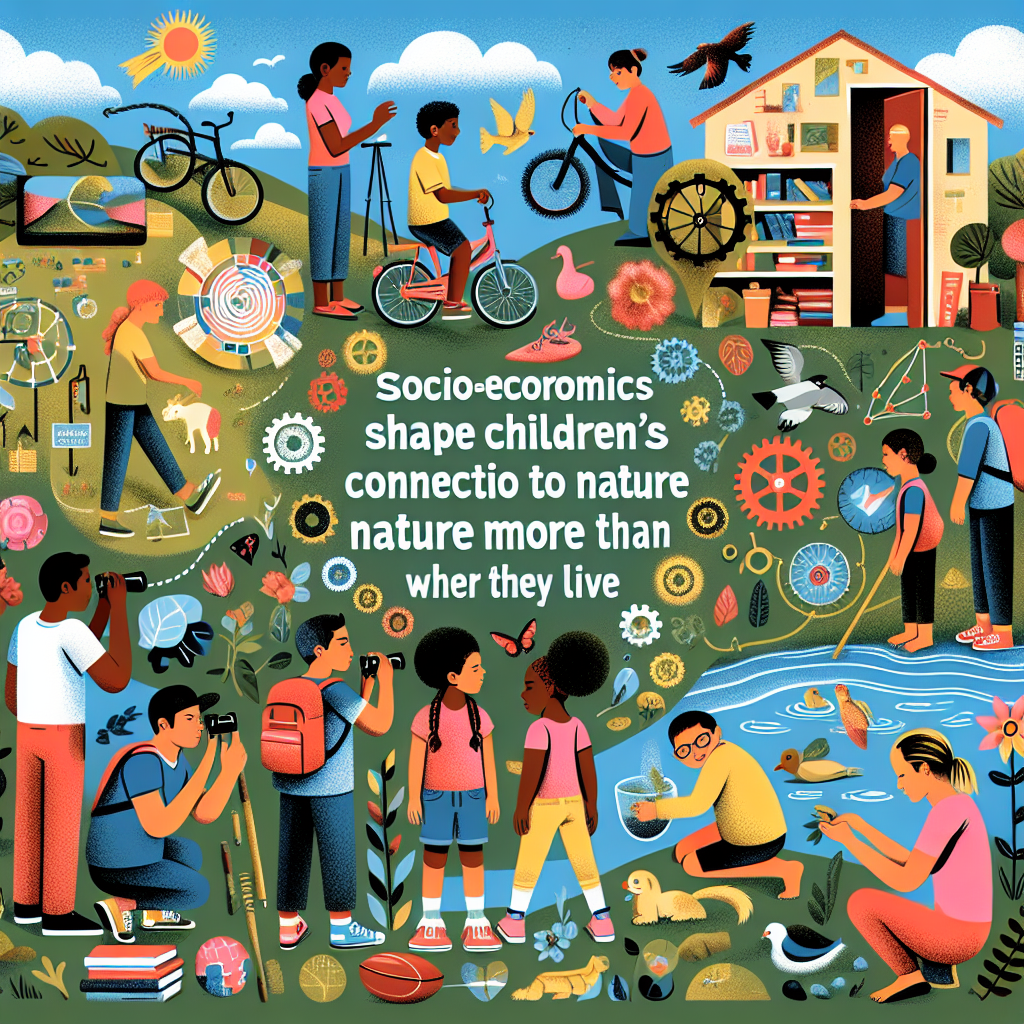
The income and education levels of a child’s environment determine their relationship to nature, not whether they live in a city or the countryside. This is the finding of a new study conducted by researchers at Lund University, Sweden. The results run counter to the assumption that growing up in the countryside automatically increases our connection to nature, and yet the study also shows that nature close to home increases children’s well-being.
The income and education levels of a child’s environment determine their relationship to nature, not whether they live in a city or the countryside. This is the finding of a new study conducted by researchers at Lund University, Sweden. The results run counter to the assumption that growing up in the countryside automatically increases our connection to nature, and yet the study also shows that nature close to home increases children’s well-being.
There is a general concern that, with urbanisation, people have lost contact with nature. According to research, less contact means lower engagement with nature and poorer health outcomes as people spend less time outdoors. How we might strengthen or rediscover our connection to nature is therefore a topical question. This is particularly important for children, partly because of the impact on their health, but also because it is in childhood that our relationships with nature are formed.
The researchers wanted to study the relationships urban and rural schoolchildren have to nature and whether these vary with socioeconomic status. They also wanted to look into whether feeding birds could serve as a point of contact with wildlife, potentially strengthening children’s knowledge of and feeling for nature, and by extension, improving their sense of well-being.
“Contrary to expectations, we have shown that children’s relationships with nature are not determined by whether they grow up in the countryside or in the city. Instead, socioeconomic factors play a decisive role. For example, children in areas with higher levels of education generally had better species knowledge, which in turn was linked to more positive attitudes towards wildlife. Higher incomes are linked to children participating more in nature-based activities, which also leads to a better connection to nature. This was true regardless of whether the children lived in a city centre or in the countryside,” says Dr Johan Kjellberg Jensen, researcher at Lund University, who led the study.
The study did find some differences between urban and rural children, however.
“It appears that children use natural environments in different ways, but this does not affect their attitudes towards nature in general. We could also see that children who have more direct access to nature close to home report a higher self-perceived sense of well-being. This shows how important contact with nature really is,” Dr Jensen says.
What was the outcome of the bird feeding project? The researchers from Lund found that children’s species knowledge increased, but they saw no effect on well-being or attitudes to nature.
“That said, we saw a very wide variation in results between schools, which points to the important role of teachers and schools in projects like this. We already know that our contact with nature is shaped through social interactions and that adults have considerable responsibility in acting as role models for how children relate to nature,” says Dr Johan Kjellberg Jensen, who also points out that this does not necessarily have to fall to teachers, who already have considerable responsibilities.
Another key finding of the study was that children with little access to nature close to home benefited most from the bird feeding project.
“This highlights the importance of green and equitable housing policies and urban planning. If we want future generations to have positive relationships with nature, enjoying all the health benefits that come with that, we may need targeted projects to increase children’s contact with nature, both in urban and rural settings. This is particularly important in areas of low socioeconomic levels and little nature near residential housing,” Dr Johan Kjellberg Jensen concludes.
Journal
People and Nature
Article Title
Reconnecting children to nature: The efficacy of a wildlife intervention depends on local nature and socio-economic context, but not on urbanisation
Cite Scienmag News
Courtney Benton. (August 23, 2024). Socioeconomics shape children’s connection to nature more than where they live. Scienmag. https://scienmag.com/socioeconomics-shape-childrens-connection-to-nature-more-than-where-they-live/
Courtney Benton. "Socioeconomics shape children’s connection to nature more than where they live." Scienmag, 23 August 2024, https://scienmag.com/socioeconomics-shape-childrens-connection-to-nature-more-than-where-they-live/. Accessed 4 September 2026.
Courtney Benton. "Socioeconomics shape children’s connection to nature more than where they live." Scienmag. August 23, 2024. https://scienmag.com/socioeconomics-shape-childrens-connection-to-nature-more-than-where-they-live/


