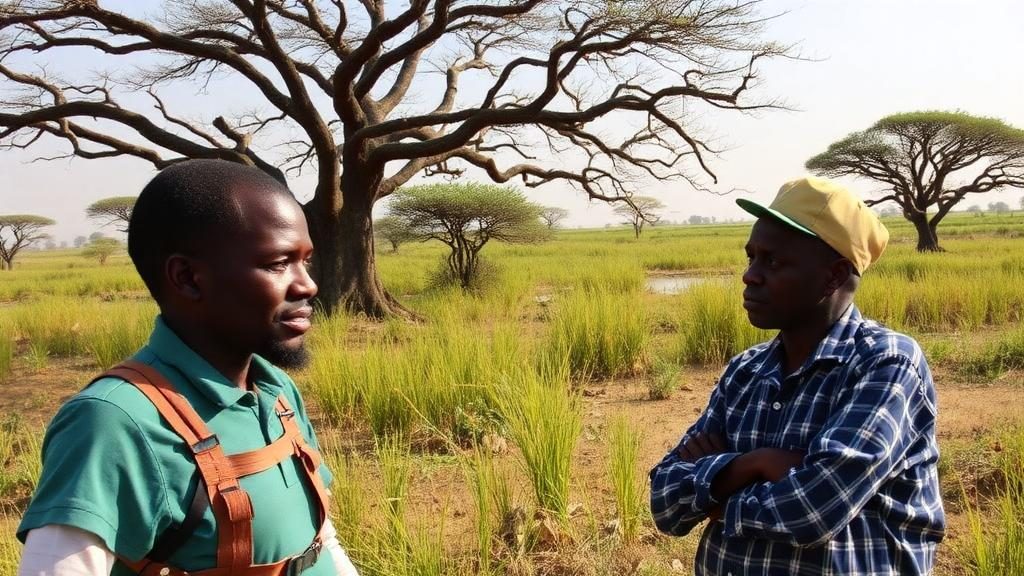
In the vast floodplains of western Zambia, where the second-largest wildebeest migration in Africa sweeps across a seasonally inundated grassland, the fortunes of local entrepreneurs appear to hinge on something far less visible than fish stocks or rainfall: the architecture of their social relationships. A new study of Liuwa Plain National Park, published in Frontiers in Sustainable Resource Management, has used the tools of social network analysis to reveal that the performance of nature-based enterprises—fishing, weaving, beekeeping, timber harvesting, and mushroom and caterpillar production—is woven into the pattern of who cooperates with whom, and that gender, ethnicity, and household size quietly script those patterns.
The research team, led by Vincent R. Nyirenda of the Copperbelt University together with colleagues from the park’s management authority and a South African environmental management centre, surveyed 206 households across the human-dominated landscape surrounding the park. Liuwa Plain is no conventional wilderness: established in 1972 on the site of a 19th-century royal hunting reserve created by the Lozi king Lubosi Lewanika, it is today jointly managed by African Parks, Zambia’s Department of National Parks and Wildlife, and the Barotse Royal Establishment. Roughly 24,000 people live in the surrounding Liuwa constituency, most of them poor and heavily dependent on the floodplain’s fisheries, reeds, papyrus, and raffia palms for their livelihoods.
To map the invisible wiring of this economy, the researchers treated every entrepreneur as a node in a network and drew a tie between two people whenever one reported a relationship with the other. They then quantified classic network measures—density, closeness, and betweenness—and used community detection algorithms to reveal clusters of overlapping relationships. The picture that emerged was strikingly sparse. Network density was a mere 0.7 percent, with reciprocity at just 2.7 percent, which the authors attribute to inadequate cooperation, lack of trust, negative attitudes, and the disruptive rhythm of a highly seasonal floodplain system. Across the 206 individuals surveyed, the total number of connections amounted to only 590, with individuals maintaining between one and eight ties each.
Yet the sparse network carried rich social information. The largest clusters of ties occurred among male entrepreneurs, who both fostered alliances and engaged in competition—most of the recorded rivalry involved men. Women, by contrast, tended to form alliances, and the study found that nearly every participant relied on at least one inter- or intra-group alliance for their enterprise. Individuals with many ties were almost exclusively in cooperative relationships rather than competitive ones, suggesting that well-connected entrepreneurs occupy a distinct structural position in the local economy. The ties also clustered by enterprise type: fishing was commonly mixed with weaving, timber, or beekeeping, and the Lozi ethnic group, which made up 75 percent of respondents and largely held primary or secondary education, dominated the relationship structure with a marked concentration of intra-ethnic ties.
One of the most consequential findings concerns livelihood diversification. Households with fewer alliances showed a greater tendency to shift away from fishing—the historic economic mainstay of the region—into alternative enterprises such as weaving, caterpillar harvesting, beekeeping, and mushroom production. Those endowed with stronger alliance networks remained fish-dependent. The authors interpret this as evidence that social connectivity and economic strategy are deeply intertwined: diversification appears partly as an adaptive response when relational capital is thin, while abundant alliances anchor households in traditional resource use. Gender and household size also shaped the pattern, with women from households of two to nine members showing more enterprise diversity than men, whose diversification was concentrated in households of four to nine members.
When the researchers asked entrepreneurs what drove their enterprises, income generation topped the list by a statistically significant margin, followed by traditional practices embedded in the strong cultural setting governed by the Barotse Royal Establishment, and then information sharing within existing social ties. Financial capital, the analysis showed, contributed significantly more than social, cultural, and natural capitals combined. Local market availability, water transport, and scarce credit facilities reinforced the financial driver, while the availability of resources such as fish, reeds, and timber played a smaller supporting role.
The barriers were equally revealing. Climate change impacts and poor market access together formed the most significant constraint, outweighing any individual factor. Seasonal flooding restricts mobility, damages infrastructure, and raises transport costs, while human-wildlife conflicts involving crocodiles, hyenas, and lions create insecurity that discourages participation in livelihood activities. Governance-related barriers—weak institutional support, lack of transparency among some leaders, inequitable resource access, and poor conflict management—followed closely, alongside socio-economic frictions such as non-cooperation, poverty, and lack of trust, and technical shortcomings including insufficient skills and inappropriate fishing methods.
Against these obstacles, the study identified three bridging pillars for building resilient enterprises: adaptive capacity, good governance, and traditional practices. Adaptive capacity—encompassing cooperation, trust, self-motivation, functional cooperatives, peace, negotiation skills, and good customer relations—proved statistically more significant than governance factors, which in turn outperformed traditional practices. The governance pillar included communication among entrepreneurs, government agencies, conservation NGOs, and traditional leaders, along with accountability, skills transfer, transparency, and transport infrastructure. Traditional practices, rooted in cultural values and long-standing co-adaptation to resource use, rounded out the triad.
The findings carry a double edge for conservation policy. Strong kinship-based networks can promote trust, reciprocity, and collective action, but the same bonding social capital can privilege insiders—dominant clans, influential families, politically connected fishers—while excluding migrants, women, and poorer households. The authors note that kinship loyalty and patron-client relationships may even shield rule-breakers, weakening fisheries enforcement and allowing inappropriate fishing methods to persist. In this sense, social cohesion functions simultaneously as a governance asset and a source of regulatory failure, a nuance the authors argue distinguishes Liuwa from wildlife-tourism-focused studies elsewhere in African transfrontier conservation areas.
For the researchers, the practical message is that strengthening adaptive capacity, collaborative governance, and social connectivity within shared landscapes is critical for enterprise resilience—and that conservation planning aimed at the Sustainable Development Goals, from poverty reduction to climate action and life on land, must account for the relational fabric of communities, not just the ecological resources they harvest. Because the study captured only a single seasonal snapshot of a dynamic floodplain system, the authors call for continuous, longitudinal monitoring to track how social networks and enterprise performance shift under changing socio-ecological conditions, ensuring that interventions remain tuned to the living architecture of relationships on which Liuwa’s nature-based economy ultimately depends.
Subject of Research: Social network drivers of nature-based livelihood enterprises in a Zambian protected landscape
Article Title: Sociocentric relationships drive nature-based enterprises in the human dominated Liuwa Plain National Park
Article References: Nyirenda, V. R., Phiri, D., Namukonde, N., Kalolekesha, H., & Nkhata, B. A. (2026). Sociocentric relationships drive nature-based enterprises in the human dominated Liuwa Plain National Park. Frontiers in Sustainable Resource Management, 5, Article 1871815. https://doi.org/10.3389/fsrma.2026.1871815
Image Credits: AI Generated
DOI: 10.3389/fsrma.2026.1871815
Keywords: social network analysis, nature-based enterprises, Liuwa Plain National Park, Zambia, livelihood diversification, community conservation, gender, climate change, governance, social capital, sustainable development goals, floodplain fisheries
Cite Scienmag News
Margaret Porter. (October 16, 2026). Social Ties Shape the Fate of Nature-Based Enterprises in Zambia’s Liuwa Plain. Scienmag. https://scienmag.com/social-ties-shape-the-fate-of-nature-based-enterprises-in-zambias-liuwa-plain/
Margaret Porter. "Social Ties Shape the Fate of Nature-Based Enterprises in Zambia’s Liuwa Plain." Scienmag, 16 October 2026, https://scienmag.com/social-ties-shape-the-fate-of-nature-based-enterprises-in-zambias-liuwa-plain/. Accessed 16 October 2026.
Margaret Porter. "Social Ties Shape the Fate of Nature-Based Enterprises in Zambia’s Liuwa Plain." Scienmag. October 16, 2026. https://scienmag.com/social-ties-shape-the-fate-of-nature-based-enterprises-in-zambias-liuwa-plain/