


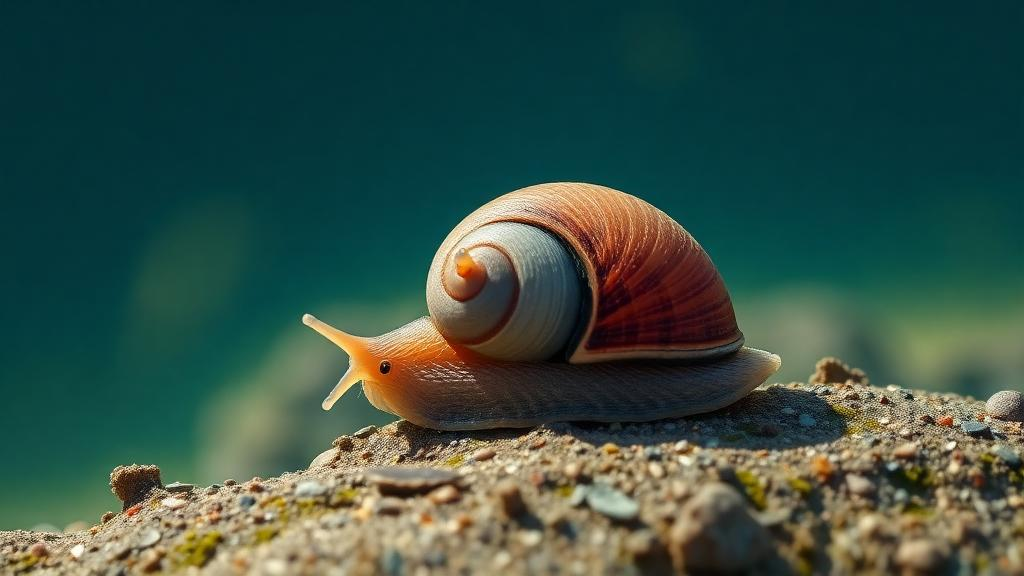
Deep in southwestern Turkey, along a dusty river valley near the town of Babadağ, paleontologists have uncovered a fossil treasure trove that is rewriting the story of one of Earth’s most remarkable evolutionary laboratories. A newly described assemblage of freshwater mollusks from the Denizli Basin reveals a long-lived lake ecosystem that thrived roughly 1.8 million years ago, at the very dawn of the Pleistocene epoch, and it is far younger than anyone had previously believed.
The research, published in the journal Zitteliana, documents at least 27 species of freshwater snails and bivalves recovered from the Kolankaya Formation, a thick sequence of lake sediments filling the Denizli graben. Among the haul are an entirely new genus, named Harzhauseria in honor of Viennese paleontologist Mathias Harzhauser, and six new species of minute spring snails belonging to the family Hydrobiidae. Perhaps most striking, a third of the entire fauna is found nowhere else on Earth but in this single Turkish basin.
The discovery carries a scientific bombshell in its chronology. For decades, the fossil-bearing strata of the Denizli Basin were assumed to date back to the late Miocene, some 6 to 10 million years ago. That assumption had made the younger of the basin’s two fossil faunas a candidate for the oldest known Pontocaspian-type assemblage, a potential ancestral source for the famous brackish-water lineages that today dominate the Black and Caspian Seas. New magnetostratigraphic and chronostratigraphic analyses have demolished that timeline. The older Kolankaya I fauna, described in the new study, is now firmly placed in the Gelasian stage of the Early Pleistocene, older than roughly 1.8 million years, while the overlying Kolankaya II fauna belongs to the Calabrian stage.
This dramatic age revision forces a complete rethink of biogeographic relationships across the region. Rather than being an ancient cradle from which Pontocaspian lineages spread, the Denizli lake system now appears to have been a contemporary refuge where Aegean-Anatolian and Pontocaspian elements mingled during the turbulent climate swings of the early Ice Age. The fauna’s composition tells the story: nearly half of the species, 44.7 percent, are endemic to the Aegean-Anatolian region, showing close affinities with Pliocene and Early Pleistocene faunas from the Greek islands of Rhodes and Kos, from mainland Greece, and from the nearby Turkish basins of Çameli and Eşen.
At the same time, the assemblage is peppered with classic Pontocaspian genera. Theodoxus, Ecrobia, Laevicaspia, and Dreissena all have deep evolutionary roots in the Paratethyan seas that once stretched across Eurasia, and the snail genera Graecoanatolica and Iraklimelania are now assigned to the Caspiinae, a quintessentially Pontocaspian subfamily. The Denizli Basin, wedged between the Menderes Massif and the Lycian nappes, was evidently a crossroads where two great biogeographic realms met and exchanged species.
The ecological signals embedded in the shells point to a very specific kind of environment. The taxonomic makeup, dominated by hydrobiid snails and melanopsids with only rare pulmonate gastropods and a conspicuous absence of unionid and sphaeriid bivalves, is the classic signature of a long-lived lake with oligohaline, slightly brackish conditions. Long-lived lakes, which persist for hundreds of thousands to millions of years, are renowned as cradles of evolution, and the Denizli fauna fits the pattern perfectly, with its high endemism and specialized morphologies.
Among the new species are some genuinely extraordinary animals. Harzhauseria schizopleura, the new genus’s sole species, is a tiny conical snail barely 3.5 millimeters tall whose whorls bear irregular, wavy ribs that sometimes split and interfinger, a sculpture unlike anything else known in the Hydrobiidae. Its name derives from the Greek words for splitting and rib, a nod to this bizarre ornamentation. Iraklimelania minutissima is even smaller, an exceptionally slender shell measuring just under two millimeters, while Falsipyrgula coronata sports a beaded, crown-like keel running around its whorls.
The taxonomic detective work behind the study involved considerable sleuthing. Many of the species had been named in the nineteenth and early twentieth centuries, but the original type specimens, deposited by the pioneering researcher Oppenheim in Berlin, could not be traced to the Museum für Naturkunde or to the Hebrew University of Jerusalem, which holds much of his collection. Inquiries across European museums yielded no clues, leading the authors to conclude the material was probably lost during the wartime relocation of the Berlin collections. To stabilize the nomenclature, the team designated a neotype for the neritid snail Theodoxus percarinatus and lectotypes for Staja orientalis and Valvata orientalis, anchoring these old names to physical specimens for the first time in over a century.
The fieldwork itself was painstaking. Three shell-rich horizons were sampled in the Babadağ river valley, roughly 200 to 230 meters above the base of the Kolankaya Formation. Hundreds of kilograms of sediment were washed through 0.5-millimeter sieves to extract the minute shells, many of which required scanning electron microscopy and digital stacking microscopes to document their delicate protoconch sculpture, growth lines, and apertural details. Preservation varied dramatically, from specimens retaining original color patterns of black, white, and orange zigzag markings to fragments worn smooth by ancient transport.
Some of the recovered species still have living descendants. Esperiana esperi, a sleek melanopsid snail with zigzag banding, survives today from the western Black Sea coast to Hungary and Austria, and Valvata piscinalis remains one of Europe’s most widespread freshwater snails. Most remarkably, the Denizli shells appear conspecific with Falsipyrgula sieversi, a species now restricted to the Aras River in Nakhchivan, Azerbaijan, hinting at a once-continuous distribution that Ice Age climate changes have since fragmented. As the Anatolian lake faunas continue to yield their secrets, the Denizli Basin stands as a vivid reminder that even well-studied landscapes can conceal entire lost worlds, and that the age of a fossil, once assumed, can transform everything we thought we knew about how life spread across the ancient Mediterranean realm.
Subject of Research: Early Pleistocene freshwater mollusks of the Denizli Basin in southwestern Turkey
Article Title: The Early Pleistocene freshwater mollusks of the Denizli Basin (Turkey): a new long-lived lake fauna at the crossroads of Pontocaspian and Aegean-Anatolian realms
Article References: Neubauer, T. A., & Wesselingh, F. P. (2023). The Early Pleistocene freshwater mollusks of the Denizli Basin (Turkey): a new long-lived lake fauna at the crossroads of Pontocaspian and Aegean-Anatolian realms. Zitteliana, 97, 53-88. https://doi.org/10.3897/zitteliana.97.115682
Image Credits: AI Generated
DOI: 10.3897/zitteliana.97.115682
Keywords: Denizli Basin, freshwater mollusks, Early Pleistocene, Pontocaspian, endemic species, Hydrobiidae, paleobiogeography, long-lived lake, Anatolia, new species, Kolankaya Formation, Gelasian
Cite Scienmag News
Gavin Prescott. (October 16, 2026). Ancient Turkish Lake Yields a Hidden World of New Snail Species From the Dawn of the Ice Age. Scienmag. https://scienmag.com/ancient-turkish-lake-yields-a-hidden-world-of-new-snail-species-from-the-dawn-of-the-ice-age/
Gavin Prescott. "Ancient Turkish Lake Yields a Hidden World of New Snail Species From the Dawn of the Ice Age." Scienmag, 16 October 2026, https://scienmag.com/ancient-turkish-lake-yields-a-hidden-world-of-new-snail-species-from-the-dawn-of-the-ice-age/. Accessed 16 October 2026.
Gavin Prescott. "Ancient Turkish Lake Yields a Hidden World of New Snail Species From the Dawn of the Ice Age." Scienmag. October 16, 2026. https://scienmag.com/ancient-turkish-lake-yields-a-hidden-world-of-new-snail-species-from-the-dawn-of-the-ice-age/


