


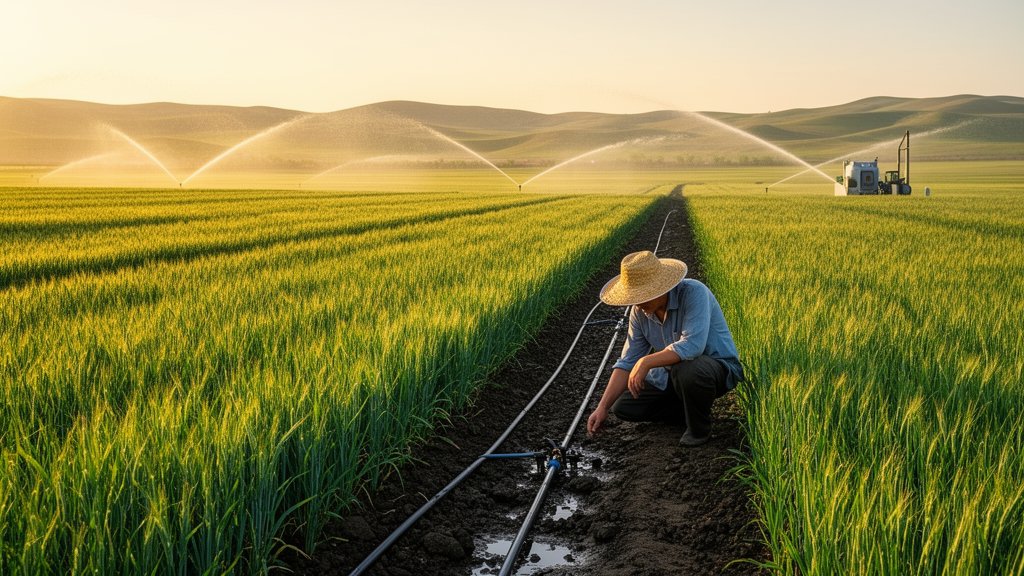
China’s push to modernize irrigation has delivered measurable water savings, but a new analysis finds that simply staying the course will not be enough to secure the country’s cereal harvests against climate change. The study, published in Nature Food, concludes that an optimized investment strategy pairing upgrades of existing irrigated land with targeted expansion could raise yields by 0.1–10.9% while cutting water use by at least 25.5%, with rice offering the greatest savings potential.
The research team assembled an unusually rich evidence base: 42,190 county-level agricultural records spanning China, a nationally representative farmer survey with 3,576 observations, and 2,230 controlled field experiments covering maize, wheat and rice. By combining these datasets, the researchers quantified how different irrigation technologies affect water consumption and crop productivity across the diversity of China’s farming regions, and validated that the estimated benefits of water-saving technologies match what controlled field trials actually show.
The historical record itself offers grounds for cautious optimism. Since 2010, China’s shift toward more efficient irrigation systems has reduced water use by an estimated 6.6% to 13.4%, according to the study. That demonstrates that the country’s investment in water-saving technologies has produced real conservation gains on the ground.
Yet the authors find that extrapolating these historical trends forward falls short on both challenges it would need to meet. Continued incremental improvement is insufficient to reach national targets, and it leaves crop yields exposed to the pressures of future climate change. The study examined projections under the high-emissions SSP5-8.5 scenario, modeling how climate impacts would affect yields of the three staple cereals and how different irrigation scenarios could buffer those losses.
The core of the paper is an optimized investment pathway that departs from uniform national policies. Instead of applying the same technology everywhere, the researchers identified crop- and region-specific strategies, recognizing that the return on irrigation investment varies depending on whether water is applied to wheat, maize or rice. Under this optimized approach, yields could increase by between 0.1% and 10.9% while water use declines by at least 25.5%. Rice emerges as the crop with the greatest potential for water savings.
The modeling distinguishes between two complementary levers. Upgrading technology in areas already under irrigation improves the efficiency of water currently being used, while targeted expansion brings previously rain-fed cropland under controlled water supply, stabilizing yields where climate change is expected to make rainfall less reliable. The study’s scenarios show how yields and irrigation water requirements change under technology upgrades alone, under expansion combined with maximum-technology adoption in existing irrigated areas, and under the final optimized strategy.
Crucially, the researchers also weighed the economics. A cost–benefit analysis accompanying the optimal strategies indicates that the pathway is not merely agronomically effective but investment-efficient, addressing a persistent gap in irrigation policy where conservation, yield stability and financial returns are often evaluated separately. Approaches that jointly improve all three have remained elusive, the authors note, which is precisely the niche this framework is designed to fill.
The findings arrive at a moment when irrigation expansion and water-saving technologies are widely recognized as essential for future water and food security. By grounding its recommendations in farmer surveys, administrative records and experimental data, the study offers a template for deciding where each yuan of irrigation spending does the most good.
Like all forward-looking work, the analysis carries uncertainties. Its yield projections rest on a high-emissions climate scenario, and the range of estimated benefits, from nearly negligible yield gains in some crop-region combinations to more than 10% in others, reflects real heterogeneity across China’s landscapes. The modeled savings represent potential under the optimized pathway rather than achieved outcomes, and realizing them would depend on implementation at scale. Still, the authors describe the framework as actionable guidance for strategic irrigation investment in China to support sustainable agricultural intensification.
Subject of Research: Optimized irrigation investment strategies for water-efficient, climate-resilient cereal production in China
Article Title: Coupling irrigation technology upgrades with targeted expansion enables water-efficient and climate-resilient cereal production in China
Article References: Zhang, T., Wang, J., Chen, H., Liu, Y., Chao, W., Zhou, F., Kang, S., Jin, Z., Anderson, W., & Mendelsohn, R. O. (2026). Coupling irrigation technology upgrades with targeted expansion enables water-efficient and climate-resilient cereal production in China. Nature Food. https://doi.org/10.1038/s43016-026-01455-5
Image Credits: AI Generated
DOI: 10.1038/s43016-026-01455-5
Keywords: irrigation, water conservation, cereal crops, food security, climate change, China, agriculture, rice, maize, wheat, crop yields, sustainable intensification
Cite Scienmag News
Alan Morgan. (October 23, 2026). Smarter Irrigation Could Cut China’s Crop Water Use by a Quarter While Boosting Yields. Scienmag. https://scienmag.com/smarter-irrigation-could-cut-chinas-crop-water-use-by-a-quarter-while-boosting-yields/
Alan Morgan. "Smarter Irrigation Could Cut China’s Crop Water Use by a Quarter While Boosting Yields." Scienmag, 23 October 2026, https://scienmag.com/smarter-irrigation-could-cut-chinas-crop-water-use-by-a-quarter-while-boosting-yields/. Accessed 23 October 2026.
Alan Morgan. "Smarter Irrigation Could Cut China’s Crop Water Use by a Quarter While Boosting Yields." Scienmag. October 23, 2026. https://scienmag.com/smarter-irrigation-could-cut-chinas-crop-water-use-by-a-quarter-while-boosting-yields/


