An artificial pancreas that delivers both insulin and glucagon without any input from the person wearing it has passed its most demanding test yet: a full year of real-world use in more than 240 adults with type 1 diabetes. The verdict, delivered by the largest and longest randomized trial of dual-hormone fully closed-loop therapy to date, is a study in contrasts. For people relying on multiple daily insulin injections, the system delivered a clinically meaningful improvement in glucose control. For those already wearing a modern hybrid closed-loop insulin pump, it offered essentially nothing beyond what they already had. And in a finding that may matter more than either result, half of the participants abandoned the device before the trial ended.
The DARE trial, conducted at 14 centers across the Netherlands and coordinated by University Medical Center Utrecht, enrolled adults aged 18 to 75 who had lived with type 1 diabetes for at least a year and whose glucose control fell short of guideline targets. Participants were split into two cohorts based on how they managed their diabetes at baseline. Cohort A comprised 70 adults using multiple daily insulin injections combined with continuous glucose monitoring. Cohort B comprised 173 adults already using a hybrid closed-loop system, the class of automated insulin delivery devices that adjusts basal insulin rates and delivers autocorrection doses but still requires users to count carbohydrates and announce meals. Within each cohort, participants were randomly assigned in a one-to-one ratio to either the dual-hormone system or to continue their usual care for 12 months.
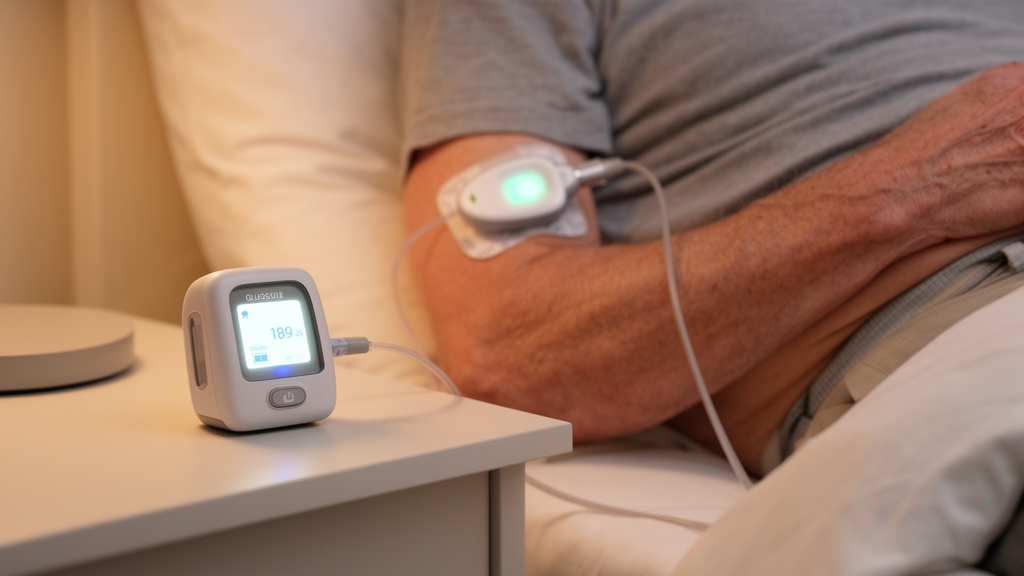
The device at the heart of the trial, the Inreda AP 5, is a CE-marked system that integrates two pumps and two infusion sets, one for insulin and one for glucagon, together with two glucose sensors and a control algorithm. Unlike hybrid closed-loop systems, it operates with no possibility for meal boluses, autocorrection doses, or exercise announcements. The algorithm reads real-time sensor glucose values and continuously adjusts the infusion of both hormones, using glucagon to counteract impending hypoglycemia in a way that approximates physiological control. Glucagon, the counter-regulatory hormone that raises blood glucose, is the element that sets dual-hormone systems apart from every insulin-only device on the market.
The primary endpoint was the percentage of time participants spent in the target glucose range of 70 to 180 milligrams per deciliter, equivalent to 3.9 to 10.0 millimoles per liter, measured at 12 months with blinded continuous glucose sensors. In cohort A, the dual-hormone group saw mean time in range rise from 60.8 percent at baseline to 64.8 percent at 12 months, while the injection group remained essentially stable at around 52 percent. The adjusted between-group difference was 8.3 percentage points, a gap the researchers calculate as nearly two additional hours per day in the healthy glucose zone. The benefit emerged within the first three months and persisted throughout the trial period. Glycated hemoglobin, the blood test that reflects average glucose over roughly three months, also fell in the dual-hormone group by 0.4 percentage points compared with usual care. At 12 months, 51.5 percent of participants in the dual-hormone group of cohort A achieved a glycated hemoglobin below 7 percent, compared with 16.1 percent in the injection group, a risk difference of 35.4 percentage points.
The nighttime picture was even more striking. During the hours between midnight and 6 a.m., the dual-hormone group in cohort A spent 15.7 percentage points more time in range than the injection group. Time below range, the metric that captures dangerously low glucose, showed no difference between the groups, meaning the improvement came without increasing hypoglycemia exposure as measured by sensors. In cohort B, by contrast, the dual-hormone system produced no meaningful advantage over hybrid closed-loop therapy. Mean time in range at 12 months was 66.1 percent in the dual-hormone group versus 66.8 percent in the hybrid closed-loop group, an adjusted difference of negative 0.4 percentage points that is statistically indistinguishable from zero. The only glycemic edge in cohort B was a modest 5.2 percentage point improvement in nighttime time in range.
Then came the discontinuation data. Over the 12-month trial, 59 of 119 participants assigned to the dual-hormone system, exactly 50 percent, stopped using it, with 43 percent discontinuing in cohort A and 52 percent in cohort B. The vast majority quit within the first three months. The leading reasons were device burden, cited by 69 percent of those who discontinued in cohort A and 44 percent in cohort B, and dissatisfaction with glycemic control, cited by 56 percent and 51 percent respectively. Participants described the sheer logistics of the system as overwhelming: it requires wearing two infusion sets and two sensors simultaneously, demands frequent fingerstick calibrations, and generates a high volume of alarms. Infusion set failures, skin reactions, and a general feeling of being unwell rounded out the list. Nobody in the usual care groups discontinued their treatment.
Safety findings added a further layer of complexity. Nine severe hypoglycemic events, defined as episodes requiring assistance from another person to recover, occurred in the dual-hormone groups compared with two in the usual care groups, and six of the nine in the dual-hormone groups required hospitalization or an emergency department visit. The researchers found no clear pattern in the contributing factors. On the reassuring side, not a single case of diabetic ketoacidosis was recorded across the entire trial, and no safety concerns related to long-term glucagon exposure emerged, addressing a question that has lingered over chronic glucagon infusion since the concept was first proposed. One participant in the usual care group of cohort B died of lung cancer diagnosed after the trial began, an event judged unrelated to the study.
Patient-reported outcomes painted a partly contradictory picture. In cohort A, diabetes-related distress fell in the dual-hormone group compared with injections. In cohort B, participants on the dual-hormone system reported fewer hypoglycemia-related worries than those on hybrid closed-loop therapy, yet they were less satisfied with their treatment device and reported poorer sleep quality. The researchers acknowledge that these findings are difficult to reconcile and that their clinical significance remains uncertain, though the pattern of lower device satisfaction and disrupted sleep aligns with the high discontinuation rate and the burden of wearing a more complex system.
A complicating factor in interpreting the results is that the glucagon formulation originally intended for the device, manufactured by Novo Nordisk, became unavailable just before the trial started, forcing an urgent switch to an alternative product from United Biotech. Two software updates and a new infusion set were introduced during the trial to adapt the algorithm to the new formulation, including earlier glucagon dosing in March 2024 and an increased daily glucagon maintenance dose in December 2024. However, 43 to 46 percent of participants never received the second update, which the researchers suggest may have contributed to the lower-than-expected glycemic benefit, the high discontinuation rate, and the severe hypoglycemic events. The trial design also cannot isolate the specific contribution of glucagon from the effects of full automation itself, since the two components are intricately connected in the intervention.
The broader implication is sobering for the field. Dual-hormone fully closed-loop therapy improves glucose control in adults not previously using automated insulin delivery, extending findings from small crossover trials of just days or weeks to a full year in a large population. But it demonstrates no additional glycemic benefit over the insulin-only hybrid closed-loop systems that have become the standard of care for many people with type 1 diabetes. The researchers conclude that future generations of dual-hormone systems must reduce device burden and enhance glycemic control if they are to justify their added complexity. Until then, the promise of a truly hands-off artificial pancreas remains technically achievable but practically demanding, with the trial showing that what the technology can achieve and what people will tolerate wearing every day do not yet fully align.
Subject of Research: Dual-hormone fully closed-loop insulin and glucagon therapy in adults with type 1 diabetes
Article Title: Dual-hormone fully closed-loop therapy versus multiple daily insulin injections or hybrid closed-loop therapy in adults with type 1 diabetes: a multicentre, open-label, randomised controlled trial
Article References: Jancev, M., Snoek, F. J., van der Meulen, M. P., Knottnerus, H. C., Vlaskamp, L. B., Witkop, M. F. T., Moons, K. G. M., de Valk, H. W., van Bon, A. C., DeVries, J. H., Serné, E. H., & van Sloten, T. T. (2026). Dual-hormone fully closed-loop therapy versus multiple daily insulin injections or hybrid closed-loop therapy in adults with type 1 diabetes: a multicentre, open-label, randomised controlled trial. The Lancet Regional Health – Europe, Article 101872. https://doi.org/10.1016/j.lanepe.2026.101872
Image Credits: AI Generated
DOI: 10.1016/j.lanepe.2026.101872
Keywords: type 1 diabetes, artificial pancreas, dual-hormone closed-loop, glucagon, insulin delivery, continuous glucose monitoring, hybrid closed-loop, hypoglycemia, randomized controlled trial, glycemic control, diabetes technology, DARE trial
Cite Scienmag News
Ophelia Keating. (October 23, 2026). Artificial Pancreas Delivers Mixed Results in Year-Long Diabetes Trial. Scienmag. https://scienmag.com/artificial-pancreas-delivers-mixed-results-in-year-long-diabetes-trial/
Ophelia Keating. "Artificial Pancreas Delivers Mixed Results in Year-Long Diabetes Trial." Scienmag, 23 October 2026, https://scienmag.com/artificial-pancreas-delivers-mixed-results-in-year-long-diabetes-trial/. Accessed 23 October 2026.
Ophelia Keating. "Artificial Pancreas Delivers Mixed Results in Year-Long Diabetes Trial." Scienmag. October 23, 2026. https://scienmag.com/artificial-pancreas-delivers-mixed-results-in-year-long-diabetes-trial/