


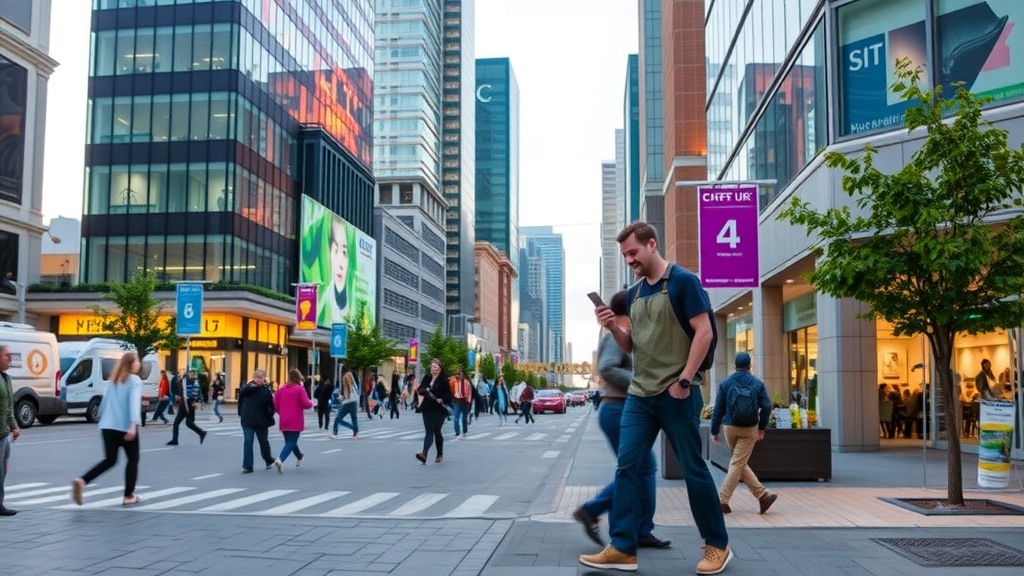
Smart city initiatives promise cleaner air, safer streets and more efficient public services, but many of the highest-profile deployments have instead met fierce public resistance. Projects such as LinkNYC in New York, Project Green Light in Detroit, San Diego’s Smart Streetlights and Sidewalk Toronto’s Quayside development all encountered backlash that delayed, curtailed or ultimately shut them down. A new perspective article in the journal Discover Cities argues that this record of failure stems not primarily from technical shortcomings but from a fundamental misunderstanding of what public trust is and how it can be built.
The study, authored by Brady Kennedy of Columbia University’s Department of Sociology, Cristian Capotescu of Columbia’s Trust Collaboratory, and Jennifer Laird of Lehman College, challenges the prevailing assumption that trust in smart city technologies can be engineered through better privacy protections, more reliable sensors and clearer communication. Drawing on a thematic synthesis of sociological research on trust alongside the literature on public participation, the authors contend that trust is not an attitude stored in the minds of individuals and measured by surveys, but a property of ongoing social relations between residents and the experts and institutions behind these initiatives.
Smart city initiatives typically combine several layers of technology: distributed sensors and connected devices grouped under the heading of the Internet of Things, which collect data from the built environment; information and communication technologies and cloud computing, which transmit and process that data at scale; and increasingly, artificial intelligence and algorithmic decision-making, which translate the resulting data into classifications and predictions for operational use. Stated aims range from optimizing public services and improving environmental sustainability to making infrastructure more accessible and cities safer and more livable.
Much existing research on trust in smart cities operates within a risk-benefit logic. Scholars have produced testable models simulating how mistrust hinders deployment, measured public attitudes through surveys, and proposed lists of trust characteristics such as privacy, reliability and fairness that designers can integrate into systems. The assumption is that as initiatives follow prescribed security parameters, privacy standards and governance norms, and communicate those choices transparently, public trust will follow. Kennedy and colleagues call this a technology-centric view that treats trust as flowing in one direction, with the public asked to extend it according to how experts adjust technical features.
In contrast, recent sociological scholarship, particularly from the field of science, technology and society, understands trust as inherently relational. In this account, trust emerges from interactions between trustors, the people doing the trusting; trustees, those in whom trust is placed; and trust objects, the specific focus of the relation at a given time and place. A smart city initiative may be the object of a trust relation, but it is never the trustee: residents extend or withhold trust with respect to the agency, vendor or partnership that designs and operates the system. Crucially, because uncertainty is what makes trust necessary in the first place, its conditions can never be fully engineered away through technical decisions.
The authors further draw on work describing trust as a verb, an active practice of trusting. Trusting is a skillful evaluative process in which residents scrutinize information and conduct rather than placing blind faith in experts. This carries a demand for both sides: the trustor must do the work of assessment, and the trustee must render itself answerable to that scrutiny. Because the trustee in these relations is an institution whose authority is itself at issue, answerability requires that decisions, and the power behind them, be made contestable. Notably, the authors argue that mistrust is not a failure of trust-building but internal to the same relational ties, playing an important role in promoting accountability and public engagement.
From this foundation, the study develops a typology of three participatory roles: the public as co-accessors, co-collectors and co-designers. Each role names the position residents occupy relative to smart city experts, and, because a relation cannot be specified from one side alone, also names what experts must place at stake. As co-accessors, residents shape, monitor and contest how data is gathered and used, while institutions accept the vulnerability of scrutiny. Examples range from static open data dashboards such as London’s DataStore to deeper arrangements like Barcelona’s New Data Deal, which re-envisions collected data as a public commons, and Manchester’s data governance practices, where residents and policymakers negotiate data gathering within structured engagements.
As co-collectors, residents directly produce data for smart city systems, through passive smartphone sensing or active crowdsourcing, while experts accept dependence on evidence they did not themselves produce. The MiraMap platform in Torino, Italy, allows residents to report and track urban problems, research showing it increased trust in government and technology alike. At the furthest extent, residents deploy their own sensors through systems such as HabitatMap AirSense and AirBox to generate environmental evidence independent of official accounts, converting mistrust into an instrument of accountability. As co-designers, finally, residents participate in shaping what is built, with experts relinquishing exclusive control. Iterative workshop approaches that visibly incorporate resident feedback have been shown in follow-up surveys to increase community trust in both the technology and the researchers, while game-based and virtual reality formats help include elderly and non-technical participants.
The framework carries pointed lessons for practitioners. Tokenism and consultation that leave residents feeling passively managed are not failures of technique but interactions in which no reciprocity was established; the mistrust that follows is a proportionate response, as illustrated by the urban data trust proposed for Sidewalk Toronto, constituted by the operator on the operator’s own terms, which failed to generate the mutuality on which trusting depends. The authors also caution that participatory approaches do not encounter a ready-made public but bring one into being, and that formats demanding time, mobility and technical confidence tend to reproduce existing inequalities, underrepresenting marginalized groups. Compensation and trusted community intermediaries can help widen who participates.
Ultimately, the authors argue, smart city professionals should stop treating participation as an instrument for raising approval scores and start treating it as the intentional structuring of reciprocal interaction in which trust, and mistrust, can both operate productively. There is no single modality for building trust, and each initiative will pose context-specific challenges. But without a relational understanding in which experts make themselves genuinely answerable, they warn, even well-intentioned future initiatives will face the same public backlash that has already derailed smart city projects from Toronto to San Diego.
Subject of Research: Trust-building through public participation in smart city initiatives
Article Title: Reframing participatory approaches to the smart city as opportunities for trust-building
Article References: Kennedy, B., Capotescu, C., & Laird, J. (2026). Reframing participatory approaches to the smart city as opportunities for trust-building. Discover Cities, 3(1), Article 177. https://doi.org/10.1007/s44327-026-00352-7
Image Credits: AI Generated
DOI: 10.1007/s44327-026-00352-7
Keywords: smart cities, public trust, public participation, sociology of trust, STS, expertise, data governance, participatory design, citizen sensing, urban technology, co-design, mistrust
Cite Scienmag News
Courtney Benton. (September 13, 2026). Smart cities need trust, not just better tech, new study argues. Scienmag. https://scienmag.com/smart-cities-need-trust-not-just-better-tech-new-study-argues/
Courtney Benton. "Smart cities need trust, not just better tech, new study argues." Scienmag, 13 September 2026, https://scienmag.com/smart-cities-need-trust-not-just-better-tech-new-study-argues/. Accessed 5 October 2026.
Courtney Benton. "Smart cities need trust, not just better tech, new study argues." Scienmag. September 13, 2026. https://scienmag.com/smart-cities-need-trust-not-just-better-tech-new-study-argues/


