


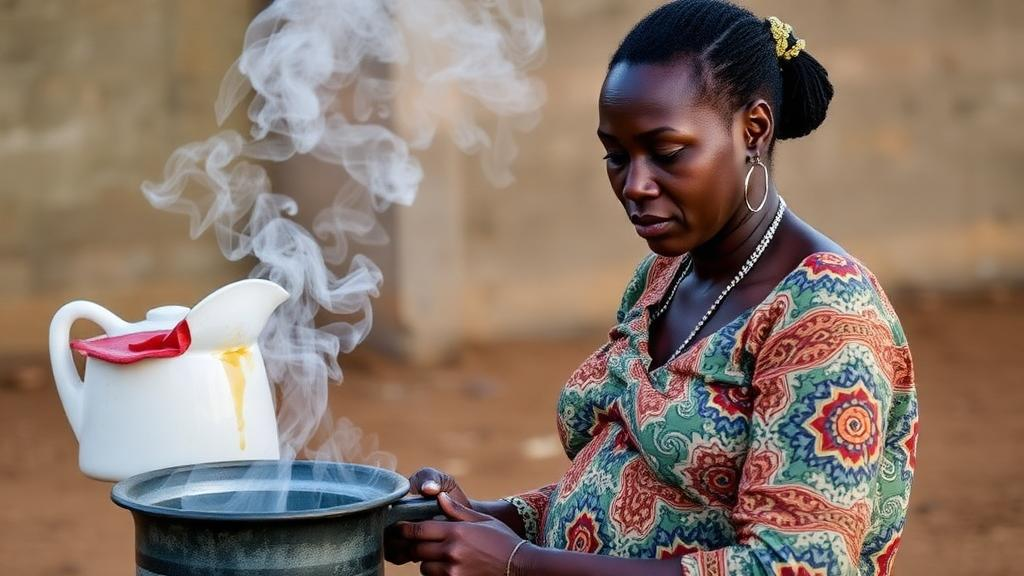
Across Ghana, roughly three out of every four women of reproductive age cook their family’s meals using solid fuels such as wood, charcoal, or crop residues rather than cleaner options like liquefied petroleum gas or electricity. That everyday habit, repeated in millions of kitchens, releases a dense cocktail of fine particulate matter and other pollutants into the air that women breathe for hours each day. A new nationwide analysis, published in Discover Social Science and Health, has now examined whether this household air pollution is linked to one of the most common yet underappreciated health problems in the region: anemia. The findings paint a nuanced picture in which the burden of both smoke exposure and low hemoglobin falls unevenly across the population, with pregnant women emerging as a group that may deserve special attention.
The study, conducted by Michael Mensah and Sampson Opoku of the Family Health Medical School at Family Health University in Accra, drew on data from the nationally representative Ghana Demographic and Health Survey. The researchers analyzed records from 7,657 women of reproductive age, using survey-weighted regression models designed to account for the complex sampling design of the survey. Anemia was classified according to World Health Organization hemoglobin thresholds, while cooking fuel type was sorted into two categories: clean fuels and unclean fuels, the latter encompassing the biomass and solid fuels that dominate household energy use in many low- and middle-income countries. By stratifying their analysis by pregnancy status and by rural or urban residence, the team aimed to reveal patterns that a single national average would obscure.
The headline numbers are striking. Overall, 41.1 percent of the women in the sample were anemic, a prevalence that WHO would classify as a severe public health problem. At the same time, 74.0 percent relied on unclean cooking fuels. Anemia was more common among pregnant women, affecting 51.2 percent of them, compared with 40.4 percent of women who were not pregnant. Geography mattered as well: rural women reported anemia at a rate of 43.4 percent, versus 39.4 percent among their urban counterparts, a gap consistent with differences in healthcare access, nutrition, and fuel availability between the two settings.
The most dramatic contrast appeared when the researchers crossed fuel type with pregnancy status. Among pregnant women, those using unclean fuels had an anemia prevalence of 57.4 percent, while those using clean fuels had a prevalence of just 32.5 percent. That gap of nearly 25 percentage points suggests that the combination of pregnancy and solid fuel exposure may place women at a compounded disadvantage. During pregnancy, the body’s demand for iron rises sharply to support the expanding blood volume of the mother and the development of the fetus, so any factor that impairs iron metabolism or increases inflammatory stress can push hemoglobin levels below healthy thresholds more easily than in the non-pregnant state.
Biologically, there are plausible mechanisms connecting smoke from burning biomass to anemia. Combustion of wood, charcoal, and agricultural waste generates fine particulate matter that penetrates deep into the lungs and enters the bloodstream, triggering systemic inflammation and oxidative stress. Chronic inflammation interferes with iron homeostasis by promoting the sequestration of iron in storage compartments and reducing its availability for red blood cell production, a pattern similar to the anemia of chronic disease. Repeated exposure to these pollutants could therefore, in principle, erode hemoglobin concentrations over time, particularly in people whose iron reserves are already stretched thin by dietary insufficiency, parasitic infection, or the physiological demands of pregnancy.
Yet when the researchers applied the full statistical machinery of multivariable logistic regression, adjusting for the other factors that influence anemia risk, the picture became more cautious. In the overall population, unclean fuel use showed no association with anemia: the adjusted odds ratio was 1.00, with a 95 percent confidence interval of 0.82 to 1.23, meaning the data were fully compatible with no effect. Among pregnant women, the adjusted odds ratio rose to 2.12, indicating a doubling of the odds of anemia among users of unclean fuels, but the confidence interval of 0.95 to 4.74 crossed the threshold of 1.0, so the association did not reach statistical significance at the study’s 0.05 threshold. In other words, the crude pattern was suggestive, but the adjusted evidence remains inconclusive.
This distinction between crude and adjusted results matters for how the findings should be interpreted. Crude associations can be distorted by confounding: women who cook with solid fuels may also differ from clean fuel users in income, education, diet, access to healthcare, and a host of other characteristics that independently affect anemia risk. Adjusting for such covariates strips away much of that overlap, and when the researchers did so, the apparent nationwide link between fuel type and anemia vanished. The persistent, though statistically uncertain, elevation among pregnant women may reflect a genuine biological vulnerability, or it may simply be a signal that the study lacked the statistical power to confirm, given the smaller number of pregnant women in the sample and the wide confidence interval that resulted.
The authors are careful about what their study can and cannot establish. As a secondary analysis of cross-sectional survey data, it captures fuel use and hemoglobin status at a single point in time, so it cannot determine whether smoke exposure precedes anemia or establish any causal pathway. The authors note that further research should explore causal mechanisms and employ longitudinal exposure assessment, following women over time and measuring their actual pollutant exposure rather than relying on fuel type as a proxy. Such work could clarify whether the pregnant subgroup signal is real and, if so, which components of household smoke, at what doses and durations, drive the hematological changes involved.
Even with those caveats, the study carries practical implications for public health policy in Ghana and comparable settings. The authors suggest that integrating clean cooking interventions into antenatal care could be a promising strategy, since pregnancy is a period when women have frequent contact with the health system and heightened motivation to reduce risks. Promoting liquefied petroleum gas and other cleaner fuels among expectant mothers would address a modifiable exposure while the broader structural determinants of anemia, including nutrition, poverty, and energy access, are tackled over the longer term. The finding that three quarters of Ghanaian women of reproductive age still cook with unclean fuels underscores how far the country remains from the clean household energy targets embedded in the Sustainable Development Goals.
The research also highlights persistent rural-urban inequities that go beyond fuel choice. Rural women faced higher anemia prevalence than urban women, and they are also more likely to depend on biomass fuels, compounding their disadvantage. Because the adjusted analysis found no overall fuel-anemia association, the authors emphasize that addressing anemia in Ghana will require attention to structural determinants rather than a singular focus on cooking smoke. Still, with more than four in ten women anemic and half of pregnant women affected, the study adds weight to the argument that household energy policy is health policy, and that the smoke rising from millions of traditional cookstoves deserves a place in any serious national strategy to protect women’s health.
Subject of Research: The association between household air pollution from cooking fuels and anemia among women of reproductive age in Ghana
Article Title: A nationwide comparative analysis of household air pollution and anemia among women of reproductive age in Ghana by rural and urban residence and pregnancy status
Article References: Mensah, M., & Opoku, S. (2026). A nationwide comparative analysis of household air pollution and anemia among women of reproductive age in Ghana by rural and urban residence and pregnancy status. Discover Social Science and Health. https://doi.org/10.1007/s44155-026-00499-z
Image Credits: AI Generated
DOI: 10.1007/s44155-026-00499-z
Keywords: household air pollution, anemia, cooking fuel, pregnancy, Ghana, rural-urban disparities, hemoglobin, biomass fuel, liquefied petroleum gas, Demographic and Health Survey, environmental health, women's health
Cite Scienmag News
Harold Sullivan. (October 5, 2026). Cooking Smoke and Anemia in Ghana: Why Pregnant Women May Face the Greatest Risk. Scienmag. https://scienmag.com/cooking-smoke-and-anemia-in-ghana-why-pregnant-women-may-face-the-greatest-risk/
Harold Sullivan. "Cooking Smoke and Anemia in Ghana: Why Pregnant Women May Face the Greatest Risk." Scienmag, 5 October 2026, https://scienmag.com/cooking-smoke-and-anemia-in-ghana-why-pregnant-women-may-face-the-greatest-risk/. Accessed 5 October 2026.
Harold Sullivan. "Cooking Smoke and Anemia in Ghana: Why Pregnant Women May Face the Greatest Risk." Scienmag. October 5, 2026. https://scienmag.com/cooking-smoke-and-anemia-in-ghana-why-pregnant-women-may-face-the-greatest-risk/


