


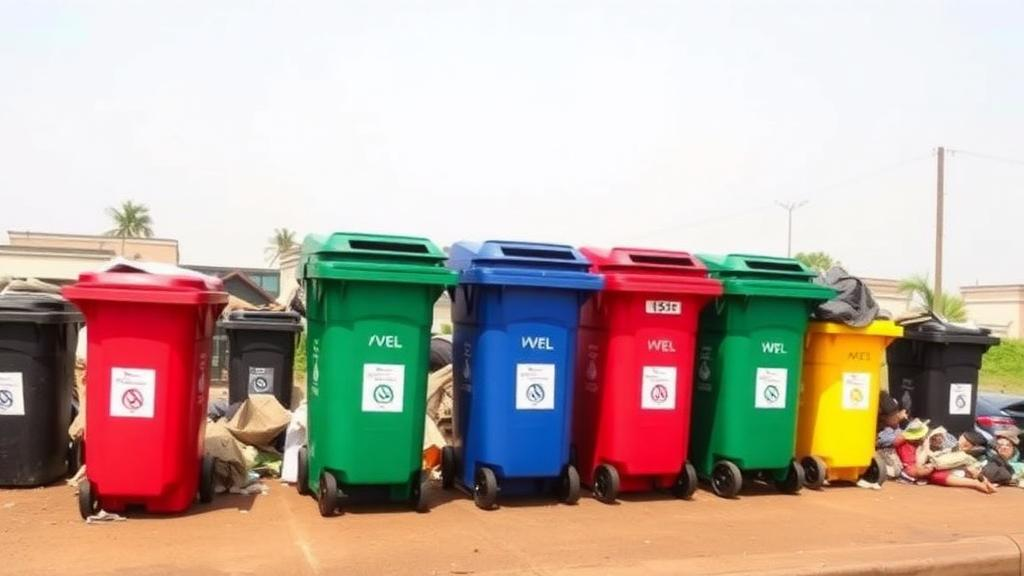
Municipal solid waste is one of the most visible failures of urban governance in the developing world, and few places illustrate the crisis more starkly than Senegal. In the capital region of Dakar, rapid population growth, expanding informal settlements, and chronically underfunded collection systems have combined to overwhelm conventional waste infrastructure, producing economic losses, public health hazards, and environmental degradation. A new systematic review published in the journal Discover Sustainability argues that the solution may lie not in simply importing more trucks and landfills, but in a coordinated digital transformation that researchers are calling Waste Management 4.0. The study, led by Amadou Thiam with Ousmane Diallo and EL Hadji Malick Ndoye of the LI3 Laboratory at Assane Seck University of Ziguinchor, maps the enabling technologies of this transformation and tests their fit against the gritty realities of Senegalese cities.
The research pursues two complementary objectives. The first is a systematic literature review conducted according to the PRISMA 2020 guidelines, the international standard for transparent evidence synthesis. The authors searched five major academic databases, namely Scopus, Web of Science, ScienceDirect, IEEE Xplore, and SpringerLink, covering the period from 2016 to 2026. The initial sweep returned 850 records, which the team filtered against explicit eligibility criteria until 72 studies remained for qualitative synthesis. That funnel matters: it means the findings rest on a curated body of peer-reviewed evidence rather than a loose assembly of pilot projects and vendor claims. The second objective is more unusual for a technology review. The researchers confronted their literature findings with empirical data gathered on the ground, through a household survey in the Dakar metropolitan area, to see whether the digital tools celebrated in academic papers could plausibly take root in a resource-constrained West African urban context.
At the heart of the review is a taxonomy of emerging technologies organized across the entire waste management life cycle, from generation and source separation through collection, transport, sorting, treatment, and final disposal. The Internet of Things features prominently at the front end of the chain. Ultrasonic fill-level sensors mounted inside bins and containers can report how full they are in real time, allowing municipalities to replace fixed collection schedules with demand-driven dispatch. The authors’ comparative analysis shows that such sensing, combined with route optimization algorithms, can substantially reduce the distance traveled by collection fleets, with corresponding savings in fuel, vehicle wear, and greenhouse gas emissions. In cities where collection can account for the majority of a waste budget, those algorithmic gains translate directly into freed-up resources for other services.
Artificial intelligence occupies the middle of the life cycle. Machine learning and deep learning models, particularly convolutional neural networks, have demonstrated strong performance in classifying waste streams from camera imagery, enabling automated sorting at material recovery facilities and even citizen-facing applications that identify recyclable items through a smartphone camera. The review’s comparative assessment of algorithmic performance is one of its technical contributions, cataloguing accuracy figures, training data requirements, and computational demands across published models. Robotics appears at the sorting stage, where robotic arms guided by computer vision can pick targeted materials from moving conveyor belts at speeds and consistency beyond human sorters, while reducing occupational exposure to hazardous waste. Next-generation communication networks, including low-power wide-area protocols and cellular technologies, form the connective tissue that lets sensors, vehicles, and processing facilities exchange data reliably and affordably.
Yet the review is deliberately unsentimental about the barriers. The authors offer a critical assessment of interoperability problems, since sensors, platforms, and analytics software from different vendors frequently cannot communicate with one another, locking cities into fragmented systems. Cost remains a decisive constraint: the capital expenditure for sensor networks, connectivity, and data infrastructure is difficult to justify in municipalities that struggle to fund basic collection. Energy consumption is a further concern, because battery-powered devices deployed across a hot, dusty urban environment require maintenance cycles and power strategies that are rarely discussed in technology-focused papers. The study’s insistence on a cost-aware, energy-aware reading of the literature is what separates it from promotional accounts of smart city technology, and it is precisely this framing that makes the findings relevant beyond Senegal to developing countries generally.
The empirical half of the study provides the socio-technical baseline that most reviews lack. The field survey collected 435 valid household responses across ten neighborhoods of Dakar, capturing waste generation rates, source-separation practices, access to collection services, and citizens’ stated willingness to adopt digital tools. This baseline is essential for calibrating any smart system: route optimization algorithms are only as good as the generation and composition data feeding them, and public acceptance of pay-as-you-throw schemes or reporting apps depends on trust in existing services. The survey also grounds the analysis in a specific geography, including the Mbeubeuss landfill, Dakar’s principal disposal site, which exemplifies the environmental and social pressures that conventional management has failed to resolve. The authors are careful to state that the survey informs their framework but does not constitute a field validation of it, an honest distinction that strengthens rather than weakens the work’s credibility.
From the synthesis of literature and field data, the researchers propose a seven-layer conceptual framework tailored to Senegalese realities. While the full architecture is detailed in the paper, its logic is that of a layered socio-technical system: physical sensing and actuation at the bottom, communication and data management above, analytics and decision support in the middle layers, and governance, financing, and citizen engagement at the top. The layering is not decorative. It reflects a central finding of the review, namely that technology failures in developing-country waste systems are rarely purely technical. A sensor network without a maintenance budget, a routing algorithm without reliable vehicle data, or a citizen app without digital literacy support will each fail for reasons that no amount of algorithmic sophistication can fix. The framework therefore treats institutional capacity and community participation as structural components, not afterthoughts.
The practical implication is a phased deployment roadmap for decision-makers. Rather than advocating a big-bang smart city rollout, the authors’ cost-aware approach suggests starting where digital interventions deliver the clearest returns, such as fill-level sensing and route optimization for collection fleets, before progressing to automated sorting, treatment monitoring, and landfill management systems. Each phase generates data and operational experience that de-risks the next, an incremental logic well suited to municipalities with limited capital and competing priorities. For Dakar, where the gap between waste generated and waste collected continues to widen, such sequencing could mean that the first digital investments pay measurable dividends within existing budgets instead of waiting for infrastructure that may never arrive.
The authors are transparent about the study’s main limitation: the proposed framework has not yet undergone pilot-scale field validation. The household survey provides a baseline, but no sensor has been deployed, no route has been optimized, and no sorting robot has been tested under Dakar’s conditions. That gap defines the research agenda that follows. Pilot deployments at Mbeubeuss or in selected collection districts would test whether the performance figures reported in the international literature survive contact with heat, dust, intermittent power, and informal waste-sector dynamics. The study was funded by Assane Seck University of Ziguinchor and its LI3 Laboratory, and the authors declare no competing interests, which situates the work as independent academic analysis rather than technology advocacy.
What makes this research resonate beyond its national case is its reframing of the smart waste debate. Much of the global conversation about Waste Management 4.0 has been written by and for wealthy cities, where the marginal gains of optimization are measured against systems that already function. Thiam, Diallo, and Ndoye invert that perspective, asking which digital technologies can deliver the greatest leverage where the baseline system is broken, budgets are thin, and the consequences of failure are borne by the poorest households. Their answer, grounded in 72 rigorously selected studies and 435 household voices from Dakar, is that the technology exists and the economics can work, but only if deployment is phased, contextually adapted, and honest about interoperability, cost, and energy constraints. For the rapidly urbanizing cities of the developing world, that may be the most important roadmap yet offered for turning the fourth industrial revolution into cleaner streets.
Subject of Research: Enabling technologies for smart municipal solid waste management in developing countries, with a contextual framework for Senegal
Article Title: Enabling technologies for waste management 4.0 in developing countries a systematic review and contextual framework for Senegal
Article References: Enabling technologies for waste management 4.0 in developing countries a systematic review and contextual framework for Senegal. (n.d.). https://doi.org/10.1007/s43621-026-04901-3
Image Credits: AI Generated
DOI: 10.1007/s43621-026-04901-3
Keywords: Waste Management 4.0, municipal solid waste, Internet of Things, artificial intelligence, robotics, smart waste collection, route optimization, Senegal, Dakar, developing countries, systematic review, sustainable development
Cite Scienmag News
Denise Maddox. (October 13, 2026). Smart Bins and AI: Can Waste Management 4.0 Rescue Senegal’s Overflowing Cities? Scienmag. https://scienmag.com/smart-bins-and-ai-can-waste-management-4-0-rescue-senegals-overflowing-cities/
Denise Maddox. "Smart Bins and AI: Can Waste Management 4.0 Rescue Senegal’s Overflowing Cities?" Scienmag, 13 October 2026, https://scienmag.com/smart-bins-and-ai-can-waste-management-4-0-rescue-senegals-overflowing-cities/. Accessed 13 October 2026.
Denise Maddox. "Smart Bins and AI: Can Waste Management 4.0 Rescue Senegal’s Overflowing Cities?" Scienmag. October 13, 2026. https://scienmag.com/smart-bins-and-ai-can-waste-management-4-0-rescue-senegals-overflowing-cities/


