


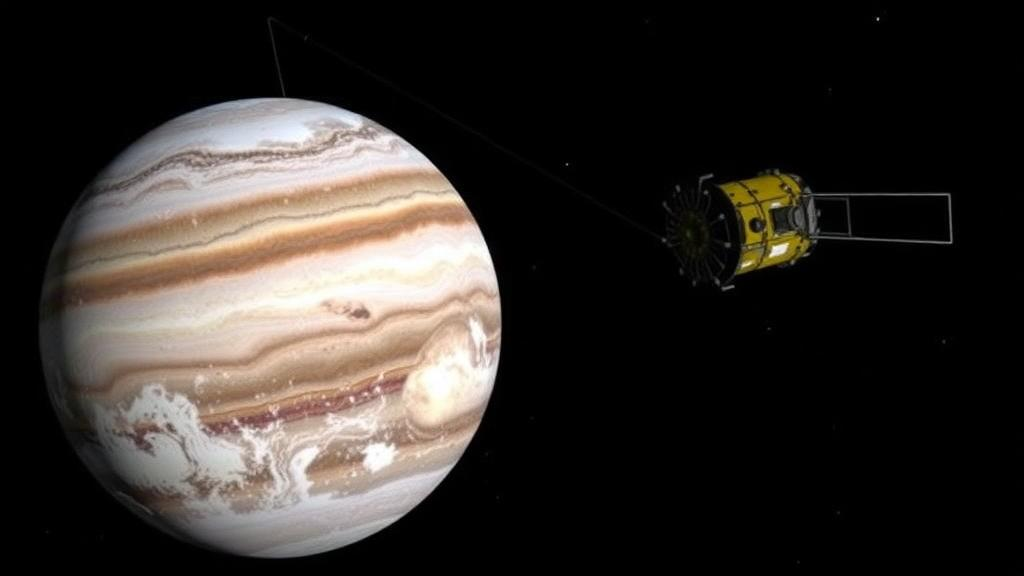
When Europe’s Jupiter-bound spacecraft swung past its home planet in August 2024, it did more than steal gravitational momentum for the long cruise to the outer solar system. It also delivered a spectacular shakedown test of the most ambitious camera ever aimed at the giant planets. JANUS, the high-resolution camera aboard ESA’s JUICE mission, turned its optics on Earth during the Lunar–Earth Gravity Assist, capturing both intimate close-up views of our planet’s day and night sides and a distant, low-resolution portrait of the whole globe. A team led by Ricardo Hueso of the University of the Basque Country and colleagues has now published a detailed analysis of these observations in the journal Annales Geophysicae, demonstrating that the instrument is performing exactly as designed and that its Earth images already contain valuable lessons for the atmospheric mysteries of Jupiter that await.
JANUS, whose full name Jovis, Amorum ac Natorum Undique Scrutator translates roughly as a scrutinizer of Jupiter, his loves and his children from all sides, is the workhorse imaging system on JUICE, the JUpiter ICy moons Explorer. The spacecraft launched in April 2023 on a mission that will ultimately deliver it to Jupiter in 2031, where it will spend years studying the gas giant and three of its large icy moons: Ganymede, Callisto and Europa. Before it can begin that science campaign, however, JUICE must execute a series of gravity assists, using the masses of Earth, the Moon and Venus to bend its trajectory and build up the enormous velocity needed to reach the outer solar system. The August 2024 Lunar–Earth flyby was the first of these crucial maneuvers, and mission planners recognized early on that it offered a rare opportunity to test the spacecraft’s instruments against a familiar target.
The choice of Earth as a calibration and validation target is more scientifically astute than it might first appear. Earth is, in effect, a rehearsal stage for planetary atmospheric imaging. Its cloud systems, storm dynamics, aerosol layers and day–night contrast phenomena operate under physical principles that also govern the atmospheres of the giant planets, albeit at different temperatures, compositions and rotation rates. By pointing JANUS at terrestrial weather systems, the science team could exercise the camera’s full observational chain, from pointing accuracy and exposure control to onboard data handling and image calibration, while simultaneously collecting genuine atmospheric data. The result is a two-for-one payoff: the instrument is validated for Jupiter, and researchers gain a benchmark dataset of Earth observations made with the very same hardware they will later use on the king of planets.
During the close portion of the flyby, JANUS acquired images of both the night side and the day side of Earth, a demanding test because the illumination conditions differ by many orders of magnitude. Day-side imaging exercises the camera’s ability to handle bright, sunlit scenes with fine spatial detail, revealing cloud structures, storm systems and surface features with the kind of contrast that will be essential for tracking Jovian weather. Night-side imaging, by contrast, pushes the sensitivity limits of the detector and tests how well the instrument can capture faint phenomena such as airglow, lightning-like flashes and the subtle glow of the upper atmosphere. Both regimes will matter enormously at Jupiter, where the planet’s rapid rotation, deep cloud decks and powerful auroral emissions create scenes of extreme dynamic range that few cameras in history have been asked to record.
The close flyby images allowed the team to characterize specific atmospheric systems in detail, and the analysis published in Annales Geophysicae focuses precisely on these features as relevant examples for future Jovian studies. Terrestrial cyclones, frontal systems and convective storm clusters observed by JANUS serve as controlled case studies: researchers know the ground truth of Earth’s weather from satellites, radar and surface observations, so they can assess how well JANUS resolves and measures such phenomena. When the same camera later images Jupiter’s anticyclones, its turbulent jet streams and its towering convective outbreaks, the team will be able to interpret the data with confidence grounded in this terrestrial validation. The methodology mirrors a long tradition in planetary science, in which flyby targets are used to cross-calibrate instruments against well-understood references before the main mission begins.
Beyond the close-ups, JUICE also captured a distant view of Earth that produced a striking low-resolution portrait of the entire planet. Such whole-disk images may seem less glamorous than detailed cloud mosaics, but they serve a distinct technical purpose. They test the camera’s performance at long range, verifying pointing, focus and radiometric calibration under conditions that resemble, in some respects, the approach phase at Jupiter and the observation of small moons from orbit. Whole-disk imaging also provides context for the higher-resolution work, and the Earth portrait stands as a poignant scientific artifact in its own right, a reminder of the pale blue dot that every interplanetary mission carries with it in memory as it ventures outward.
The validation exercise matters because JANUS faces one of the most challenging imaging assignments ever attempted at Jupiter. The planet’s atmosphere is a seething laboratory of fluid dynamics: alternating east–west jet streams reach hundreds of kilometers per hour, storms the size of Earth persist for decades or centuries, and lightning discharges far more energetic than any terrestrial flash illuminate the deep cloud layers. Understanding these phenomena requires high-resolution, time-resolved imaging that can track cloud motions and measure wind fields, and it demands a camera whose calibration is known with exquisite precision. Any systematic error in JANUS’s response, whether in geometric distortion, radiometric sensitivity or temporal stability, would propagate directly into errors in derived wind speeds and cloud heights. The Earth observations provide the empirical foundation for eliminating those errors before the spacecraft arrives at its destination.
There is also a deeper scientific continuity at play. Comparative planetology thrives on observing the same physical processes in different planetary settings, and Earth offers the most densely observed atmosphere in the solar system. Convective storms on Earth, driven by water condensation and latent heat release, have direct analogues in Jupiter’s water-cloud thunderstorms, which are thought to power the planet’s most vigorous eruptions. Cyclonic vortices on Earth can be compared with Jovian oval storms to test theories of vortex stability and decay. Even the night-side airglow observed by JANUS connects to upper-atmosphere physics that operates on Jupiter as well. By building a JANUS dataset of well-characterized terrestrial phenomena, the team has created a Rosetta stone that will help translate between what we know about Earth’s atmosphere and what we hope to learn about Jupiter’s.
The August 2024 flyby itself was a feat of celestial navigation. JUICE threaded a path around the Earth–Moon system, using the combined gravitational pull of both bodies to reshape its orbit, a maneuver type so delicate that only a handful of spacecraft have ever attempted it. Every instrument that observed during the encounter had to operate autonomously, with precise timing, because the geometry of a fast flyby leaves no room for second chances. That JANUS delivered calibrated, scientifically useful images of both the day and night sides of Earth on the first attempt speaks to the maturity of the instrument design and the thoroughness of the team led by Hueso, Antuñano, Lara and their international collaborators spanning Spain, Germany, Italy, France, Israel, Japan, the United Kingdom and the European Space Agency itself.
As JUICE continues its interplanetary cruise, with further gravity assists still ahead before its 2031 arrival at Jupiter, the JANUS Earth observations will remain a touchstone for the mission’s imaging science. They confirm that the camera is ready to tackle the gas giant’s atmosphere, and they have already begun producing science, offering fresh perspectives on our own planet from a vantage point few cameras have shared. When JANUS finally turns its gaze from Earth to Jupiter, every cloud deck it resolves and every storm it tracks will rest on the foundation laid during those August days in 2024, when a Jupiter camera came home briefly, looked at its makers’ world, and proved itself worthy of the giant that awaits.
Subject of Research: JANUS camera observations of Earth during the JUICE mission's 2024 Lunar–Earth gravity assist as validation for imaging Jupiter's atmosphere
Article Title: JUICE-JANUS observations of Earth in preparation for the JANUS investigation of Jupiter's atmosphere
Article References: Hueso, R., Antuñano, A., Lara, L. M., Stephan, K., Zinzi, A., Coustenis, A., Yair, Y., Sato, M., Haruyama, J., Simon, A., Tubiana, C., Penasa, L., Agostini, L., Lucchetti, A., Aboudan, A., Aye, M., Kersten, E., Matz, K.-D., Politi, R., … Palumbo, P. (2026). JUICE-JANUS observations of Earth in preparation for the JANUS investigation of Jupiter's atmosphere. Annales Geophysicae, 44(2), 1043-1073. https://doi.org/10.5194/angeo-44-1043-2026
Image Credits: AI Generated
DOI: 10.5194/angeo-44-1043-2026
Keywords: JUICE, JANUS, ESA, Jupiter, Earth flyby, gravity assist, planetary science, atmospheric science, space instrumentation, camera calibration, comparative planetology, Annales Geophysicae
Cite Scienmag News
Grant Pearson. (October 13, 2026). ESA’s JUICE Probe Photographed Earth on Its Way to Jupiter, Proving Its Camera Is Ready. Scienmag. https://scienmag.com/esas-juice-probe-photographed-earth-on-its-way-to-jupiter-proving-its-camera-is-ready/
Grant Pearson. "ESA’s JUICE Probe Photographed Earth on Its Way to Jupiter, Proving Its Camera Is Ready." Scienmag, 13 October 2026, https://scienmag.com/esas-juice-probe-photographed-earth-on-its-way-to-jupiter-proving-its-camera-is-ready/. Accessed 13 October 2026.
Grant Pearson. "ESA’s JUICE Probe Photographed Earth on Its Way to Jupiter, Proving Its Camera Is Ready." Scienmag. October 13, 2026. https://scienmag.com/esas-juice-probe-photographed-earth-on-its-way-to-jupiter-proving-its-camera-is-ready/


