In the coastal city of Susaki in Kochi Prefecture, Japan, a sewage treatment plant has quietly completed one of the most demanding tests in environmental engineering: thirty months of continuous, full-scale operation of a novel reactor technology that had never before been deployed at this scale for direct domestic sewage treatment in a temperate country. The results, published in Environmental Science and Pollution Research, show that a downflow hanging sponge (DHS) system can match the effluent quality of conventional activated sludge while consuming 83 percent less process-specific power, producing less excess sludge, and — perhaps most remarkably — shrinking its own treatment capacity on demand as the population it serves continues to decline.
The DHS concept is deceptively simple. Instead of forcing air through wastewater in energy-hungry aeration tanks, the system lets wastewater trickle downward over stacked cubes of polyurethane sponge, each enclosed in a cylindrical net frame. The sponges act as biomass carriers, hosting dense microbial communities that degrade organic matter and convert ammonium to nitrate. Because the biomass clings to the sponge rather than floating freely, the reactor retains very high sludge concentrations with sludge retention times exceeding 100 days, and the oxygen the microbes need is supplied passively by natural ventilation rather than by blowers. Oxygen gradients develop within each sponge cube, creating an aerobic outer layer and oxygen-limited inner zones where denitrification can proceed — meaning a single reactor can perform both nitrification and partial nitrogen removal.
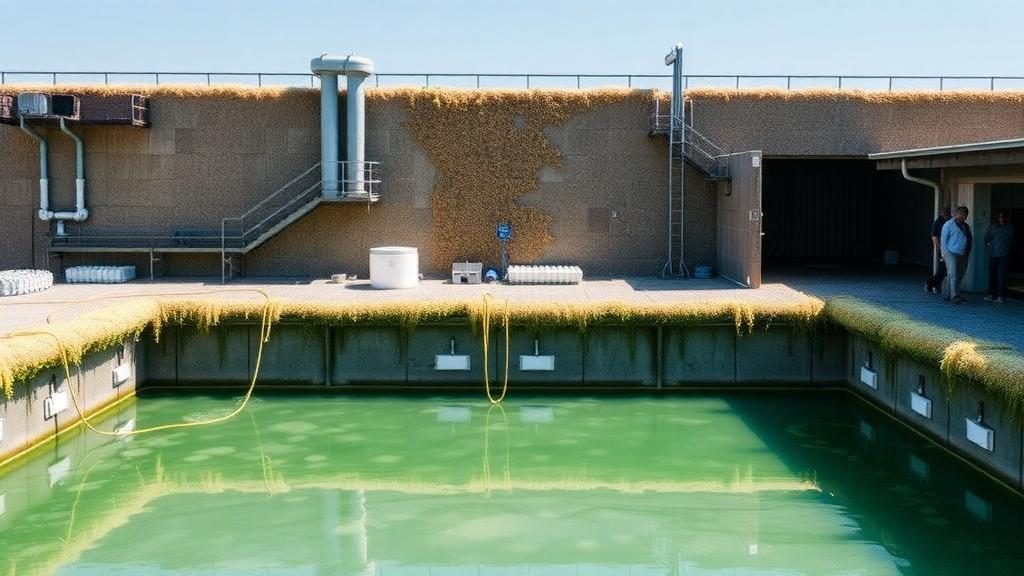
What makes the Susaki installation scientifically significant is its configuration and its context. The plant replaced an extended-aeration activated sludge process originally designed in 1976 for 1,800 cubic meters per day. With Susaki’s population shrinking and little prospect of expanding sewer connections, the new DHS system was deliberately designed for just 500 cubic meters per day, with an average operational flow of 365 cubic meters per day. The reactor comprises ten identical units operated in parallel, each consisting of four stacked segments filled with sponge carriers, giving a total sponge volume of 64 cubic meters and a theoretical hydraulic retention time of roughly 4.2 hours. Downstream, an aerated moving bed biological filter filled with anthracite media polishes the DHS effluent before final chlorination and discharge into the Mitarai River.
The monitoring program was rigorous. From June 2021 through December 2023, researchers from the National Institute for Environmental Studies and their collaborators collected weekly grab samples of raw sewage and DHS effluent, tracking dichromate-based chemical oxygen demand, biochemical oxygen demand, total suspended solids, ammonium, nitrate, total nitrogen, and fecal indicator bacteria. The influent was typical medium-strength domestic sewage, with a chemical oxygen demand of 368 milligrams per liter and a biochemical oxygen demand of 134 milligrams per liter. Against this feed, the DHS reactor consistently delivered effluent with 77 to 85 percent removal of organic pollutants and a 1.5 log10 reduction in Escherichia coli, comfortably meeting Japanese discharge standards even before the polishing stage. The full treatment train pushed final effluent to a biochemical oxygen demand of just 9 milligrams per liter and ammonium of 3 milligrams of nitrogen per liter.
Winter posed the first stress test. Between December 2021 and March 2022, wastewater temperatures generally stayed below 20 degrees Celsius and influent chemical oxygen demand rose. Organic removal dipped slightly — effluent chemical oxygen demand crept from 45 to 66 milligrams per liter — but the downstream filter kept the plant compliant, and ammonium oxidation remained comparatively stable. This resilience matters because most previous full-scale DHS experience had been gathered in tropical or subtropical conditions, in countries such as India, Egypt, and Thailand, typically as a post-treatment step after anaerobic reactors. Susaki provided the first extended evidence that the technology can weather a temperate winter while directly treating raw domestic sewage.
The second test was deliberate self-shrinking. From April to December 2022, the operators intermittently shut down one of the ten units in weekly rotations, reducing the active sponge volume to 57.6 cubic meters and the theoretical retention time to 3.8 hours, simulating the capacity reductions that declining inflows will eventually demand. Effluent quality barely budged: chemical oxygen demand, biochemical oxygen demand, and ammonium remained essentially indistinguishable from full-capacity operation. Laboratory experiments on sponge carriers removed from service showed that roughly 30 percent of the attached sludge was lost over eight days of feed stoppage, driven by endogenous respiration — microbes digesting their own reserves — yet the volatile fraction of the sludge recovered within two weeks of restarting, indicating rapid biomass regrowth. The parallel-unit architecture thus functions as a dial, allowing operators to match treatment capacity to demand without sacrificing performance.
The third modification was almost embarrassingly low-tech. In March 2023, engineers slid a polyurethane sponge sheet about 20 millimeters thick directly beneath the wastewater distributor at the top of the reactor, above the first sponge-filled segment. The intent was to spread the incoming flow more evenly and eliminate channeling. The effect on nitrification was dramatic. Ammonium in the DHS effluent fell from 16 to 19 milligrams of nitrogen per liter to about 9, nitrate accumulated in the lower segments as expected from intensified oxidation, and statistical analysis confirmed that ammonium removal efficiency rose significantly — from 37 percent during normal operation to 66 percent — even though the ammonium loading itself did not differ among periods. Dissolved oxygen across the reactor segments climbed from 4.2 to 5.0 milligrams per liter to 5.5 to 7.1, and oxidation-reduction potential shifted from slightly negative to strongly positive values. Tracer tests showed the measured hydraulic retention time rising from 89 to 92 percent of the design value, confirming improved flow dispersion.
The energy accounting is where the story becomes genuinely striking. Under the old activated sludge process, aeration blowers, foam water pumps, and diffused-air equipment dominated electricity use, and because a minimum aeration rate must be maintained regardless of flow, the specific power consumption rose as flows fell. In 2016 the conventional process consumed 1.803 kilowatt-hours per cubic meter of treated water. The DHS system, by contrast, used 0.473 kilowatt-hours per cubic meter in 2023, and excluding equipment shared by both configurations, the process-specific figure was 0.270 kilowatt-hours per cubic meter — approximately 83 percent lower. Sludge handling improved too: dewatered sludge cake production fell by half, from 6,195 to 3,145 kilograms per month, aided by better dewaterability and cake moisture dropping from 82 to 74 percent. Macrofauna such as drain fly larvae colonizing the sponge media likely contributed to sludge reduction through predation, a quirk of trickling-filter ecology that the researchers note deserves further study.
The broader significance extends well beyond one small Japanese city. Japan’s sewerage network now covers 93.7 percent of the population, but roughly 30 percent of the country’s 5,353 rural community treatment facilities have operated for more than three decades, and nationwide sewage volumes have been falling since fiscal year 2015 as regional populations decline. Conventional activated sludge and membrane bioreactor systems fix their capacity in tank volume, making it difficult to cut costs and energy use when inflow drops. The DHS system offers a different model: modular units that can be switched off in rotation, passive aeration that slashes electricity demand, biomass that survives outages and recovers quickly, and a reactor height of about five meters that conceptually fits within the footprint of existing aeration tanks during facility renewal. Maintenance requirements proved modest — mainly annual manual cleaning of distributor ports to prevent clogging.
The authors are careful about limits. The findings come from a single full-scale plant under site-specific conditions, microbial communities were not analyzed in depth, and the previous facility’s oversized equipment somewhat flatters the energy comparison. Still, the thirty-month record from Susaki demonstrates something rare in wastewater engineering: a technology that gets smaller, cheaper, and cleaner in step with the community it serves. For thousands of aging facilities in Japan and countless decentralized plants worldwide facing shrinking budgets and shrinking populations, the humble sponge may prove to be an unexpectedly powerful answer.
Subject of Research: Long-term full-scale performance of a parallel-unit downflow hanging sponge wastewater treatment system in Japan
Article Title: Long-term monitoring of a full-scale parallel-unit downflow hanging sponge system with adaptive capacity for fluctuating wastewater flows in Japan
Article References: Takemura, Y., Yamazaki, S., Matsueda, T., Ohmori, S., Nagano, A., Taniwaki, M., Tomioka, N., Aoki, M., & Syutsubo, K. (2026). Long-term monitoring of a full-scale parallel-unit downflow hanging sponge system with adaptive capacity for fluctuating wastewater flows in Japan. Environmental Science and Pollution Research. https://doi.org/10.1007/s11356-026-38300-y
Image Credits: AI Generated
DOI: 10.1007/s11356-026-38300-y
Keywords: downflow hanging sponge, wastewater treatment, decentralized sewage treatment, energy efficiency, nitrification, excess sludge reduction, population decline, Japan, activated sludge alternative, hydraulic retention time, polyurethane sponge media, moving bed biological filter
Cite Scienmag News
Violet Maxwell. (October 13, 2026). Sponge-Powered Sewage Plant in Japan Cuts Energy Use by 83% While Shrinking With Its Population. Scienmag. https://scienmag.com/sponge-powered-sewage-plant-in-japan-cuts-energy-use-by-83-while-shrinking-with-its-population/
Violet Maxwell. "Sponge-Powered Sewage Plant in Japan Cuts Energy Use by 83% While Shrinking With Its Population." Scienmag, 13 October 2026, https://scienmag.com/sponge-powered-sewage-plant-in-japan-cuts-energy-use-by-83-while-shrinking-with-its-population/. Accessed 13 October 2026.
Violet Maxwell. "Sponge-Powered Sewage Plant in Japan Cuts Energy Use by 83% While Shrinking With Its Population." Scienmag. October 13, 2026. https://scienmag.com/sponge-powered-sewage-plant-in-japan-cuts-energy-use-by-83-while-shrinking-with-its-population/