


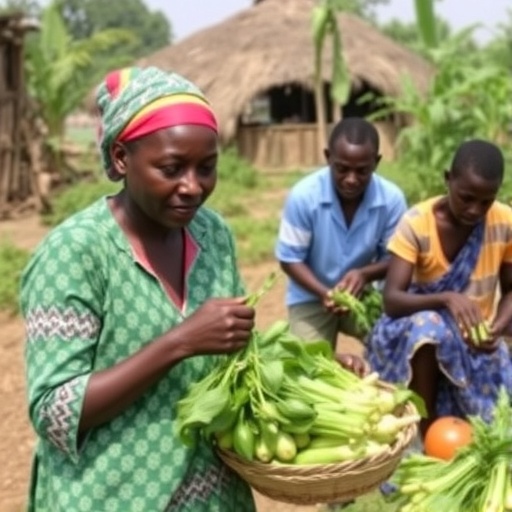
In recent years, agriculture has emerged as a critical sector affecting poverty alleviation, food security, and economic development, particularly in sub-Saharan Africa. The role of smallholder farmers, who constitute a significant portion of the agricultural workforce, cannot be overstated. A recent study spearheaded by Iddrisu, Nkegbe, and Mabe provides innovative insights into the market participation intensity of smallholder farmers in the Northern Region of Ghana. This research highlights the mechanisms by which these farmers engage with markets, the factors influencing their participation, and the implications for livelihoods and local economies.
The research methodology employed by the authors is both comprehensive and rigorous, involving both qualitative and quantitative approaches. It seeks to unravel the complexities surrounding market engagement among smallholder farmers, who often face multifaceted challenges. Factors such as access to information, financial resources, and market infrastructure play a pivotal role in determining the extent to which these farmers can participate in local and regional markets. The inclusivity of the methodologies adopted illustrates the nuanced understanding required to assess the realities of agricultural engagement in economically vulnerable regions.
One of the primary findings of the study is that market participation intensity is not uniform among all smallholder farmers. Variations exist based on factors such as farm size, crop type, and individual farmer characteristics. The research emphasizes that those who are more diversified in their agricultural practices tend to engage more vigorously in market activities. This diversification not only provides a safety net against crop failure but also opens multiple avenues for income generation, allowing farmers to meet their household needs more effectively.
Understanding the barriers to market participation is crucial for designing targeted interventions that can enhance farmers’ engagement with markets. The authors identify several obstacles, including inadequate infrastructure, poor access to credit, and limited market information. These barriers restrict the ability of farmers to connect with potential buyers and negotiate fair prices for their produce. Without appropriate support measures, the cycle of low market participation and poor agricultural performance may perpetuate, impacting overall economic growth in the region.
Furthermore, the research spotlight on the role of social networks brings to light the importance of community ties in improving market participation. Smallholder farmers who are part of cooperative groups or farmer associations demonstrated higher levels of market engagement. These networks offer not only a support system but also collective bargaining power, enabling farmers to secure better prices for their products. The collaborative model presented by the study serves as a potential roadmap for developing agricultural policies that foster community cooperation.
Market participation is further influenced by external factors such as government policy and economic conditions. The researchers stress the need for coherent policies that prioritize the agricultural sector, particularly smallholder farmers who are the backbone of food production in many regions. Investment in rural infrastructure, education, and access to technology could enhance market links and ultimately lead to increased productivity and profitability for smallholder farmers.
Additionally, the findings underscore the impact of agricultural extension services on market participation. Extension services, which offer training and resource distribution, can significantly enhance farmers’ knowledge about market trends and best practices. The research indicates that farmers who actively engage with these services tend to be more proactive in their market endeavors, which not only bolsters their income but also improves their overall agricultural effectiveness.
Technological advancements play a key role in ameliorating the challenges faced by smallholder farmers. Digital platforms that provide real-time market information are gaining traction in parts of Africa and show promise in bridging the information gap. Such tools allow farmers to make informed decisions about when and where to sell their produce, ultimately contributing to their market participation intensity. The study expresses optimism about the potential of technology to transform agricultural practices, remove inefficiencies, and create a more equitable market landscape.
Climate change presents an additional layer of complexity that smallholder farmers must navigate. Changes in weather patterns impact crop yields and, consequently, farmers’ ability to participate in markets effectively. The authors advocate for sustainable farming practices and climate-smart agriculture as essential strategies for enhancing resilience among smallholder farmers. Adopting these practices can improve both agricultural output and environmental stewardship, ensuring long-term sustainability.
In conclusion, the research by Iddrisu, Nkegbe, and Mabe sheds light on the intricate dynamics of market participation among smallholder farmers in the Northern Region of Ghana. It calls attention to the need for integrated approaches that consider the multifactorial influences on market engagement. As agricultural practices evolve, fostering a supportive ecosystem for smallholders can lead to enhanced food security and economic development in the region.
The findings of this study have enduring implications for stakeholders committed to advancing agricultural development and enhancing the livelihoods of smallholder farmers. Policymakers, development agencies, and community organizations can leverage the insights provided to design interventions that address the root causes of low market participation. Emphasizing collaboration, education, and technological innovation will be key to fostering a more inclusive agricultural sector.
Ultimately, the work undertaken by the authors contributes significantly to the existing academic literature while offering actionable solutions that can promote the resilience and economic prosperity of smallholder farmers in Ghana and beyond. By recognizing and addressing the challenges faced by this critical demographic, stakeholders can pave the way for sustainable agricultural practices and economic transformation across the region.
Iddrisu, A., Nkegbe, P.K. & Mabe, F.N. Market participation intensity of smallholder farmers in the Northern Region of Ghana. Discov Agric 3, 236 (2025). https://doi.org/10.1007/s44279-025-00417-y
Cite Scienmag News
Alan Morgan. (November 6, 2025). Smallholder Farmers’ Market Engagement in Northern Ghana. Scienmag. https://scienmag.com/smallholder-farmers-market-engagement-in-northern-ghana/
Alan Morgan. "Smallholder Farmers’ Market Engagement in Northern Ghana." Scienmag, 6 November 2025, https://scienmag.com/smallholder-farmers-market-engagement-in-northern-ghana/. Accessed 4 September 2026.
Alan Morgan. "Smallholder Farmers’ Market Engagement in Northern Ghana." Scienmag. November 6, 2025. https://scienmag.com/smallholder-farmers-market-engagement-in-northern-ghana/


