


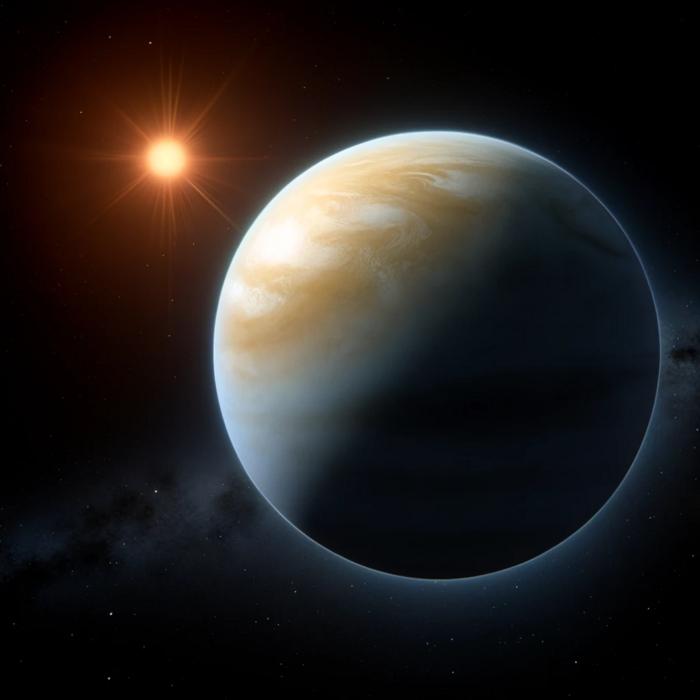
A surprising yellow haze of sulfur dioxide in the atmosphere of a gas “dwarf” exoplanet about 96 light years away from our own solar system makes the planet a prime target for scientists trying to understand how worlds are formed.

Credit: University of Wisconsin–Madison
A surprising yellow haze of sulfur dioxide in the atmosphere of a gas “dwarf” exoplanet about 96 light years away from our own solar system makes the planet a prime target for scientists trying to understand how worlds are formed.
Astronomers discovered the planet, GJ 3470 b, in 2012 when the planet’s shadow crossed the star it orbits. GJ 3470 b is located in the constellation Cancer and is about half the size of Neptune, with a mass 10 times that of Earth. In the intervening years, researchers have compiled data on the planet using the Hubble and Spitzer space telescopes, culminating in a pair of recent observations with the James Webb Space Telescope.
Planets outside our solar system — called exoplanets — like GJ 3470 b are interesting subjects for researchers wondering how planets are created. Ideally, astronomers capture light from a star that shines through the edge of the planet’s atmosphere. This allows them to assemble a measure of the component light, or its spectrum, a readout marked by spikes and dips characteristic of the interesting molecules found in that atmosphere.
“The thing is, everybody looks at these planets, and often everybody sees flat lines,” says University of Wisconsin–Madison astronomy professor Thomas Beatty. “But when we looked at this planet, we really didn’t get a flat line.”
They saw evidence of water, carbon dioxide, methane and sulfur dioxide, findings Beatty presented in Madison today at the 244th meeting of the American Astronomical Society and that he will soon publish in Astrophysical Journal Letters with co-authors from Arizona State University, the University of Arizona, NASA’s Ames Research Center and other organizations.
GJ 3470 b is the lightest and coldest (averaging a mere 325 degrees Celsius, or more than 600 Fahrenheit) exoplanet to harbor sulfur dioxide. The compound is likely a sign of the churn of active chemical reactions in the planet’s atmosphere, created when radiation from its nearby star blasts apart the components of hydrogen sulfide, which then go looking for new molecular partners.
“We didn’t think we’d see sulfur dioxide on planets this small, and it’s exciting to see this new molecule in a place we didn’t expect, since it gives us a new way to figure out how these planets formed,” says Beatty, who worked as an instrument scientist on the James Webb Space Telescope before joining the UW–Madison faculty. “And small planets are especially interesting, because their compositions are really dependent on how the planet-formation process happened.”
Divining that process is one focus of Beatty’s research. It’s a little like spying on a baker only at the beginning of their work and then again when it’s nearly time for dessert.
“Laid out on our table, we have all the ingredients that go into a cake, and we have a finished cake,” he says. “Now, can we figure out the recipe — the steps that turned the raw materials into the end product — by measuring what’s in the cake?”
Astronomers like Beatty hope they will be able to do just that: figure out the recipe for planet formation by looking at what’s in exoplanets.
“Discovering sulfur dioxide in a planet as small as GJ 3470 b gives us one more important item on the planet formation ingredient list,” says Beatty.
In the case of GJ 3470 b, there are also other interesting features that might help fill out that recipe. The planet’s orbit around its star takes it nearly over the star’s poles, which is to say that it’s circling at a 90-degree angle to the expected path of planets in the system. It’s also surprisingly close to the star, close enough that the light from its star is blowing copious amounts of GJ 3470 b’s atmosphere away into space. The planet has probably lost about 40 percent of its mass since it was formed.
The close-in, off-kilter orbit is a sign that GJ 3470 b used to be somewhere else in its system, and at some point, the planet became entangled with the gravity of another and was pulled into a new path that eventually settled it in a different neighborhood.
“That migration history that led to this polar orbit and the loss of all this mass — those are things we don’t typically know about other exoplanet targets we’re looking at,” Beatty says. “Those are important steps in the recipe that created this particular planet and can help us understand how planets like it are made.”
With further analysis of the ingredients that remain in the planet’s atmosphere and the help of colleagues like those in UW–Madison’s Wisconsin Center for Origins Research who specialize in proto-planetary disks and migration dynamics, GJ 3470 b may help Beatty and others understand how planets like it got to be so appetizing — at least from the astronomers’ perspective.
This research was supported by grants from NASA.
Cite Scienmag News
Grant Pearson. (June 10, 2024). Small, cool and sulfurous exoplanet may help write recipe for planetary formation. Scienmag. https://scienmag.com/small-cool-and-sulfurous-exoplanet-may-help-write-recipe-for-planetary-formation/
Grant Pearson. "Small, cool and sulfurous exoplanet may help write recipe for planetary formation." Scienmag, 10 June 2024, https://scienmag.com/small-cool-and-sulfurous-exoplanet-may-help-write-recipe-for-planetary-formation/. Accessed 4 September 2026.
Grant Pearson. "Small, cool and sulfurous exoplanet may help write recipe for planetary formation." Scienmag. June 10, 2024. https://scienmag.com/small-cool-and-sulfurous-exoplanet-may-help-write-recipe-for-planetary-formation/

