


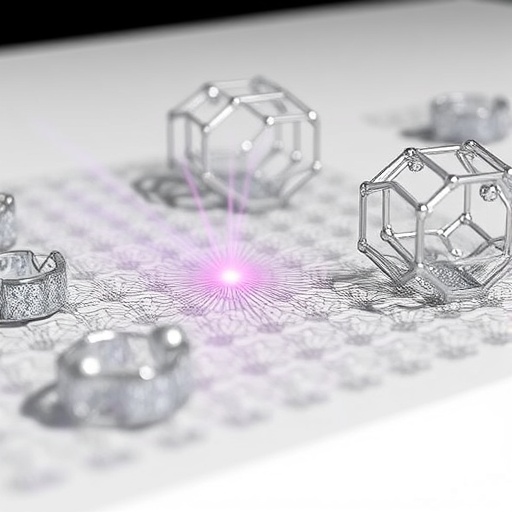
In a groundbreaking advancement poised to revolutionize the field of photonics and topological information processing, researchers have unveiled a novel class of skyrmions based on optical anisotropy that enable robust topological encoding. This pioneering work, recently published in Light: Science & Applications, introduces an innovative framework for manipulating light-matter interactions via topological structures in anisotropic optical media. Such a paradigm not only offers unprecedented control over light polarization states but also establishes a stable and scalable platform for information encoding that could transform future optical communication and quantum computing technologies.
Skyrmions, traditionally understood as nano-scale whirlpool-like configurations of magnetic spins, have captivated scientific interest for their topological protection, robustness, and potential use in data storage. Extending these concepts beyond magnetism, the current research leverages optical anisotropy—the directional dependence of optical properties—to construct analogous skyrmion structures within light fields. This optical skyrmion formation marks a remarkable shift from conventional scalar or vectorial beam configurations toward complex topological light textures governed by anisotropic media.
At the heart of this development lies the intricate interplay between polarization singularities, spatially varying anisotropic parameters, and topological invariants. The team utilized advanced materials exhibiting pronounced birefringence and engineered spatial modulation to induce distinct polarization rotations and ellipticities. By meticulously tuning these anisotropic profiles, they crafted optical fields exhibiting stable skyrmionic textures—effectively encoding information in the topology of the light polarization distribution rather than in its intensity or phase alone. This method exploits the vectorial nature of light as a multidimensional information carrier, potentially augmenting data density far beyond conventional limits.
From a technical standpoint, the research employed a combination of theoretical modeling and experimental validation using state-of-the-art photonic crystal structures and liquid crystal systems optimized for controllable anisotropy. Numerical simulations elucidated the formation conditions for optical skyrmions, revealing a rich phase diagram dependent on anisotropy strength, wavelength, and spatial symmetry. Experimentally, the team demonstrated direct observation of polarization skyrmions through polarization-resolved near-field microscopy, confirming the predicted topological characteristics with high fidelity.
What makes this breakthrough particularly exciting is its implication for topological robustness in optical systems. Unlike ordinary polarization patterns susceptible to disturbances and noise, skyrmion-based encoding offers inherent protection by virtue of topological invariance, substantially reducing error rates in information transmission and processing. This property heralds new horizons for optical communication networks where maintaining data integrity over long distances and complex environments is paramount.
Moreover, the tunability of anisotropy in the employed materials opens a versatile toolbox for dynamic control. By externally modulating factors such as electric fields, temperature, or mechanical strain, it is possible to write, erase, and reconfigure skyrmion patterns on demand. This dynamism paves the way for adaptive photonic devices—including programmable metasurfaces and reconfigurable optical switches—that leverage topological constructs for enhanced functionality.
The research also bridges the gap between fundamental topological photonics and practical applications. By demonstrating a realizable platform for optical skyrmions using widely accessible anisotropic media, the study lowers the barrier for future technologies integrating topological concepts. Potential uses range from ultra-secure holographic data storage and multi-level polarization multiplexing to topologically protected quantum state manipulation within integrated photonic circuits.
Beyond immediate technological prospects, these findings enrich the broader understanding of light-matter interactions, emphasizing the role of topology as a unifying principle across physical systems. The confluence of topology, anisotropy, and photonics invites further exploration into exotic states of light exhibiting nontrivial spin-orbit coupling, skyrmion lattices, and even interactions with matter waves, heralding a new era of interdisciplinary research.
Despite its promise, several challenges remain. Scaling the generation and manipulation of optical skyrmions to practical device dimensions, ensuring compatibility with existing photonic platforms, and enhancing operational speed and efficiency are areas ripe for development. Nonetheless, the current milestone sets a strong foundation for addressing these hurdles through synergistic advances in material science, nanofabrication, and nonlinear optics.
In summary, the demonstration of skyrmions based on optical anisotropy introduces a transformative approach to topological encoding of information. This work not only expands the toolkit of photonic engineering but also establishes a novel paradigm that harnesses the rich vectorial nature of light encoded via topology for robust and efficient data handling. As research continues to unfold, these optical skyrmions are expected to catalyze cutting-edge innovations in communications, computation, and beyond.
The authors’ insights and methodologies offer a compelling vision that may soon reshape the landscape of optical technologies, making topological photonics an integral pillar of future information sciences. This interplay of fundamental physics and applied photonics underscores the untapped potential lying at the junction of structure, symmetry, and light—vividly embodied by skyrmions sculpted through optical anisotropy.
Cite Scienmag News
Katie Riggs. (May 27, 2026). Skyrmions Enable Optical Anisotropy for Topological Encoding. Scienmag. https://scienmag.com/skyrmions-enable-optical-anisotropy-for-topological-encoding/
Katie Riggs. "Skyrmions Enable Optical Anisotropy for Topological Encoding." Scienmag, 27 May 2026, https://scienmag.com/skyrmions-enable-optical-anisotropy-for-topological-encoding/. Accessed 3 September 2026.
Katie Riggs. "Skyrmions Enable Optical Anisotropy for Topological Encoding." Scienmag. May 27, 2026. https://scienmag.com/skyrmions-enable-optical-anisotropy-for-topological-encoding/


