


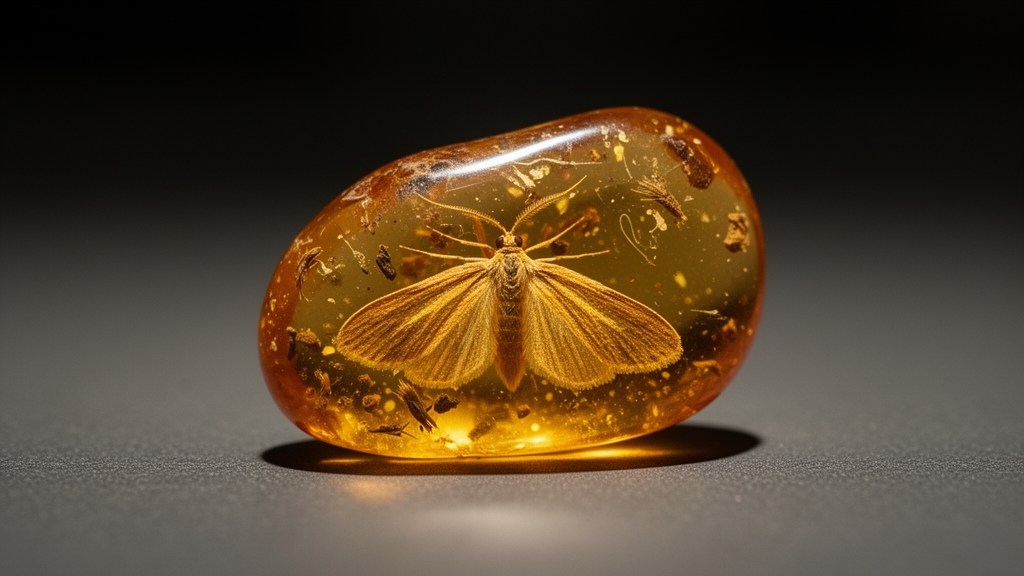
A single female moth preserved in 98.8 ± 0.6 million-year-old Myanmar amber has been described as a new genus and species, Preheterobathmia grimaldii, and tentatively assigned to the non-glossatan family Heterobathmiidae. The identification is based principally on the architecture of the female genitalia, which provides a clearer family-level signal than the visible wings, head and legs in the compressed amber inclusion.
The holotype was collected by local people in the Hukawng Valley of Myitkyina District, Kachin State, northern Myanmar. Its amber-bearing layer occurs 2–15 m below the surface. Uranium-lead dating of zircons from the volcanoclastic matrix surrounding the amber placed the deposit in the early Cenomanian. The fossil is housed at the Nanjing Institute of Geology and Palaeontology in China under inventory number NIGP 203445.
This was a morphological taxonomic study based on one inclusion rather than a population-level survey. The specimen was examined under incident and transmitted light with a stereomicroscope, measured with an ocular micrometer, photographed using stereomicroscope and digital microscope systems, and illustrated with line drawings produced through an attached drawing tube. Morphological terminology largely followed the classifications of Kristensen. Because the specimen consists of a single female, the study could evaluate individual structures but could not assess variation within the species or genus.
The female is completely preserved in a flattened, oval amber piece measuring 17 mm. Its right wings overlap and conceal the body in the illustrated position, leaving the head, thorax and abdomen visible mainly in lateral view. The moth had a body length of 4.0 mm and forewing length of 4.2 mm. Its antennae were long, approximately three-quarters of wing length, and comprised 44 flagellomeres. The legs had a spur formula of 0.4.4, while the forelegs possessed epiphyses bearing small denticles.
Both wing pairs were broad and densely covered with overlapping scales, including elongate, club-shaped scales along the margins and scattered erect piliform scales. The forewing subcostal vein was apically forked, the median vein was three-branched, and the forewing lacked a pterostigma. The hindwing retained a median cell. The fossil also possessed long, non-reduced labial palpi, a feature contrasted with the reduced palpi of the living genus Heterobathmia.
Without a view of the genitalia, the authors stated that the fossil would have keyed out as Micropterigidae in existing identification systems. The decisive structure was genital segment IX, which is large and triangular in lateral view, tapers toward small distal lobes and bears a narrow, elongate ventral depression containing the genital orifice. This configuration was considered characteristic of Heterobathmiidae and distinct from females of Micropterigidae, Agathiphagidae and basal Glossata. On that basis, the new taxon was assigned to the family tentatively.
Comparison with Heterobathmia pseuderiocrania revealed a mixture of ancestral and derived states. Preheterobathmia retained long labial palpi, two pairs of mid-tibial spurs, a forked forewing subcostal vein, separate R4 and R5 veins in both wings and 44 antennal flagellomeres, compared with 26 in Heterobathmia. Conversely, the fossil lacked a forewing pterostigma, median cell and jugum, structures present in the living genus. The authors interpreted the fossil’s broader wings, reflected in a higher wing index, as a possible ancestral condition and suggested that Preheterobathmia may have existed before the lineage shifted toward a leaf-mining larval lifestyle. This ecological interpretation remains inferential because the fossil provides no direct evidence of larval biology.
The Myanmar occurrence expands the known historical range of Heterobathmiidae. Its living species are restricted to Chile and Argentina, principally between 39° and 43° south latitude and 600–1,400 m elevation on both sides of the Andes, and their larvae mine leaves of Nothofagus. The fossil may indicate a wider ancestral distribution and challenge the family’s treatment as a temperate South American endemic. However, the authors also emphasized that post-Pangaean processes, including continental movement, terrane displacement or dispersal, could have shaped the family’s intercontinental history. The disjunct distribution of the younger Neopseustidae provides a parallel in which range formation occurred after Pangaea began breaking apart.
The new genus completes the fossil representation of the three extant non-glossatan families at the same Myanmar locality. Micropterigidae had long been known from Jurassic, Cretaceous and Tertiary deposits, while the first fossil agathiphagid was described from Myanmar amber in 2021. The Preheterobathmia finding adds a Cretaceous heterobathmiid from the same region. Its principal limitation is the evidence available from one amber inclusion: although the female genitalia support the proposed relationship, other diagnostic features of the family are concealed or cannot be assessed, and the broader evolutionary and biogeographic implications require further testing.
Subject of Research: Description and tentative family assignment of a Cretaceous non-glossatan moth from Myanmar amber
Article Title: Preheterobathmia gen. nov. – a new non-glossatan taxon from Myanmar amber tentatively assigned to Heterobathmiidae ( Insecta , Lepidoptera )
Article References: Mey, W. (2024). Preheterobathmia gen. nov. – a new non-glossatan taxon from Myanmar amber tentatively assigned to Heterobathmiidae (Insecta, Lepidoptera). Nota Lepidopterologica, 47, 1-10. https://doi.org/10.3897/nl.47.111080
Image Credits: AI Generated
DOI: 10.3897/nl.47.111080
Keywords: Preheterobathmia grimaldii, Heterobathmiidae, non-glossatan moths, Myanmar amber, Cretaceous fossils, Lepidoptera, female genitalia, taxonomic description, historical biogeography, Preheterobathmia, non-glossatan, taxon
Cite Scienmag News
Gavin Prescott. (October 20, 2026). Single-fossil taxonomic study places new non-glossatan moth tentatively in Heterobathmiidae. Scienmag. https://scienmag.com/single-fossil-taxonomic-study-places-new-non-glossatan-moth-tentatively-in-heterobathmiidae/
Gavin Prescott. "Single-fossil taxonomic study places new non-glossatan moth tentatively in Heterobathmiidae." Scienmag, 20 October 2026, https://scienmag.com/single-fossil-taxonomic-study-places-new-non-glossatan-moth-tentatively-in-heterobathmiidae/. Accessed 20 October 2026.
Gavin Prescott. "Single-fossil taxonomic study places new non-glossatan moth tentatively in Heterobathmiidae." Scienmag. October 20, 2026. https://scienmag.com/single-fossil-taxonomic-study-places-new-non-glossatan-moth-tentatively-in-heterobathmiidae/


