


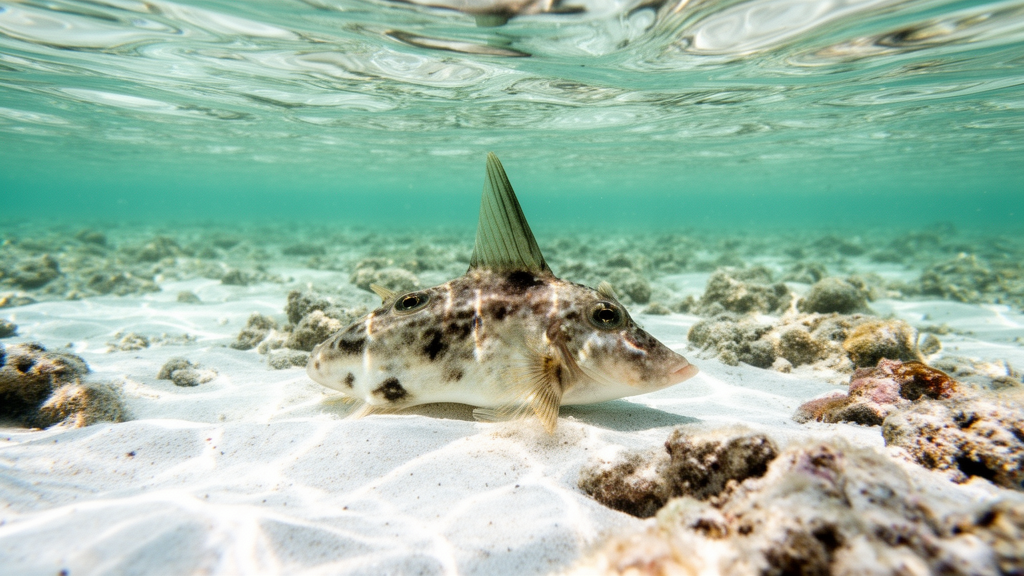
A single female sail triplefin, Enneapterygius velatus, collected at 18 m off Iriomote Island provides the first record of the species from the Yaeyama Islands and its third specimen-based record overall. The fish was observed on a sponge-covered rock over a sandy and coral-rubble bottom before being collected with a hand net on 30 August 2025.
The specimen, catalogued as KAUM–I. 220189, measured 19.7 mm standard length. The taxonomic study combined detailed counts and measurements with DNA barcoding, comparing the mitochondrial cytochrome c oxidase subunit I, or COI, sequence of the Iriomote fish with specimens of the co-occurring congener Enneapterygius tutuilae.
Enneapterygius velatus was described by Tashiro, Senou and Motomura in 2018 from two type specimens collected in Japan’s Ryukyu Islands, supported by underwater photographs. Considered a deep-water species, it is distinguished from its 67 congeners by features including an elongated, filamentous first dorsal fin. Earlier specimen records came from Kume Island, the type locality, and Amami-oshima Island, while underwater photographs had documented the species on Okinawa and Sesoko islands in Japan and on New Britain in Papua New Guinea. Allen and Erdmann suggested in 2024 that the fish’s small size and cryptic coloration may have limited recognition across western Pacific habitats.
Counts and measurements were made to the nearest 0.1 mm with calipers under a dissecting microscope, following established methods for triplefins and the original description of E. velatus. The Iriomote specimen had three dorsal-fin sections with III, XI and 9 rays, an anal fin with I, 17 rays, and 13 pectoral-fin rays. It had 32 scale rows in the longitudinal series and a mandibular pore formula of 2 + 2 + 2.
Diagnostic features included a strongly curved, U-shaped medial supratemporal canal, a very short first dorsal-fin base, well-developed inclinator muscles at the base of that fin, and a long pelvic fin extending beyond the anal-fin origin. Small cycloid scales covered the abdomen between the pelvic-fin insertion and the anus. The first two dorsal-fin spines were elongated and filamentous, and the membrane between them was irregularly incised into three branches. The specimen closely matched the morphometric and meristic characters in the original description of E. velatus.
It also possessed characters associated with the Enneapterygius tutuilae species group, including a relatively small body, unbranched pectoral-fin rays, a long first dorsal fin in both sexes, a broad unbranched orbital tentacle and the 2 + 2 + 2 mandibular pore formula. The authors distinguished E. velatus from six other members of the group using its first dorsal-fin length of 31.6%–34.6% of standard length, short first dorsal-fin base, strong first dorsal-fin inclinator muscles, pelvic-fin extension beyond the anal-fin origin, U-shaped medial supratemporal canal, slightly rounded snout, abdominal cycloid scales and blackish pigmentation at the caudal-fin base.
For DNA barcoding, DNA was extracted from muscle tissue preserved in 99.5% ethanol. The researchers sequenced a 561-base-pair COI fragment amplified with the FishF2 and FishR2 primers, then aligned the sequences with Clustal W. MEGA XII was used to select a Kimura 2-parameter model with a gamma distribution and construct a maximum-likelihood tree, with branch support assessed through 1,000 nonparametric bootstrap replications. The new E. velatus sequence was deposited in the DNA Data Bank of Japan as LC909667.
In the maximum-likelihood analysis, E. velatus and E. tutuilae each formed a distinct clade. The estimated genetic distance between the two species ranged from 25.3% to 28.4%, supporting the separation of the Iriomote specimen from E. tutuilae. The analysis did not resolve the position of E. velatus within the complete species group because sequence data were unavailable for the remaining five species, including E. mirabilis, which the authors described as the most morphologically similar.
The study also revised the assessment of group membership. Although Enneapterygius ventermaculus had previously been treated as a member of the E. tutuilae group, the examination found that its five unbranched pectoral-fin rays, mandibular pore formula of 3 + 1 + 3 and short first dorsal fin in females differed from those of the other six group members. The Iriomote occurrence documents a collection at 18 m, whereas previous authors reported the species at depths of 30–41 m on relatively deep reefs. Because the record is based on one specimen, it does not establish the species’ typical depth range, population size or broader habitat distribution.
Subject of Research: Taxonomic and DNA-barcode documentation of a sail triplefin specimen from Iriomote Island, Japan
Article Title: First record of the sail triplefin, Enneapterygius velatus ( Actinopterygii , Blenniiformes , Tripterygiidae ), from Iriomote Island, Okinawa, Japan
Article References: Dewa, Y., & Motomura, H. (2026). First record of the sail triplefin, Enneapterygius velatus (Actinopterygii, Blenniiformes, Tripterygiidae), from Iriomote Island, Okinawa, Japan. Acta Ichthyologica et Piscatoria, 56, 33-39. https://doi.org/10.3897/aiep.56.184530
Image Credits: AI Generated
Keywords: sail triplefin, Enneapterygius velatus, Iriomote Island, Yaeyama Islands, taxonomic record, DNA barcoding, COI sequencing, fish morphology, species distribution, First, record, sail
Cite Scienmag News
Margaret Porter. (October 20, 2026). Sail triplefin specimen provides first Yaeyama Islands record and COI sequence comparison. Scienmag. https://scienmag.com/sail-triplefin-specimen-provides-first-yaeyama-islands-record-and-coi-sequence-comparison/
Margaret Porter. "Sail triplefin specimen provides first Yaeyama Islands record and COI sequence comparison." Scienmag, 20 October 2026, https://scienmag.com/sail-triplefin-specimen-provides-first-yaeyama-islands-record-and-coi-sequence-comparison/. Accessed 20 October 2026.
Margaret Porter. "Sail triplefin specimen provides first Yaeyama Islands record and COI sequence comparison." Scienmag. October 20, 2026. https://scienmag.com/sail-triplefin-specimen-provides-first-yaeyama-islands-record-and-coi-sequence-comparison/


