


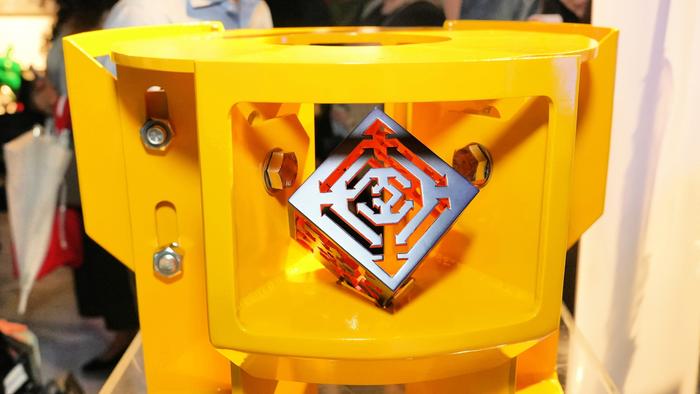
Singapore has achieved a groundbreaking milestone, establishing itself as the first nation to complete an art installation located 7,000 meters beneath the ocean’s surface. This innovative project focuses on the intersection of art, technology, and scientific monitoring, reflecting a deep commitment to nurturing creativity while advancing the understanding of marine environments. The installation consists of three intricately designed cubes created by the talented Singaporean artist, Ms. Lakshmi Mohanbabu, who previously captured international attention for sending her artwork into space aboard the International Space Station in 2022.
These remarkable metal cubes serve not just as artistic expressions but also function as components of a specialized early warning seismic sensor designed to detect undersea earthquakes. Installed off the coast of Japan near the Mariana Trench, this project is emblematic of Singapore’s progressive spirit and dedication to talent development and innovative engineering. The cubes were deployed in December 2023 through a strategic collaboration with NuStar Technologies, a firm committed to pioneering developments in technology and research, and Japan’s esteemed Agency for Marine-Earth Science and Technology (JAMSTEC).
Each hollow cube, measuring precisely 10 centimeters on each side, is crafted from corrosion-resistant stainless steel and showcases designs embodying the “Universal Language of Symbols,” a concept conceived by Mohanbabu. The design was thoughtfully created to resonate with communities worldwide, promoting a sense of unity by references to nine existential themes that are common among all human beings, such as Creation, Lifecycles, and Direction. This unique modern art sensibility reflects the deep philosophical connection between art and science, emphasizing a collaborative approach to understanding the universe.
The endeavor celebrates artistry and innovation simultaneously. One of the cubes leverages an advanced hybrid manufacturing process pioneered by researchers at Nanyang Technological University (NTU) in Singapore. This remarkable method, characterized by its intricate layering technique, involves the fusion of 80 layers of ultra-thin stainless-steel sheets, creating a wall that is only 4mm thick yet boasts superior strength and durability. This material not only withstands the immense pressure prevalent at ocean depths but also showcases resilience against corrosive environments, a testament to the evolving capabilities of additive manufacturing.
As the world increasingly faces the reality of natural disasters, the fusion of artistic expression and scientific inquiry provides a refreshing perspective on resilience. The cubes, equipped with unique designs including Nautilus, Primary, Secondary, Windmill, and Dromenon, serve as poignant tributes to those affected by calamities. They stand as a testament to the interconnectedness of humanity and nature—reminding us that art can cultivate empathy and reflection on the intricate relationships we maintain with our surroundings.
Guest-of-Honour Ms. Goh Swee Chen, Chair of the NTU Board and the National Arts Council, praised the project as it was unveiled at the Gallery ART NOW during Singapore’s SG60 celebrations. These installations are designed to foster deeper understanding and appreciation of the oceanic depths as well as the artistic visions that emerge from such collaborative efforts. The project signifies a historic achievement, underscoring Singapore’s commitment to arts and science integration while simultaneously elevating the nation’s cultural status on a global platform.
Significantly, this initiative underscores the profound implications of technological breakthroughs in the realm of additive manufacturing. The innovative method known as LAPIS—an abbreviation for Laser Patterning and Incorporation of Sheets—combines state-of-the-art 3D printing and laser cutting. This ingenious method not only enhances the structural integrity of the cubes but also results in a surface finish that surpasses traditional manufacturing techniques, minimizing the need for subsequent refinements. Such advancements attest to the relentless pursuit of innovation inherent in Singapore’s educational landscape.
The collaboration behind the Deep Ocean Interactions Project showcases a robust partnership between multiple stakeholders, including NuStar Technologies and JAMSTEC, aimed at promoting scientific advancement. The Long-Term Borehole Monitoring System (LTBMS), instrumental in charting seismic activities, incorporated these artistic installations into its structure, allowing for real-time data collection pivotal for earthquake and tsunami early warning systems. This integration signifies a paradigm shift—where art coalesces with rigorous scientific inquiry—creating a holistic understanding of the depths of the ocean and its scientific implications.
Moreover, with plans for the earlier artworks that circled the Earth to be sent to the moon as an extension of this initiative, Singapore is poised to solidify its role in the evolving narrative of space and ocean exploration. The interwoven narratives of these installations bridge vast cosmic endeavors to the unexplored mysteries beneath our ocean, highlighting the importance of collaboration across disciplines—art, science, and technology.
Ms. Mohanbabu articulates a vision that transcends mere artistic ambition, encapsulating a call for unity and purpose. Through her work, she distills complex concepts into tangible representations that ignite conversations about our shared existence. The aesthetic choices made for Cube designs demonstrate an embrace of earthly limitations and boundless aspirations, igniting a sense of hope that propels humanity toward explorative challenges.
With the recent unveiling of the Deep Ocean Floor Art Gallery, Singapore stands poised at the confluence of artistic brilliance, engineering excellence, and scientific inquiry—a microcosm of what interdisciplinary collaboration can achieve. The striking colors and designs of the three uniquely crafted cubes symbolize the deep-seated values of innovation and the relentless pursuit of knowledge. Each cube captures momentous themes, not only visually reflecting the grandeur of our world but also reminding us that the boundaries of artistic expression are as limitless as the oceans themselves.
As future explorations seek to push the boundaries of what is feasible, the success of this project embodies hope and aspiration that transcends national borders. Singapore’s cutting-edge advancements in both art and technology showcase its capacity to be at the forefront of global dialogues on creativity, sustainability, and scientific exploration—proving that through collaboration, no realm is too expansive to explore. Each of these remarkable creations contributes a unique narrative to our understanding of life, creativity, and the infinite possibilities when disciplines unite.
Cite Scienmag News
Denise Maddox. (March 19, 2025). Singapore and Japan Launch the World’s Deepest Underwater Art Installation. Scienmag. https://scienmag.com/singapore-and-japan-launch-the-worlds-deepest-underwater-art-installation/
Denise Maddox. "Singapore and Japan Launch the World’s Deepest Underwater Art Installation." Scienmag, 19 March 2025, https://scienmag.com/singapore-and-japan-launch-the-worlds-deepest-underwater-art-installation/. Accessed 3 September 2026.
Denise Maddox. "Singapore and Japan Launch the World’s Deepest Underwater Art Installation." Scienmag. March 19, 2025. https://scienmag.com/singapore-and-japan-launch-the-worlds-deepest-underwater-art-installation/


