

Thursday, July 16, 2026
Science
No Result
View All Result
  • Login
  • HOME
  • SCIENCE NEWS
  • CONTACT US
  • HOME
  • SCIENCE NEWS
  • CONTACT US
No Result
View All Result
Scienmag
No Result
View All Result
Home Science News Science Education

Simulation boosts nursing students’ home-visit training immersion, skills still under study

July 16, 2026
in Science Education
Reading Time: 2 mins read
0
Simulation boosts nursing students’ home-visit training immersion, skills still under study

Simulation boosts nursing students’ home-visit training immersion, skills still under study

65
SHARES
587
VIEWS
Share on FacebookShare on Twitter
ADVERTISEMENT

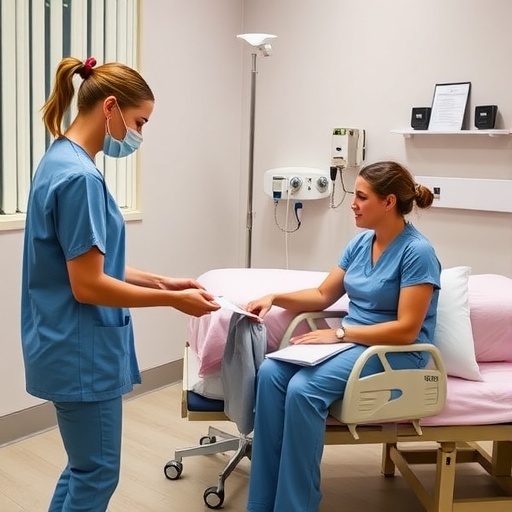
Home visits are where community nursing stops being theory and starts becoming judgment—spotting hazards, sensing family dynamics, and tailoring communication on the fly. For nursing students, that “messy realism” is difficult to reproduce in a classroom, where role-players follow scripts and environments stay tidy.

A new study in the Chinese Journal of Medical Education Research reports tests of a virtual–physical integrated scenario simulation designed to close that gap. Researchers from Peking Union Medical College School of Nursing and Beijing community health centers compared the approach with conventional laboratory-based scenario training.

A total of 143 third-year undergraduate nursing students (enrolled in 2022) participated in the March–April 2025 intervention period. After the same three-hour teaching block, 128 students completed pre- and post-questionnaires, while 24 students in the integrated-simulation arm also took part in semi-structured interviews.

Both groups trained on the same home-visit workflow: preparing the encounter, conducting inquiry and physical assessment, measuring rapid blood glucose, delivering health education, and finishing documentation and post-visit summaries. The difference was how uncertainty was generated during the scenario.

In the conventional group, classmates acted as the older adult and family member according to a written script. In the integrated group, students worked in a “smart eldercare” laboratory featuring multimedia displays, physical models, and a wireless simulation system in which an intelligent agent represented the older adult.

The system supported AI-assisted inquiry, blood pressure and glucose measurement, and transitions between a community health center context and a simulated home environment. In interviews, students described the intelligent simulator as responsive—questioning, showing impatience, and altering emotional cues in ways that scripts rarely capture.

The strongest quantitative result was “learning immersion.” Students trained with the integrated setup achieved a higher total immersion score than the conventional group (72.42±8.19 vs 69.44±8.41), with gains also reported in emotional engagement and perceived learning experience.

However, immersion did not translate cleanly into immediate competence. After teaching, there was no significant between-group difference in home-visit skills or attitudes. Skill scores were similar (virtual–physical: 60.60±6.85; conventional: 60.89±6.62), suggesting three hours may be insufficient for measurable skill consolidation.

Students also reported friction: response delays, imperfect speech recognition, the need to press buttons during interaction, and occasional breakdowns in conversational flow. The authors argue that technology can increase realism, but instructional design, repeated practice, and smoother interfaces are essential before simulated engagement becomes durable nursing competence.

Subject of Research: People
Article Title: Study on the application effects of virtual-reality integrated scenario simulation in home visit teaching
News Publication Date: 20-May-2026
Web References: http://dx.doi.org/10.3760/cma.j.cn116021-20251129-02253
References: 10.3760/cma.j.cn116021-20251129-02253
Image Credits:
Keywords: nursing education, home visit training, virtual–physical simulation, learning immersion, smart eldercare, AI-assisted scenarios, educational technology

Tags: communication in community health nursingcommunity nursing education methodseffectiveness of scenario simulation in nursingimmersive clinical skill developmentnursing education research in Chinanursing student's hazard recognition skillsnursing students home-visit trainingreal-world nursing scenario trainingsimulation-based healthcare traininguse of multimedia displays in nursing educationvirtual simulation in nursing educationvirtual-physical integrated scenario simulation
Share26Tweet16
Previous Post

New Library for Feynman Integrals Advances Particle Physics Calculations

Next Post

Ester Sztein Wins Prestigious American Geosciences Institute Award from GSA

Related Posts

UK lawmakers call for radical resident doctor training reform to cut prescribing errors
Science Education

UK lawmakers call for radical resident doctor training reform to cut prescribing errors

July 15, 2026
Study Shows Parents as Coaches Increase Children’s Physical Activity
Science Education

Study Shows Parents as Coaches Increase Children’s Physical Activity

July 15, 2026
DSI to lead $1 million Anthropic Claude credits drive for AI research
Science Education

DSI to lead $1 million Anthropic Claude credits drive for AI research

July 15, 2026
Early Technology Training Boosts Clinician Confidence in Patient Care
Science Education

Early Technology Training Boosts Clinician Confidence in Patient Care

July 15, 2026
Nelson Researching Striped Bass Patterns and Population Health
Science Education

Nelson Researching Striped Bass Patterns and Population Health

July 14, 2026
NSF Names Rochester, New York as National Laser Innovation Hub
Science Education

NSF Names Rochester, New York as National Laser Innovation Hub

July 14, 2026
Next Post
Ester Sztein Wins Prestigious American Geosciences Institute Award from GSA

Ester Sztein Wins Prestigious American Geosciences Institute Award from GSA

  • Mothers who receive childcare support from maternal grandparents show more

    Mothers who receive childcare support from maternal grandparents show more parental warmth, finds NTU Singapore study

    27656 shares
    Share 11059 Tweet 6912
  • University of Seville Breaks 120-Year-Old Mystery, Revises a Key Einstein Concept

    1061 shares
    Share 424 Tweet 265
  • Bee body mass, pathogens and local climate influence heat tolerance

    682 shares
    Share 273 Tweet 171
  • Researchers record first-ever images and data of a shark experiencing a boat strike

    546 shares
    Share 218 Tweet 137
  • Groundbreaking Clinical Trial Reveals Lubiprostone Enhances Kidney Function

    531 shares
    Share 212 Tweet 133
Science

Embark on a thrilling journey of discovery with Scienmag.com—your ultimate source for cutting-edge breakthroughs. Immerse yourself in a world where curiosity knows no limits and tomorrow’s possibilities become today’s reality!

RECENT NEWS

  • Enhanced Bayesian Hybrid Inference Using Genome Sequence Data
  • Global analysis reveals changing early-onset inflammatory bowel disease burden worldwide
  • Plasma Ceramide Ratios Link Metabolic and Inflammation Markers to Parkinson’s Cognitive Decline
  • Black Women’s Breast Cancer Screening Decisions in UK: Qualitative Study

Categories

  • Agriculture
  • Anthropology
  • Archaeology
  • Athmospheric
  • Biology
  • Biotechnology
  • Blog
  • Bussines
  • Cancer
  • Chemistry
  • Climate
  • Earth Science
  • Editorial Policy
  • Marine
  • Mathematics
  • Medicine
  • Pediatry
  • Policy
  • Psychology & Psychiatry
  • Science Education
  • Social Science
  • Space
  • Technology and Engineering

Subscribe to Blog via Email

Enter your email address to subscribe to this blog and receive notifications of new posts by email.

Join 5,146 other subscribers

© 2025 Scienmag - Science Magazine

Welcome Back!

Login to your account below

Forgotten Password?

Retrieve your password

Please enter your username or email address to reset your password.

Log In
No Result
View All Result
  • HOME
  • SCIENCE NEWS
  • CONTACT US

© 2025 Scienmag - Science Magazine

Discover more from Science

Subscribe now to keep reading and get access to the full archive.

Continue reading
