


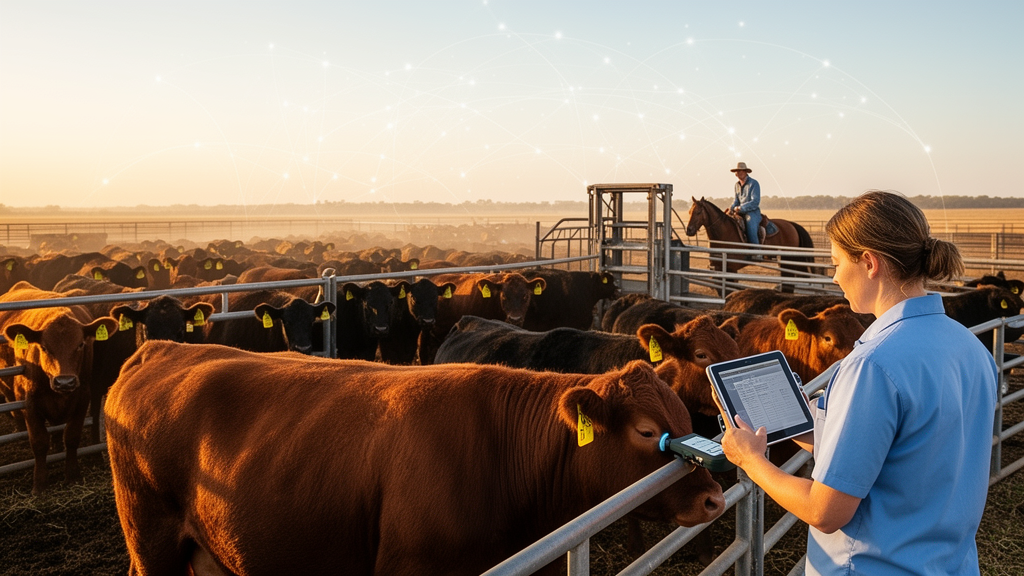
When a fast-spreading livestock disease breaks out in the United States, animal health officials must quickly identify infected and at-risk animals and trace the farms they have contacted. A new simulation study from Kansas State University, published in Frontiers in Veterinary Science, suggests that the country’s current levels of electronic identification (EID) and digital movement reporting (DR) would leave most of those contacts invisible. In the baseline scenario, modeled on estimated current usage, the researchers found zero traceable incoming contacts across all three farm types they tested.
The research team, including MRMaRyka R. Smith, Michael W. Sanderson, and Christy J. Hanthorn, built a simulated 30-day national cattle movement network. In this network, farms, markets, processors, and other premises served as nodes, and the movements of cattle between premises formed the edges connecting them. From the full network, they randomly selected 100 cow-calf farms, 100 markets, and 100 feedlots as “farms of interest” to evaluate how well their contact farms could be traced during an outbreak investigation.
To model traceability, the researchers assigned EID status to the source of each movement and DR status to the destination using a binomial process. A movement counted as traceable, and entered the traceable network, only when the source premises had tagged the outgoing animals and the destination premises had reported the incoming movement digitally. This dual requirement reflects how electronic tracing actually works in practice: an animal must carry an identifiable tag, and the receiving location must record its arrival in a digital system, for investigators to reconstruct the chain of contacts.
The simulation began with a baseline representing estimated current usage in US cattle, then progressively improved EID and DR probabilities up to the highest level tested, in which 75 percent of all beef cattle farms tagged outgoing movements and 90 percent reported incoming movements. At that top level, the average percentage of traceable contacts reached 83.56 percent for cow-calf farms of interest, 86.5 percent for the total contacts of market farms of interest, and 75.63 percent for feedlot farms of interest.
The gap between the baseline and the highest scenarios is stark. Under current estimated adoption, not a single incoming contact was traceable for any of the 300 farms of interest, meaning that officials responding to an outbreak would have essentially no electronic record of where affected cattle had come from. As tagging and reporting probabilities rose, traceability climbed steadily, demonstrating that even partial improvements in adoption translate directly into more complete contact networks for disease investigators.
The authors note that the United States currently does not require all cattle movements to be reported, and official EID is required only for dairy cattle and some classes of beef cattle. This regulatory landscape shapes the baseline used in the model and explains why electronic tracing would struggle today. For rapidly spreading diseases, the study argues, electronic identification of animals and digital reporting of movements are likely needed to achieve rapid, effective tracing and timely implementation of control measures.
Because the study relies on a simulated network rather than observed outbreak data, its findings are model estimates rather than measurements of a real epidemic response. The 30-day window captures a snapshot of movement patterns, and the traceability figures represent averages across the sampled farms of interest, so individual farms could perform better or worse depending on their position in the network. Nevertheless, the structure of the simulation, drawing nodes and movements from a national-scale network, is designed to reflect the heterogeneous ways cattle actually move through the US industry, from scattered cow-calf operations through auction markets to concentrated feedlots and processors.
The practical value of the results lies in the implementation targets they provide. By showing how traceability responds at different combinations of EID and DR adoption, the study offers policymakers concrete benchmarks: the highest scenario tested, with 75 percent of farms tagging outgoing movements and 90 percent reporting incoming movements, still left roughly one in six to one in four contacts untraceable, depending on farm type. Reaching effective electronic tracing, the authors conclude, will require adoption levels well above what is estimated today, and the trajectory of improvement mapped in the simulation can help guide where investment in tagging and reporting infrastructure would yield the greatest gains for outbreak readiness.
Subject of Research: Assessment of cattle traceability using electronic identification and digital movement reporting in simulated United States cattle movement networks
Article Title: Assessment of cattle traceability using electronic identification and digital movement reporting in simulated United States cattle movement networks
Article References: Smith, M. R., Sanderson, M. W., & Hanthorn, C. J. (2026). Assessment of cattle traceability using electronic identification and digital movement reporting in simulated United States cattle movement networks. Frontiers in Veterinary Science, 13, 1972037. https://doi.org/10.3389/fvets.2026.1972037
Image Credits: AI Generated
DOI: 10.3389/fvets.2026.1972037
Keywords: Assessment, cattle, traceability, electronic, identification, digital, movement, reporting, simulated, United, States, networks
Cite Scienmag News
William Thompson. (October 27, 2026). Simulated US Cattle Networks Show Current Electronic ID and Digital Reporting Fall Short for Outbreak Tracing. Scienmag. https://scienmag.com/simulated-us-cattle-networks-show-current-electronic-id-and-digital-reporting-fall-short-for-outbreak-tracing/
William Thompson. "Simulated US Cattle Networks Show Current Electronic ID and Digital Reporting Fall Short for Outbreak Tracing." Scienmag, 27 October 2026, https://scienmag.com/simulated-us-cattle-networks-show-current-electronic-id-and-digital-reporting-fall-short-for-outbreak-tracing/. Accessed 27 October 2026.
William Thompson. "Simulated US Cattle Networks Show Current Electronic ID and Digital Reporting Fall Short for Outbreak Tracing." Scienmag. October 27, 2026. https://scienmag.com/simulated-us-cattle-networks-show-current-electronic-id-and-digital-reporting-fall-short-for-outbreak-tracing/


