


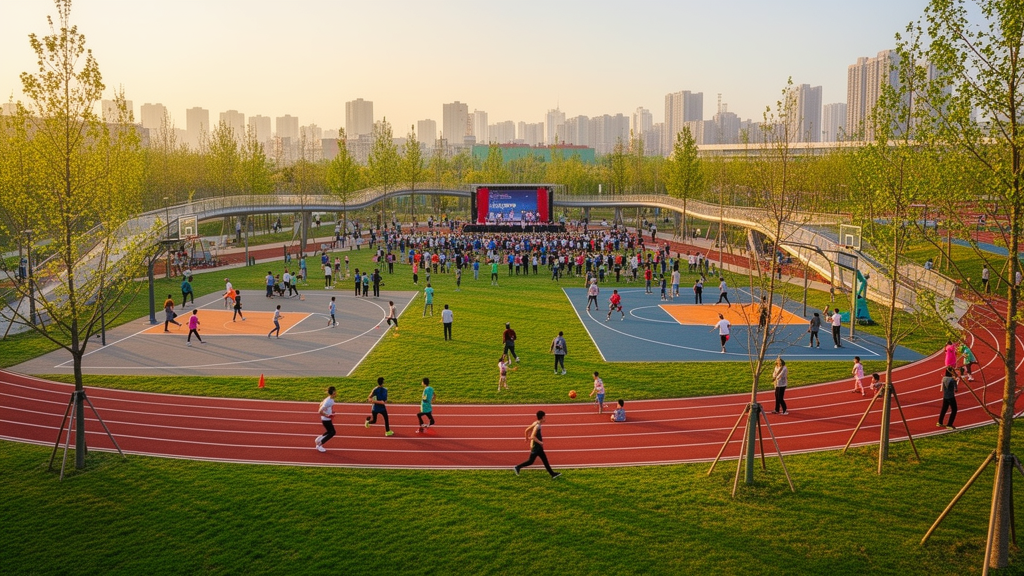
A new analysis argues that sports parks can turn some of the most neglected corners of Chinese cities—riverbanks, rusting industrial sites, the shadows beneath elevated expressways, and even the roof of a wastewater-treatment plant—into working infrastructure for public health and urban regeneration. But the authors caution that facilities alone guarantee nothing: whether these spaces deliver lasting social and environmental benefits depends on affordable access, careful scheduling of events around everyday use, and long-term maintenance backed by real accountability.
The Perspective, published in Frontiers in Sports and Active Living, examines four illustrative cases in Ningbo, Wuhan, and Wenzhou. Rather than measuring outcomes directly, the authors—a team from South-Central Minzu University and Zhejiang Normal University—draw on planning documents, media reports, and site observations to interpret how each park combines land reuse, daily recreation, and organized sport. They frame the analysis through three connected dimensions: spatial retrofit, programmed activation, and adaptive stewardship.
The first case, Jiangbei Riverside Sports Park in Ningbo, forms part of a district-wide waterfront network built under a local ‘park+sport’ policy requiring that at least 5% of newly built or renovated park green space be allocated to public sports facilities. The park devotes 16,800 square meters—12% of its 140,000-square-meter site—to running, cycling, ball games, and waterfront recreation, all woven into a continuous, publicly accessible green corridor. Its event calendar illustrates what the authors call a multi-level continuum: operator-organized activities such as a parent–child kite competition, grassroots contests including a square-dancing event with more than 200 participants, a 2025 fun run for the district’s construction workforce, and the 2023 Ningbo Marathon, whose 15,000 runners passed through the park as one node on a wider riverside route.
The second case shows how environmental enforcement can trigger regeneration. Zhangzhidong Sports Park in Wuhan’s Hanyang District, roughly 52,000 square meters, sits on land once used as a steel-cooling pond for the historic Hanyang Iron Works. After serving as a memorial park, the site fell into neglect and accumulated illegal structures; residents’ complaints during the 2018 round of central environmental-protection inspections placed it on a priority rectification list. The district invested 58 million RMB and eight months of construction to open a smart sports park in May 2021. By July 2022 it had reportedly hosted more than twenty mass-sport activities, and in 2023 it staged the two-day provincial finals of the second Hubei Community Games. A report republished on the municipal government website estimates a catchment of about 100,000 residents and cites the operator’s figure of more than one million visits in the first year.
The third case tackles a distinctly modern form of urban leftover land. Panhuo Sports Park in Ningbo’s Yinzhou District converts nearly one kilometer of underspace beneath an elevated expressway—about 9,000 square meters of overgrown, pothole-ridden land that had long been a blind spot of urban administration—into a linear sports park embedded in dense residential fabric. After surveying under-bridge spaces citywide, the district’s administrative bureau selected a sports-park scheme and, through open tendering, introduced a private operator who financed the entire conversion, more than 8 million RMB over four months, in exchange for the right to operate the site. That arrangement ties the right of use to responsibility for construction, operation, and maintenance, making affordable pricing, enforceable maintenance standards, and provisions for operator withdrawal central stewardship questions.
Panhuo’s event life operates at the neighborhood scale. CCTV reporting documents ‘Pan-BA’ community basketball matches, and local coverage of the inaugural 2025 tournament describes sixteen resident teams, collaboration among subdistrict organizations and communities, and a corporate sponsor. Local reporting also links the tournament to community co-governance through volunteers and community-run food stalls. The park pairs paid sports facilities with freely accessible public areas, including a plaza and children’s play areas—a combination that makes the balance between revenue-generating provision and free public access a daily management task.
The fourth case stacks functions vertically. Wenzhou Sports and Leisure Park sits atop a rebuilt semi-underground wastewater-treatment plant in the city’s Binjiang business district. According to the project group’s reporting, its football base had hosted more than twenty provincial- and municipal-level matches by 2023, along with the Zhejiang Football Association youth futsal championship for boys under 15. Co-locating recreation with working utility infrastructure makes coordination between public access and utility maintenance a central operating requirement, and the authors note that assessing its environmental contribution would require attention to construction inputs and ongoing resource use.
Across the four sites, the authors argue that the real test of a sports park is not which facility is missing but which urban relationship sport can help repair. Reuse can reduce demand for additional land, though environmental gains depend on how much reconstruction occurs, what materials and vegetation are used, and how the site is subsequently operated. Programming, meanwhile, needs an everyday base load of low-threshold activity—walking, informal games, social use—punctuated by events that add intensity and attention. Those benefits do not arise automatically: they depend on deliberate leveraging strategies and organizations capable of converting a single weekend of competition into skills, partnerships, equipment, and public confidence that persist afterwards.
The analysis also confronts uncomfortable distributional questions. Research on green gentrification shows that new green amenities can accompany neighborhood change and unequal access to environmental improvements, with effects varying across cities. For sports parks, the authors contend, assessment should consider housing affordability, participation across income groups, and the fate of existing informal uses—not just hectares delivered or courts installed. Paid activities and organized events may keep the books balanced, but they can also compete with free access for space and time. They point to critical research on New York’s High Line as a cautionary example of public-space investment becoming entangled with property development priorities.
From these observations the authors distill four practical priorities. Sport-policy assessment should weigh land reuse and environmental performance alongside facility counts, with ecological claims backed by measured indicators such as surface permeability and retained structures. Event infrastructure—routes, barriers, signage, spectator facilities—should remain temporary or adaptable so that everyday public functions survive before, during, and after each event. Assessment frameworks should distinguish built capacity from activation and legacy, since observational research has shown that park facilities sometimes attract users different from their intended target groups. And capital funding must be paired with stewardship capacity: a named coordinating body, a multi-year operating budget, and a community feedback mechanism matter as much as design quality, with operating agreements specifying maintenance standards and affordable access even if revenue declines or an operator withdraws. The authors acknowledge their study’s limits—three relatively prosperous cities, reliance on institutional reporting, no direct ecological measurements, and sparse data on participation across social groups—and call for repeated observations, resident perspectives, and environmental monitoring to clarify when these transformed spaces truly deliver inclusive, environmentally beneficial regeneration.
Subject of Research: Adaptive reuse of urban land for sports parks integrating physical activity and sport events in Chinese cities
Article Title: From underused urban space to regenerative infrastructure: how sports parks integrate activity and sport events
Article References: Yang, J., Zhang, B., & Fang, X. (2026). From underused urban space to regenerative infrastructure: how sports parks integrate activity and sport events. Frontiers in Sports and Active Living, 8, 1979214. https://doi.org/10.3389/fspor.2026.1979214
Image Credits: AI Generated
DOI: 10.3389/fspor.2026.1979214
Keywords: sports parks, urban regeneration, adaptive reuse, physical activity, sport events, China, green infrastructure, residual land, stewardship, public access, community sport, spatial retrofit
Cite Scienmag News
Phoebe Ingram. (October 27, 2026). From Leftover Land to Living Infrastructure: How Chinese Sports Parks Blend Recreation and Events. Scienmag. https://scienmag.com/from-leftover-land-to-living-infrastructure-how-chinese-sports-parks-blend-recreation-and-events/
Phoebe Ingram. "From Leftover Land to Living Infrastructure: How Chinese Sports Parks Blend Recreation and Events." Scienmag, 27 October 2026, https://scienmag.com/from-leftover-land-to-living-infrastructure-how-chinese-sports-parks-blend-recreation-and-events/. Accessed 27 October 2026.
Phoebe Ingram. "From Leftover Land to Living Infrastructure: How Chinese Sports Parks Blend Recreation and Events." Scienmag. October 27, 2026. https://scienmag.com/from-leftover-land-to-living-infrastructure-how-chinese-sports-parks-blend-recreation-and-events/


