

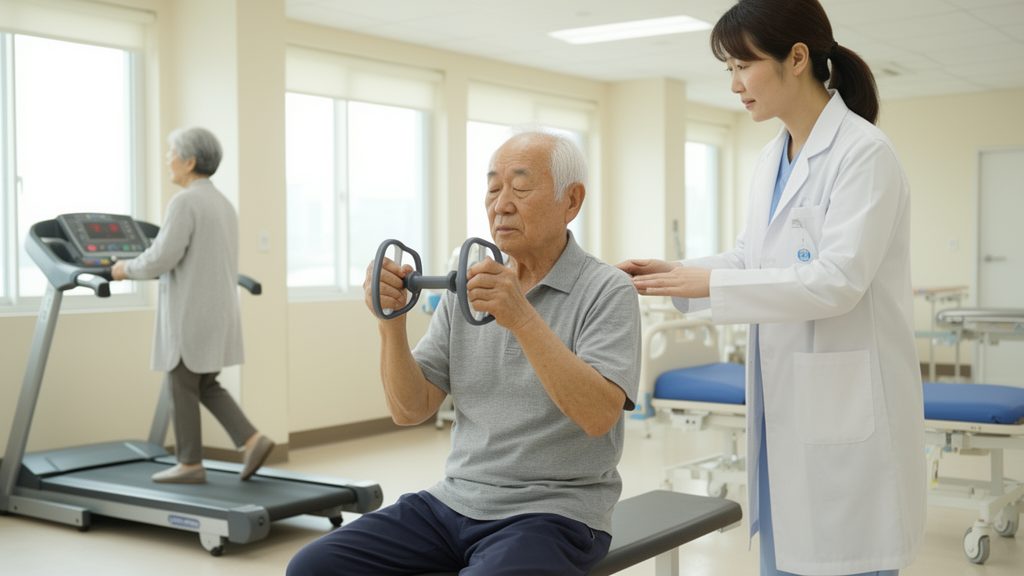
Pulmonary rehabilitation is one of the most firmly established non-drug treatments for chronic obstructive pulmonary disease, yet a new nationwide analysis of South Korea's health insurance records shows that only a small fraction of patients ever receive it. Using claims data from the National Health Insurance Service covering 2017 through 2021, researchers tracked how often adults aged 40 and older with COPD were billed for comprehensive, exercise-based rehabilitation sessions and for the objective functional tests that should accompany such programs. The proportion of patients receiving comprehensive pulmonary rehabilitation rose from 0.49 percent in 2017 to 1.56 percent in 2021, a more than threefold increase, but the absolute uptake remained strikingly low for an intervention with proven benefits for breathlessness, quality of life, and clinical outcomes.
The study, published in Frontiers in Rehabilitation Sciences, was a retrospective population-based cohort analysis built on the NHIS database, which covers virtually the entire Korean population. The researchers identified patients using diagnosis codes J43 and J44 from the Korean Classification of Diseases, 8th revision, excluding a rare congenital subtype, and accepted codes listed as either primary or secondary diagnoses. Because the tailored dataset did not include medication records, spirometric confirmation, symptom burden, or disease severity, the cohort represents a broad claims-defined COPD population rather than a clinically confirmed one.
The authors note that the exact identification algorithm has not been specifically validated against clinical or spirometric diagnoses, so diagnostic misclassification is possible and the sensitivity and specificity of cohort identification cannot be determined from the data. Two rehabilitation-related billing codes anchored the analysis. The first, MM440, describes a comprehensive one-hour exercise-based rehabilitation session combining aerobic, strength, and flexibility training; the second, MM290, covers therapeutic breathing exercises including breathing retraining and airway clearance techniques.
Korea's National Health Insurance Service began covering pulmonary rehabilitation costs in 2016, making the 2017 to 2021 window a natural test of whether reimbursement translates into widespread delivery. Claim-defined utilization of the comprehensive code rose steadily: the number of patients with at least one MM440 claim grew from 2,008 in 2017 to 5,947 in 2021, and the implementation rate climbed from 3.9 to 11.6 patients per 100,000 population, with a relative plateau between 2019 and 2020 that coincided with the early COVID-19 pandemic. Yet the growth in reach was accompanied by a decline in intensity.
The mean number of comprehensive rehabilitation claims per patient fell modestly from 3.0 to 2.6 over the study period, and in 2021 the overwhelming majority of recipients, 94.8 percent, had fewer than eight recorded MM440 claims. Only 2.4 percent had eight to fourteen claims and 2.8 percent had more than fourteen. The authors are careful about what these counts mean: because claims data do not capture program scheduling, actual treatment frequency, total duration, or completion status, claim counts serve only as an indirect proxy for repeated reimbursed encounters.
Fewer than eight claims, they stress, should not be read as evidence of non-adherence, discontinuation, or failure to complete a structured program. The separate breathing-exercise code told a different story, rising to 2,087 patients in 2019 before falling to 1,572 in 2021, a pattern the authors suggest may reflect a gradual shift toward more structured rehabilitation coding. To characterize who was actually receiving rehabilitation, the team performed 1:1 propensity score matching on age, sex, and region, comparing 5,947 patients with at least one MM440 claim in 2021 against an equal number of non-recipients drawn from a total analytic population of 380,320.
The matching was deliberately limited to demographic and geographic variables because the goal was a descriptive comparison of healthcare utilization and clinical characteristics, not an estimate of causal effects. Even so, meaningful imbalances persisted after matching, and the authors repeatedly caution that residual confounding, selection bias, and confounding by indication cannot be excluded. The comparison therefore describes real-world delivery patterns rather than demonstrating any benefit or harm of rehabilitation itself.
The matched picture revealed a system that concentrates rehabilitation among the most complex and well-connected patients. Recipients were far more likely to be treated at tertiary hospitals, 81.2 percent versus 50.0 percent, and had more admissions, 1.58 versus 0.88 on average, along with longer cumulative hospital stays for respiratory diseases, 49.25 versus 28.29 days. They were also more frequently enrolled in the Co-payment Reduction Program, 48.7 percent versus 35.1 percent, and showed higher malignancy-related claim counts, 11.9 versus 6.2 claims per patient per year, the only comorbidity with a notable between-group difference.
Conversely, Medical Aid beneficiaries, who face minimal out-of-pocket expenses, were more prevalent among non-recipients, 23.6 percent versus 9.7 percent. The authors interpret this as evidence that non-financial barriers, not just cost, contribute to underuse, and that access to structured rehabilitation appears concentrated in institutions with established rehabilitation infrastructure. One of the study's most distinctive contributions is its examination of objective functional assessment, a question no prior Korean study had addressed with NHIS data.
The researchers tracked four reimbursable test codes: maximal inspiratory and expiratory pressure testing to assess respiratory muscle strength, handgrip strength testing as a marker of sarcopenia and frailty, cardiopulmonary exercise testing with gas analysis, and cardiopulmonary exercise testing without gas analysis. Absolute volumes of these tests rose over the period; for example, respiratory muscle pressure testing claims grew from 923 in 2017 to 1,754 in 2021, and exercise testing with gas analysis rose from 507 to 1,107. But relative to the volume of rehabilitation claims, testing remained infrequent.
In 2021, respiratory muscle pressure testing claims amounted to just 11.2 percent of MM440 claims, and gas-analysis exercise testing claims to 7.0 percent. These ratios come with important caveats. They are annual claim-count ratios, not patient-level testing rates, and the data cannot establish whether individual patients or discrete rehabilitation episodes lacked assessment.
Because discrete rehabilitation episodes could not be identified in the claims, testing claims could not be classified as occurring before, during, or after rehabilitation. The six-minute walk test, a standard field measure of exercise capacity in pulmonary rehabilitation, could not be evaluated at all because its claim code is also used for general oxygen saturation monitoring and is therefore indistinguishable in the database. Even with these limitations, the authors argue that the infrequency of reimbursed objective testing points to a persistent gap in quality measurement within the current reimbursement-based delivery system.
Geography and specialty patterns added further texture. Regional implementation rates varied substantially: in 2017 the highest rates appeared in Jeonbuk, Busan, and Ulsan, while by 2021 Gangwon recorded the highest rate, followed by Seoul, Busan, Jeonbuk, and Daejeon. Because the data do not identify individual institutions, these regional patterns may partly reflect the activity of high-volume tertiary centers rather than uniform service availability.
Among billing specialties, Rehabilitation Medicine accounted for the largest share of comprehensive rehabilitation claims throughout, though its proportion fell from 66.2 percent in 2017 to 54.7 percent in 2021, while the shares of Internal Medicine and Thoracic Surgery grew from 29.2 to 34.6 percent and from 3.3 to 6.1 percent, respectively. Given the multidisciplinary nature of pulmonary rehabilitation, the authors highlight coordination and referral pathways across specialties as key levers for improving continuity of care. The findings align with international evidence that rehabilitation access and delivery are suboptimal even in high-income settings, and the authors situate their results within a broader implementation agenda.
They point to strategies including stronger referral pathways across care levels, reimbursement or quality-indicator incentives for key objective assessments, and expanded home-based and tele-rehabilitation programs, noting that an Australian audit between 2020 and 2023 found only 6.2 percent of rehabilitation referrals originated from primary care. Technology-supported models studied in cardiac and heart failure rehabilitation, including immersive virtual reality approaches, may offer translational lessons, though engagement and implementation context remain important considerations. The study's own limitations frame its conclusions: the claims-based COPD definition lacks spirometric confirmation, the data cannot separate inpatient from outpatient rehabilitation, patient-reported outcomes are absent, and the analysis window ends in 2021, the most recent dataset available when the study began.
Whether the pandemic-era patterns represent temporary disruption or lasting change in rehabilitation delivery will require analyses of post-pandemic years.
Subject of Research: Nationwide trends in pulmonary rehabilitation utilization and clinical testing practices for COPD in Korea using National Health Insurance Service claims data
Article Title: Nationwide trends in pulmonary rehabilitation and clinical testing practices for chronic obstructive pulmonary disease in Korea: a National Health Insurance Service database study
Article References: Kim, S.-H., Hong, C. H., Kim, J., Kim, S., Kim, S. H., Kim, M.-H., Shin, M.-J., Park, T. S., Jeong, J.-H., & Shin, Y. B. (2026). Nationwide trends in pulmonary rehabilitation and clinical testing practices for chronic obstructive pulmonary disease in Korea: a National Health Insurance Service database study. Frontiers in Rehabilitation Sciences, 7, 1778935. https://doi.org/10.3389/fresc.2026.1778935
Image Credits: AI Generated
DOI: 10.3389/fresc.2026.1778935
Keywords: chronic obstructive pulmonary disease, pulmonary rehabilitation, National Health Insurance Service, Korea, health insurance claims, cardiopulmonary exercise testing, respiratory muscle strength testing, healthcare utilization, retrospective cohort study, rehabilitation access, health disparities, tele-rehabilitation
Cite Scienmag News
Barbara Leach. (October 27, 2026). Pulmonary Rehabilitation Use in Korean COPD Patients Tripled but Remained Under 2 Percent. Scienmag. https://scienmag.com/pulmonary-rehabilitation-use-in-korean-copd-patients-tripled-but-remained-under-2-percent/
Barbara Leach. "Pulmonary Rehabilitation Use in Korean COPD Patients Tripled but Remained Under 2 Percent." Scienmag, 27 October 2026, https://scienmag.com/pulmonary-rehabilitation-use-in-korean-copd-patients-tripled-but-remained-under-2-percent/. Accessed 27 October 2026.
Barbara Leach. "Pulmonary Rehabilitation Use in Korean COPD Patients Tripled but Remained Under 2 Percent." Scienmag. October 27, 2026. https://scienmag.com/pulmonary-rehabilitation-use-in-korean-copd-patients-tripled-but-remained-under-2-percent/


