


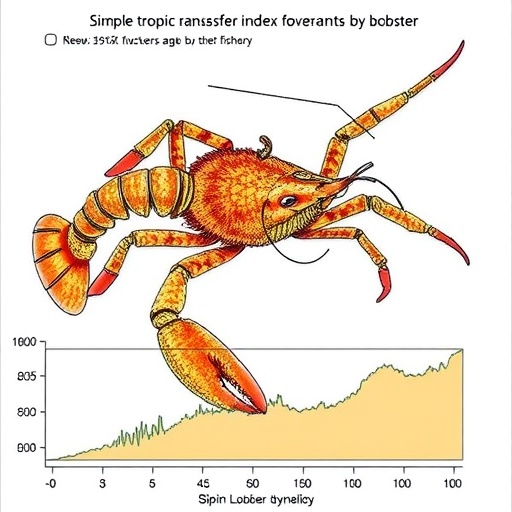
Marine scientists have unveiled a streamlined way to forecast how spiny lobster fisheries will rise or fall—using nothing more than a diet-based “trophic transfer index.” In a new study published in Communications Earth & Environment (2026), researchers led by L. Blanco-Bercial and colleagues describe an approach that converts ecological feeding relationships into a quantitative signal of population momentum.
The core idea is that lobster abundance is tightly linked to what supports their food web. If the trophic pathways feeding lobsters strengthen, energy can move upward through the ecosystem; if they weaken, lobster recruitment and survival should follow. Rather than relying on complex, data-heavy ecosystem models, the team proposes a simpler metric designed to capture this transfer efficiently.
Technically, the trophic transfer index is built from predator–prey linkages and trophic positions, effectively estimating how much energy or biomass potential can flow from prey communities to lobster consumers. The index is intended to summarize whether the surrounding food resources are positioned to sustain lobster growth over relevant time scales.
Using the index in analyses of spiny lobster fishery dynamics, the authors report that it can track changes in population indicators and better reflect how ecological conditions translate into fishery outcomes. The method aims to improve responsiveness—helping managers anticipate shifts earlier than they could with slower-moving indicators alone.
A key advantage is practicality. Many regions lack the long time series or fine-scale ecological measurements required for traditional modeling frameworks. By grounding predictions in trophic structure, the index reduces the dependency on extensive parameter tuning.
The paper also suggests that trophic forcing can serve as a bridge between ecosystem change and harvest performance. In other words, environmental variability that reshapes prey availability or community structure may propagate through the food web and become visible in lobster fisheries.
For decision-makers, the result is a tool that is conceptually transparent and operationally feasible. With further calibration and continued monitoring, the trophic transfer index could support adaptive management by linking ecological signals to stock status.
Looking ahead, the authors note that future work should test the framework across regions and incorporate additional ecological drivers such as habitat variation and fishing pressure. Still, the headline remains: a simple diet-based metric can carry surprising predictive power.
Cite Scienmag News
Gavin Prescott. (July 17, 2026). Simple trophic transfer index forecasts spiny lobster fishery dynamics. Scienmag. https://scienmag.com/simple-trophic-transfer-index-forecasts-spiny-lobster-fishery-dynamics/
Gavin Prescott. "Simple trophic transfer index forecasts spiny lobster fishery dynamics." Scienmag, 17 July 2026, https://scienmag.com/simple-trophic-transfer-index-forecasts-spiny-lobster-fishery-dynamics/. Accessed 4 September 2026.
Gavin Prescott. "Simple trophic transfer index forecasts spiny lobster fishery dynamics." Scienmag. July 17, 2026. https://scienmag.com/simple-trophic-transfer-index-forecasts-spiny-lobster-fishery-dynamics/


