

Monday, July 13, 2026
Science
No Result
View All Result
  • Login
  • HOME
  • SCIENCE NEWS
  • CONTACT US
  • HOME
  • SCIENCE NEWS
  • CONTACT US
No Result
View All Result
Scienmag
No Result
View All Result
Home Science News Agriculture

Shrimp Feeding Behavior Studied in Simulated Microgravity for Space Aquaculture

July 13, 2026
in Agriculture
Reading Time: 2 mins read
0
Shrimp Feeding Behavior Studied in Simulated Microgravity for Space Aquaculture

Shrimp Feeding Behavior Studied in Simulated Microgravity for Space Aquaculture

65
SHARES
587
VIEWS
Share on FacebookShare on Twitter
ADVERTISEMENT

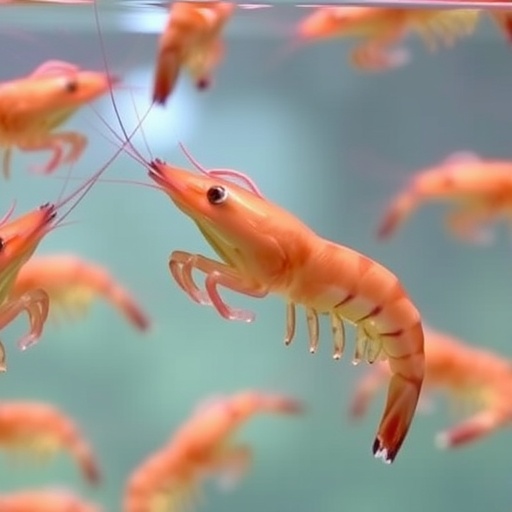
Researchers at Okayama University of Science have achieved a breakthrough in space aquaculture by successfully observing the feeding behavior of juvenile shrimp under simulated microgravity conditions. This advance could pave the way for sustainable food production systems on the Moon and Mars, essential for long-term human space exploration.

The hallmark of this study lies in the development of a novel high-speed clinostat—a device that simulates microgravity by rapidly rotating specimens around two perpendicular axes. Unlike traditional clinostats rotating at about 20 rpm, which allow aquatic animals to regain normal posture and thus negate microgravity effects, this new design spins swiftly enough to prevent shrimp from righting themselves. This innovation enabled unprecedented long-duration observation of shrimp feeding behaviors in a microgravity analog environment.

Transporting fully grown fish to extraterrestrial colonies is impractical, so juvenile fish, larvae, or eggs must be cultured in space. However, uncertainties regarding their ability to thrive and feed properly without Earth’s gravity have posed significant challenges. The research group, comprising life science experts and aquaculture specialists, sought to address these questions by creating conditions mimicking space’s microgravity on Earth.

Previous microgravity simulation methods—such as parabolic flights, drop towers, and magnetic levitation—proved unsuitable for extended experiments or failed in practical application with live aquatic animals. The high-speed clinostat overcame these issues, allowing realistic and sustained microgravity simulation for freely moving aquatic species.

After rigorous testing and refinement, the team successfully recorded live footage of juvenile shrimp feeding under simulated microgravity. Subsequent genetic analyses, including Gene Ontology assessments, revealed molecular changes potentially induced by microgravity exposure. To strengthen their findings, the team expanded experiments to include Artemia, small crustaceans that grow rapidly and tolerate group culturing. Artemia feeding on microalgae—Tetraselmis—was confirmed to continue unabated even under these conditions.

All experiments utilized “Third Water,” a proprietary aquatic medium developed by the university, optimized to support aquatic life in space-like environments. This innovative approach aims to sustain closed-loop aquaculture systems suitable for space habitats.

Looking ahead, the team is engineering an aquaculture tank sized for potential installation on the International Space Station. Their goal is a fully closed recirculating system that can maintain aquatic life for over 100 days without water exchange. Remote-controlled automatic feeders and AI-powered organism recognition systems are also in development to automate and enhance aquaculture operations in space.

These breakthroughs represent critical steps toward realizing the vision of space-based aquaculture, promising to enhance future astronauts’ nutrition and well-being on long-duration planetary missions. As humanity eyes extended stays beyond Earth, innovations like these will be indispensable to sustainable life support.


Article Title: In Situ Observation of Shrimp Feeding Process Under Microgravity Environment
News Publication Date: June 2026
Web References: http://dx.doi.org/10.1007/s12217-026-10262-3
Image Credits: Okayama University of Science
Keywords: Space aquaculture, microgravity simulation, clinostat, juvenile shrimp, Artemia, closed-loop aquaculture, space food production

Tags: advanced microgravity research methodschallenges of extraterrestrial aquaculturehigh-speed clinostat technologyimplications for human space explorationjuvenile shrimp feeding behaviorlong-duration microgravity experimentsmicrogravity effects on aquatic animalsmicrogravity simulationsimulated microgravity environmentSpace aquaculturespace farming for Moon and Marssustainable food production in space
Share26Tweet16
Previous Post

Richer, denser cities cut water use faster after early drought warnings

Next Post

Ceperognastat Shows Promise in Early Symptomatic Alzheimer’s Disease Treatment

Related Posts

Mulberry Biochar Boosts Fish Gut Health and Aquaculture Water Quality
Agriculture

Mulberry Biochar Boosts Fish Gut Health and Aquaculture Water Quality

July 10, 2026
Wearable Devices Developed to Monitor Plant Health in Real Time
Agriculture

Wearable Devices Developed to Monitor Plant Health in Real Time

July 9, 2026
Plant Roots Avoid Rot by Steering Clear of Infected Areas
Agriculture

Plant Roots Avoid Rot by Steering Clear of Infected Areas

July 9, 2026
Designing Successful Living Labs for Agriculture and Nutrition Research
Agriculture

Designing Successful Living Labs for Agriculture and Nutrition Research

July 9, 2026
Sawdust-Based Material Effectively Cleans Dye and Food Processing Wastewater
Agriculture

Sawdust-Based Material Effectively Cleans Dye and Food Processing Wastewater

July 8, 2026
Harnessing Neglected Livestock for Sustainable Food Systems in the Global South
Agriculture

Harnessing Neglected Livestock for Sustainable Food Systems in the Global South

July 8, 2026
Next Post
Ceperognastat Shows Promise in Early Symptomatic Alzheimer’s Disease Treatment

Ceperognastat Shows Promise in Early Symptomatic Alzheimer’s Disease Treatment

  • Mothers who receive childcare support from maternal grandparents show more

    Mothers who receive childcare support from maternal grandparents show more parental warmth, finds NTU Singapore study

    27656 shares
    Share 11059 Tweet 6912
  • University of Seville Breaks 120-Year-Old Mystery, Revises a Key Einstein Concept

    1061 shares
    Share 424 Tweet 265
  • Bee body mass, pathogens and local climate influence heat tolerance

    682 shares
    Share 273 Tweet 171
  • Researchers record first-ever images and data of a shark experiencing a boat strike

    546 shares
    Share 218 Tweet 137
  • Groundbreaking Clinical Trial Reveals Lubiprostone Enhances Kidney Function

    531 shares
    Share 212 Tweet 133
Science

Embark on a thrilling journey of discovery with Scienmag.com—your ultimate source for cutting-edge breakthroughs. Immerse yourself in a world where curiosity knows no limits and tomorrow’s possibilities become today’s reality!

RECENT NEWS

  • Researchers remotely achieve real-time autonomous control of nuclear reactor power
  • IU Study Links Obesity to Leukemia, Weight-Loss Drugs Could Halt It
  • CCNY Researchers Unveil Breakthrough in Quantum Materials Science
  • Groundbreaking Surgery Completed on Western Lowland Gorilla at San Diego Zoo

Categories

  • Agriculture
  • Anthropology
  • Archaeology
  • Athmospheric
  • Biology
  • Biotechnology
  • Blog
  • Bussines
  • Cancer
  • Chemistry
  • Climate
  • Earth Science
  • Editorial Policy
  • Marine
  • Mathematics
  • Medicine
  • Pediatry
  • Policy
  • Psychology & Psychiatry
  • Science Education
  • Social Science
  • Space
  • Technology and Engineering

Subscribe to Blog via Email

Enter your email address to subscribe to this blog and receive notifications of new posts by email.

Join 5,146 other subscribers

© 2025 Scienmag - Science Magazine

Welcome Back!

Login to your account below

Forgotten Password?

Retrieve your password

Please enter your username or email address to reset your password.

Log In
No Result
View All Result
  • HOME
  • SCIENCE NEWS
  • CONTACT US

© 2025 Scienmag - Science Magazine

Discover more from Science

Subscribe now to keep reading and get access to the full archive.

Continue reading
