

Thursday, September 3, 2026
Science
No Result
View All Result
  • Login
  • HOME
  • SCIENCE NEWS
  • CONTACT US
  • HOME
  • SCIENCE NEWS
  • CONTACT US
No Result
View All Result
Scienmag
No Result
View All Result
Home Science News Space

ShortSCOPE: Optical Short-Period Seismic Sensor Designed for Planetary Exploration

August 25, 2026
in Space
Grant Pearson
By Grant Pearson Scienmag Editorial Profile - Observational Astronomy
Reading Time: 2 mins read
0
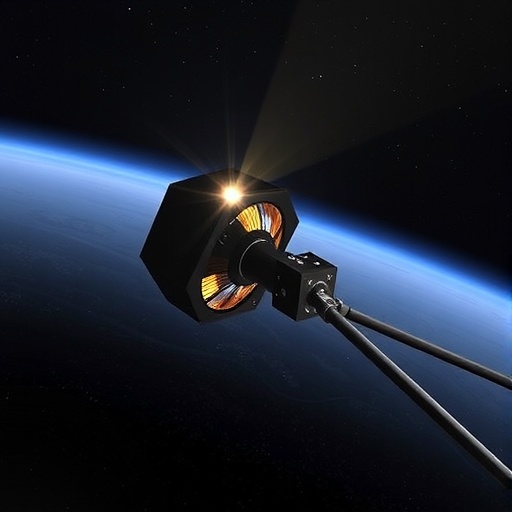
ShortSCOPE: Optical Short-Period Seismic Sensor Designed for Planetary Exploration

ShortSCOPE: Optical Short-Period Seismic Sensor Designed for Planetary Exploration

65
SHARES
587
VIEWS
Share on FacebookShare on Twitter
ADVERTISEMENT

This article presents ShortSCOPE, a compact optical force-balanced seismometer designed for planetary missions.

Key points

  • Purpose: Detect seismic activity and study planetary interiors on targets such as the Moon, Europa, asteroids, and other ocean worlds.
  • Technology: Uses a suspended coil–magnet proof mass with an 850-nm laser interferometer to measure extremely small displacements. Feedback forces keep the proof mass near equilibrium.
  • Performance:
    • Target noise: approximately (1\times10^{-9}\ \mathrm{m/s^2/\sqrt{Hz}}) at 10 Hz
    • Flat acceleration response from 0.0095 to 150 Hz
    • Extended response up to approximately 400 Hz
    • Shock tolerance: up to 500 g
    • Random vibration tolerance: 14.1 g RMS
    • Thermal-vacuum qualification from −55 °C to +70 °C
    • Survival at housing temperatures as low as −170 °C
  • Size and resources:
    • Approximately (3.2 \times 4) cm
    • Mass: 115 g per sensor
    • Power: 40 mW per sensor
  • Deployment advantages: It can tolerate at least ±30° of tilt in lunar or Europan gravity, reducing or eliminating the need for leveling mechanisms.
  • Design improvements over the commercial SiA sensor:
    • Larger proof mass, up to roughly 30 g
    • Lower mechanical resonant frequency, about 15 Hz
    • Modified leaf springs
    • Reduced self-noise through improved suspension and operation in low-pressure or vacuum environments
  • Mission relevance: The sensor reached Technology Readiness Level 6 and is intended for potential deployment through the Lunar Environment Monitoring Station (LEMS). It could provide long-duration seismic observations near the lunar south pole, particularly at frequencies above 20 Hz.
  • Scientific significance: On Europa, such measurements could help constrain ice-shell thickness, ocean depth, internal layering, tectonic activity, and high-frequency icequakes.

In short, ShortSCOPE combines optical displacement sensitivity with low power, small size, ruggedness, and high tilt tolerance, making it well suited to planetary surface missions where conventional broadband seismometers may be difficult to deploy.

Subject of Research: Space

Article Title: ShortSCOPE: Optical Short-Period Seismic Sensor Designed for Planetary Exploration

Article References: DellaGiustina, D. N., Avenson, B. D., Kim, D., Marusiak, A. G., Bray, V. J., Hofstadter, D., Meyer, S., Otterbacher, S. E., Golish, D. R., Bennett, C. A., Schmerr, N. C., Benna, M., Pettit, E. C., Ballouz, R.-L., Weber, R. C., & “Hop” Bailey, S. (2026). ShortSCOPE: An Optical Short-Period Seismic Sensor for Planetary Exploration. Space Science Reviews, 222(6), Article 65. https://doi.org/10.1007/s11214-026-01320-8

Image Credits: AI Generated

DOI: 10.1007/s11214-026-01320-8

Keywords: high sensitivity seismic instruments for space missions, laser interferometer seismic measurement, long-duration planetary seismic monitoring, low-noise seismic sensors for extraterrestrial environments, lunar and planetary interior exploration, optical force-balanced seismometer, planetary seismic sensors, seismic activity detection on moons and asteroids, shock and vibration tolerant seismometers, small form factor seismometer, thermal-vacuum qualified planetary sensors, tilt-tolerant lunar seismometers

Cite Scienmag News

Grant Pearson. (August 25, 2026). ShortSCOPE: Optical Short-Period Seismic Sensor Designed for Planetary Exploration. Scienmag. https://scienmag.com/shortscope-optical-short-period-seismic-sensor-designed-for-planetary-exploration/


Grant Pearson. "ShortSCOPE: Optical Short-Period Seismic Sensor Designed for Planetary Exploration." Scienmag, 25 August 2026, https://scienmag.com/shortscope-optical-short-period-seismic-sensor-designed-for-planetary-exploration/. Accessed 3 September 2026.

Grant Pearson. "ShortSCOPE: Optical Short-Period Seismic Sensor Designed for Planetary Exploration." Scienmag. August 25, 2026. https://scienmag.com/shortscope-optical-short-period-seismic-sensor-designed-for-planetary-exploration/

Tags: high sensitivity seismic instruments for space missionslaser interferometer seismic measurementlong-duration planetary seismic monitoringlow-noise seismic sensors for extraterrestrial environmentslunar and planetary interior explorationoptical force-balanced seismometerplanetary seismic sensorsseismic activity detection on moons and asteroidsshock and vibration tolerant seismometerssmall form factor seismometerthermal-vacuum qualified planetary sensorstilt-tolerant lunar seismometers
Share26Tweet16
Previous Post

AI and Blockchain Trace Sanskrit Manuscripts, Link Variants and Support Ethical Preservation

Next Post

Neuromorphic bionic eye with dense waveguide pixels enables tunable-depth 3D vision

Related Posts

Trafficability and excavatability of icy lunar regolith simulants quantified using cone penetration
Space

Trafficability and excavatability of icy lunar regolith simulants quantified using cone penetration

September 3, 2026
Why Decoding Alien Atmospheres Is Pushing Supercomputers to Their Limits
Space

Why Decoding Alien Atmospheres Is Pushing Supercomputers to Their Limits

September 3, 2026
Developing a sustainable human lunar presence using space resources
Space

Developing a sustainable human lunar presence using space resources

September 3, 2026
Mercury’s crust formed by extreme volcanism
Space

Mercury’s crust formed by extreme volcanism

September 3, 2026
Warm inflation in a braneworld scenario
Space

Warm inflation in a braneworld scenario

September 3, 2026
Subauroral Flows and Arcs Rewrite the Rules of Space Electrodynamics
Space

Subauroral Flows and Arcs Rewrite the Rules of Space Electrodynamics

August 30, 2026
Next Post
Neuromorphic bionic eye with dense waveguide pixels enables tunable-depth 3D vision

Neuromorphic bionic eye with dense waveguide pixels enables tunable-depth 3D vision

  • Mothers who receive childcare support from maternal grandparents show more optimized

    Mothers who receive childcare support from maternal grandparents show more parental warmth, finds NTU Singapore study

    27656 shares
    Share 11059 Tweet 6912
  • University of Seville Breaks 120-Year-Old Mystery, Revises a Key Einstein Concept

    1061 shares
    Share 424 Tweet 265
  • Bee body mass, pathogens and local climate influence heat tolerance

    682 shares
    Share 273 Tweet 171
  • Researchers record first-ever images and data of a shark experiencing a boat strike

    546 shares
    Share 218 Tweet 137
  • Groundbreaking Clinical Trial Reveals Lubiprostone Enhances Kidney Function

    531 shares
    Share 212 Tweet 133
Science

Embark on a thrilling journey of discovery with Scienmag.com—your ultimate source for cutting-edge breakthroughs. Immerse yourself in a world where curiosity knows no limits and tomorrow’s possibilities become today’s reality!

RECENT NEWS

  • Estimating uncertainty in end-of-life costs and embodied carbon of construction projects
  • Pediatric Behçet’s Disease Marked by Recurring Oral and Genital Ulcers
  • Ultrafast Ultrasound With Phrenic Stimulation Diagnoses Diaphragm Dysfunction Noninvasively
  • Shikonin compound triggers prostate cancer cell death through heme oxygenase-1 and ERK/p38 pathways

Categories

  • Agriculture
  • Anthropology
  • Archaeology
  • Athmospheric
  • Biology
  • Biotechnology
  • Blog
  • Bussines
  • Cancer
  • Chemistry
  • Climate
  • Earth Science
  • Editorial Policy
  • Marine
  • Mathematics
  • Medicine
  • Pediatry
  • Policy
  • Psychology & Psychiatry
  • Science Education
  • Social Science
  • Space
  • Technology and Engineering

Subscribe to Blog via Email

Enter your email address to subscribe to this blog and receive notifications of new posts by email.

Join 5,151 other subscribers

© 2025 Scienmag - Science Magazine

Welcome Back!

Login to your account below

Forgotten Password?

Retrieve your password

Please enter your username or email address to reset your password.

Log In
No Result
View All Result
  • HOME
  • SCIENCE NEWS
  • CONTACT US

© 2025 Scienmag - Science Magazine

Discover more from Science

Subscribe now to keep reading and get access to the full archive.

Continue reading