


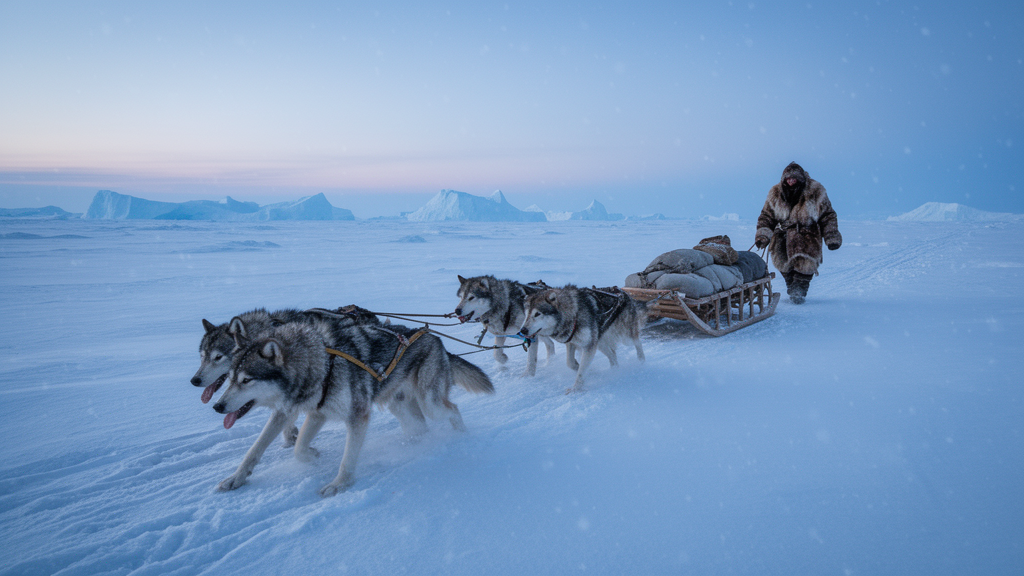
For at least nine millennia, the frozen expanses of the Arctic have been crossed not on horseback or by ox cart, but behind teams of dogs. Sled dogs hauled supplies, hunting gear, and household goods across snow and sea ice where no other domesticated animal could operate, making them the logistical backbone of some of the most demanding human societies on Earth. Now, a new study published on October 14 in the Cell Press journal iScience suggests that the remarkable efficiency of these animals was written into their very skeletons. By combining biomechanical modeling with the analysis of both modern and ancient dog bones, researchers have found that sled dogs, past and present, share a distinctive short-legged body plan that appears to give them a measurable mechanical advantage when pulling heavy loads. The discovery not only explains why these dogs look the way they do, but also offers archaeologists a new tool for tracing how dog-powered transport spread across the cold regions of the world.
The research was motivated by a long-standing puzzle in Arctic archaeology. The earliest archaeological evidence associated with dog sledding dates to the early Holocene, roughly 9,000 years ago, on Zhokhov Island in modern-day Russia, where excavators uncovered sled parts alongside dog remains. Yet sledding equipment, made largely of wood, bone, and antler, rarely survives in the archaeological record, and when it does, it is often difficult to interpret. As a result, scientists have struggled to determine precisely when and where dog sledding first emerged, and how the practice dispersed across Siberia, the North American Arctic, and Greenland. Without a reliable marker in the dogs themselves, the deep history of this partnership has remained frustratingly opaque.
First author Mitya Kletzerman of the University of Haifa in Israel emphasizes just how central these animals were to life at the top of the world. Sled dogs, he notes, played an indispensable role in Arctic communities: without them, people could not move efficiently to hunt, relocate as conditions changed, or travel between communities to exchange knowledge and share new ideas. Understanding how the practice of dog sledding evolved, he argues, offers new insights into how humans adapted to life in one of the planet’s harshest environments. The question his team set out to answer was whether the physical demands of hauling sleds had left a detectable signature in the dogs’ skeletons, one that could survive in the archaeological record long after sleds and harnesses had rotted away.
There was good reason to think such a signature might exist. Previous research has shown that work imposed by humans can leave traces in an animal’s skeleton. Racing reindeer, for example, along with reindeer used for carrying loads and pulling, show limb bone differences compared with their non-working counterparts. Bone is a living tissue that remodels in response to the forces placed upon it, and selective breeding over generations can fix proportions that suit a particular task. Kletzerman and his colleagues therefore wondered whether sled dogs had developed skeletal traits that helped them cope with the specific biomechanical demands of pulling a loaded sled across snow and ice.
To find out, the team first built a biomechanical model describing how a dog’s body handles the work of hauling. The model revealed a key principle: one effective way for a dog to pull a loaded sled is to lower its center of gravity. When people or animals pull a load, the force tends to tip them backward, and a lower or more forward position of the center of mass counteracts this effect, allowing the animal to generate greater pulling force. In other words, a dog built closer to the ground can lean into its harness more effectively, converting muscle power into forward motion with less of the load’s resistance wasted in destabilizing torque. The physics pointed to a simple prediction: sled dogs should have proportionally shorter limbs than other canids of similar size.
The researchers then tested that prediction on modern animals. They analyzed the limb bones of 60 canids, including sled dogs, wolves, mongrels, and spitzes, comparing the lengths of five long bones: the humerus, radius, and ulna in the forelegs, and the femur and tibia in the hind legs. After accounting for overall skeletal size, a clear pattern emerged. Sled dogs had relatively shorter radius, ulna, and tibia bones than the non-sled canids, with these particular bones measuring about 6 percent shorter on average. Intriguingly, the shortening was not uniform across all limb segments, suggesting a specific rather than a general reduction in leg length. Kletzerman notes that it remains unclear exactly how this trait developed, but selective pressure may have preserved it because it gave sled dogs an advantage over other dogs working in the same environment.
The crucial next step was to determine whether this short-legged phenotype existed in the deep past, or whether it arose only recently through modern breeding. To answer that question, the team examined 82 ancient dog bones and three complete skeletons of ritually buried dogs recovered from three archaeological sites associated with ancestral Inuit populations in present-day Chukotka, Russia, dating from roughly 2,000 to 500 years ago. The results were striking. About 89 percent of the ancient bones were classified as consistent with the modern sled-dog pattern of shorter leg bones, and all three of the ritually buried dogs conformed to it as well. Two thousand years ago, dogs living in the western Arctic already possessed the same biomechanically advantageous proportions seen in sled teams today.
Beyond its biomechanical interest, the finding carries significant practical weight for archaeology. Because the skeletal pattern appears in incomplete remains, it can be used to identify probable sled dogs even at sites where no sled parts, harness fittings, or other direct evidence of transport equipment have survived. Bone fragments that would previously have been cataloged simply as dog remains can now be reinterpreted as evidence of a working sled dog population, potentially pushing back the known geographic range and timeline of dog-powered transport. The method could allow researchers to map how and when the sledding partnership spread from its early Holocene origins toward the eastern Arctic, complementing the sparse and fragile record of wooden sled hardware with the far more durable record of bone.
The study also adds a new chapter to the long story of human-dog coevolution. Dogs have been working alongside humans for thousands of years, Kletzerman observes, but scientists are only beginning to understand how that partnership shaped the animals themselves. In the Arctic, that shaping appears to have been profound: the demands of hauling loads across snowfields favored dogs whose shortened radius, ulna, and tibia lowered their center of mass and improved traction against the backward pull of a loaded sled. Whether this phenotype emerged through deliberate selection by ancient breeders or through natural filtering of which dogs could best perform the work is a question the researchers hope future studies will resolve. Either way, the stubby legs of the sled dog now stand as a fossilizable record of one of humanity’s oldest technological partnerships, readable from bones long after the sleds themselves have vanished.
Published as Kletzerman and colleagues’ paper, Ancient Inuit dogs conform to a short-legged phenotype biomechanically advantageous for sledding, in iScience, an open-access journal from Cell Press, the work exemplifies how biomechanics, archaeology, and zooarchaeology can converge on questions that neither field could answer alone. For the communities of the Arctic, the findings confirm what generations of mushers have known intuitively: the sled dog’s low-slung, powerful build is no accident but an adaptation honed over thousands of years of shared labor. And for science, the 6 percent difference in limb proportions offers a durable, measurable signature of that labor, one that promises to illuminate the deep history of how humans and dogs together conquered the coldest landscapes on the planet.
Subject of Research: Biomechanical and archaeological analysis of the short-legged phenotype of ancient and modern sled dogs
Article Title: The stubby legs of ancient sled dogs helped people traverse the Arctic for the past 9,000 years
Article References: The stubby legs of ancient sled dogs helped people traverse the Arctic for the past 9,000 years. (n.d.). Original publication
Image Credits: AI Generated
DOI: Not provided
Keywords: sled dogs, Arctic, biomechanics, ancient DNA-free skeletal analysis, iScience, Inuit, Chukotka, Zhokhov Island, dog sledding, limb bone proportions, zooarchaeology, human-animal partnership
Cite Scienmag News
Denise Maddox. (October 15, 2026). Short legs gave ancient sled dogs a 9,000-year pulling advantage in the Arctic. Scienmag. https://scienmag.com/short-legs-gave-ancient-sled-dogs-a-9000-year-pulling-advantage-in-the-arctic/
Denise Maddox. "Short legs gave ancient sled dogs a 9,000-year pulling advantage in the Arctic." Scienmag, 15 October 2026, https://scienmag.com/short-legs-gave-ancient-sled-dogs-a-9000-year-pulling-advantage-in-the-arctic/. Accessed 15 October 2026.
Denise Maddox. "Short legs gave ancient sled dogs a 9,000-year pulling advantage in the Arctic." Scienmag. October 15, 2026. https://scienmag.com/short-legs-gave-ancient-sled-dogs-a-9000-year-pulling-advantage-in-the-arctic/


