


Pain is notoriously difficult to measure. Researchers can ask people how much something hurts, but self-reports are shaped by memory, vocabulary, mood, and social expectations. Now a team of scientists from the University of Osnabrück and the University Hospital of Child and Adolescent Psychiatry and Psychotherapy in Bern has unveiled a system that captures pain as it unfolds, second by second, combining objective stimulus data with subjective ratings and an unexpected behavioral signal: how hard a person presses their hand against the source of the pain. The open-source tool, called CAREST, is described in the journal Behavior Research Methods and could reshape how pain sensitivity is studied from childhood through adulthood.
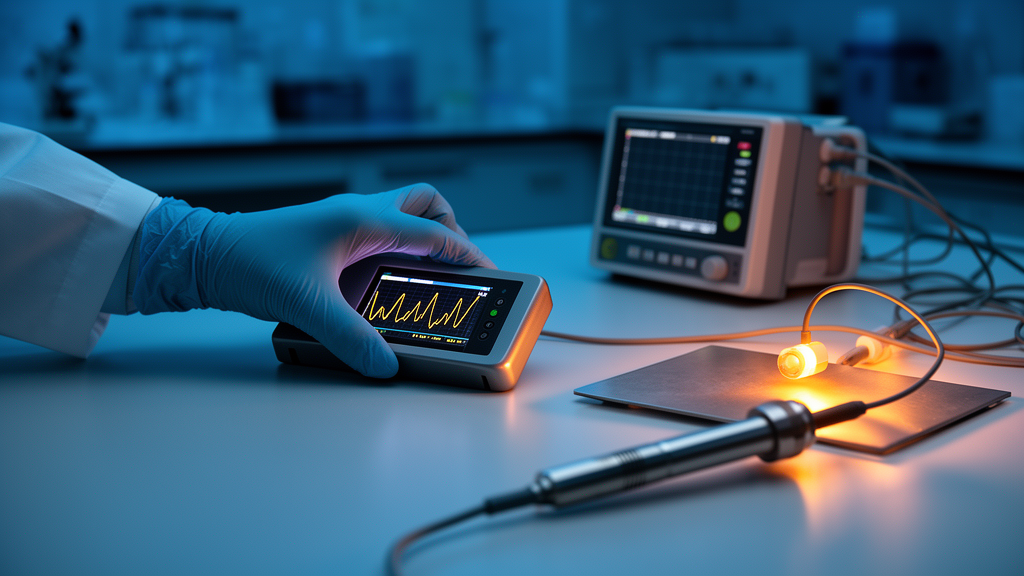
CAREST, short for Controlling and Recording Experiments in Sensitivity to Temperature, is built on the open-source PsychoPy platform and orchestrates a complete thermal pain experiment from a single touchscreen laptop. At its heart is a dual cold/hot plate resting on a platform supported by four load cells. The software communicates with the plate’s internal temperature controller over USB, programming precise heating or cooling ramps, while simultaneously reading the force exerted by the participant’s hand at ten samples per second through an HX711 24-bit analog-to-digital converter and an ESP32 microcontroller. Every two seconds, the system logs three synchronized data streams: plate surface temperature, the participant’s pain rating, and hand-plate contact force.
The experimental protocol is deliberately gentle. For heat pain trials, the plate starts at a comfortable 35 degrees Celsius and ramps upward at just 0.08 degrees per second, reaching a safety-capped peak of 47.4 degrees within about two and a half minutes. Cold pain trials begin at 25 degrees and descend at a similar pace toward 5 degrees. Before the temperature ramp begins, participants spend three minutes adapting while the experimenter delivers standardized instructions, including practice with the rating scale using hypothetical pain vignettes such as falling into soft snow, scraping a knee on pavement, or pinching a finger in a car door. This familiarization helps ensure that everyone, including children with limited attention spans, understands how to use the visual analog scale before real thermal stimulation starts.
That rating scale is itself a thoughtful design choice. Rather than spanning from
Rather than spanning from zero to one hundred, the visual analog scale runs from 0, labeled “no pain,” to 10, labeled “very severe pain.” Participants drag a slider on the touchscreen continuously while the plate warms or cools, which means their ratings track the unfolding sensation in real time rather than being reconstructed after the fact. This continuous approach sidesteps a well-known problem in pain research: when people rate pain only at the end of a stimulus, their judgments are contaminated by reaction time, memory, and peak-end effects. Because the rating is time-stamped alongside the temperature record, researchers can later align the moment a participant first reports pain with the exact plate temperature at that instant, yielding a threshold estimate that is both objective on the stimulus side and subjective on the perception side.
The load cells beneath the plate add a dimension that has rarely been captured in human thermal pain testing. When a participant rests a hand on a heated or cooling surface, the force of that contact is not trivial. Pressing harder increases the contact area between palm and plate, improves the thermal connection, and engages more thermoreceptors while accelerating heat transfer. Lifting slightly or hovering above the surface does the opposite. In other words, contact force is not just a technical detail of stimulus delivery; it is a behavioral variable that can modulate how quickly and how intensely pain arrives. Prior work on spatial summation has shown that larger stimulated skin areas reliably lower heat pain thresholds, so two participants receiving the same nominal temperature may experience quite different sensations depending on how firmly they press down.
What makes the force measurement especially interesting is what it reveals when participants do not know it is being recorded. The experimenters can hide the force display, turning the load cells into an unobtrusive window on automatic motor behavior. As pain intensifies, some people press down harder, a pattern the authors interpret as potentially reflecting rising muscular tension or a kind of bracing against the stimulus. Others lighten their touch or lift away entirely, consistent with a flight response or avoidance tendency. The pilot data suggest these tendencies are far from uniform: roughly one in five participants deviated markedly from the modest average preference for avoiding the painful contact. This heterogeneity is precisely the kind of signal that could matter for research linking pain processing to psychiatric conditions, since altered pain perception and unusual pain-related behavior have been reported in depression, borderline personality disorder, and self-injurious behavior.
The rationale for connecting pain biology to mental health is grounded in a substantial literature. Quantitative sensory testing, the standardized framework within which thermal pain thresholds and tolerances are typically assessed, has been used to identify individual neuronal pain mechanisms and to evaluate or predict how patients respond to medications. Thermal stimuli delivered through carefully controlled devices are among the best-established ways to induce pain safely in the laboratory, and they allow researchers to measure detection thresholds, pain thresholds, and tolerance in a single session. What earlier setups generally lacked, however, was the ability to record stimulus parameters, subjective perception, and behavioral responses continuously and synchronously at high temporal resolution. That gap matters for studies that want to align pain events with concurrently recorded physiological signals such as heart rate or brain activity, where even a second of timing uncertainty can blur the interpretation of evoked responses.
The choice of a plate rather than a small handheld thermode also reflects a deliberate trade-off. Devices like the Contact Heat Evoked Potential Stimulator are fixtures of the field, but they must be affixed to a specific patch of skin, which lengthens setup time and can provoke anxiety, particularly in younger participants. A plate, by contrast, mimics an everyday scenario—putting a hand on a surface that is growing uncomfortably warm or cold—and requires no attachment at all. The participant can withdraw the hand at any moment, which doubles as an ethical safeguard and a built-in stop mechanism. The surface is large enough to accommodate an entire palm regardless of body size, avoiding a subtle bias: when a small thermode covers a fixed area of skin, that area represents a different proportion of a child’s palm than an adult’s, producing different spatial summation effects that confound age comparisons. With a plate, the stimulated region scales naturally with the hand, making lifespan studies more methodologically defensible.
The slow ramp rates serve a similar dual purpose of safety and practicality. Rapid temperature changes are known to produce higher pain ratings and to make measured thresholds more dependent on reaction time, which disadvantages children whose responses may be less consistent. Gentle ramps of a fraction of a degree per second reduce that dependence, keep skin temperature stress low, and give participants ample opportunity to report sensations and withdraw before reaching tolerance. The safety caps on the hardware—47.4 degrees for heat and 5 degrees for cold in this implementation—ensure that no trial can push a participant beyond well-tolerated limits, addressing the ethical requirement that no stimulus exceed a child’s tolerance and that withdrawal always remain possible.
The pilot study with 94 adults provides a first map of what the system can measure. Alongside the conventional trio of pain threshold, pain intensity, and pain tolerance, the researchers derived measures of endurance and contact force dynamics, all computed from the same synchronized recording. The data showed substantial individual variation not only in sensitivity but in behavior: while the group average leaned toward mild avoidance of the painful plate, a meaningful minority behaved differently, some maintaining or even increasing contact as pain grew. Whether such patterns reflect stable trait-like differences in pain coping, momentary strategy, or something else entirely remains an open question, but the tool makes it possible to ask it with continuous, quantifiable data rather than retrospective reports.
For researchers considering adoption, the open-source nature of the software lowers a significant barrier. Pain testing equipment and proprietary stimulation software can be costly, and closed systems often make it difficult to integrate stimulus timing with other recording hardware. Because CAREST is built on PsychoPy, a widely used platform for behavioral experiments, labs can inspect the code, adapt protocols, and synchronize the pain task with electroencephalography, electrocardiography, or other physiological streams using shared clocks. The use of inexpensive, off-the-shelf components for the force measurement—an ESP32 microcontroller and an HX711 converter—suggests that the hardware side of the platform is similarly accessible to labs without specialized engineering support.
There are, of course, limits to what any single method can capture. Thermal pain is only one modality, and findings from heat and cold plates may not generalize to mechanical pain, chemical pain, or clinical pain conditions. Self-reports on a visual analog scale, even continuous ones, remain subjective judgments that can be influenced by expectancy and context. The pilot sample was composed of adults, so reference values for children and adolescents will need to be established before lifespan comparisons can be fully realized. Still, the underlying logic of the design—that pain should be measured as a dynamic process involving stimulus, perception, and behavior simultaneously—is broadly applicable, and the demonstration that contact force carries meaningful information about approach and avoidance opens a line of inquiry that earlier thermode-based protocols could not pursue.
As pain research increasingly turns toward developmental questions—how pain sensitivity emerges in childhood, how it changes through adolescence, and how it relates to the onset of stress-related psychopathology—tools that are safe, tolerable, comparable across ages, and rich in synchronized data will be essential. CAREST represents a step in that direction, packaging established psychophysical principles with a novel behavioral measure in a form that other laboratories can freely examine, replicate, and extend.
Subject of Research: A real-time thermal pain assessment tool integrating stimulus temperature, contact force, and subjective pain ratings across age groups
Article Title: Real-time assessment of temperature sensitivity, pain processing, and pain behavior across the lifespan: Integrating stimulus data, contact force, and subjective ratings
Article References: Real-time assessment of temperature sensitivity, pain processing, and pain behavior across the lifespan: Integrating stimulus data, contact force, and subjective ratings. (n.d.). https://doi.org/10.3758/s13428-026-03192-w
Image Credits: AI Generated
DOI: 10.3758/s13428-026-03192-w
Keywords: pain research, thermal stimulation, CAREST, quantitative sensory testing, pain threshold, pain tolerance, contact force, approach avoidance, PsychoPy, lifespan, visual analog scale, psychiatry
Cite Scienmag News
Glenn Wilkins. (October 15, 2026). New Lab Tool Records Pain in Real Time, From Temperature to Hand Force. Scienmag. https://scienmag.com/new-lab-tool-records-pain-in-real-time-from-temperature-to-hand-force/
Glenn Wilkins. "New Lab Tool Records Pain in Real Time, From Temperature to Hand Force." Scienmag, 15 October 2026, https://scienmag.com/new-lab-tool-records-pain-in-real-time-from-temperature-to-hand-force/. Accessed 15 October 2026.
Glenn Wilkins. "New Lab Tool Records Pain in Real Time, From Temperature to Hand Force." Scienmag. October 15, 2026. https://scienmag.com/new-lab-tool-records-pain-in-real-time-from-temperature-to-hand-force/


