


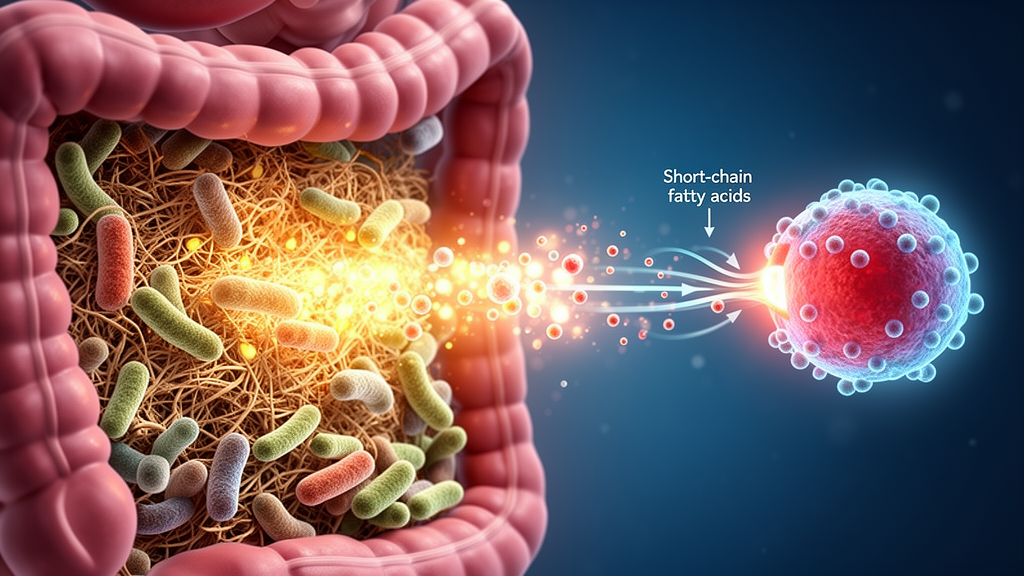
Deep in the colon, trillions of microbes are running a chemical factory whose products reach far beyond the gut. When dietary fiber resists digestion in the small intestine, it arrives in the colon as raw material for anaerobic fermentation, and the resulting metabolites—short-chain fatty acids, or SCFAs—are now recognized as some of the most important signaling molecules connecting the gut microbiota to the host immune system. A new review published in Frontiers in Nutrition by Xiaoli Hou, Yan Li, Weiwei Mu, Huiqin Wang, and Shaoping Ji of Zhengzhou Health College synthesizes a large body of research on how these metabolites regulate immune homeostasis and inflammation, and how their dysregulation is implicated in diseases ranging from inflammatory bowel disease to cancer and neurodegeneration. The authors argue that SCFAs have been redefined from mere intestinal energy sources into central mediators of host-microbiota communication.
SCFAs are organic fatty acids with short carbon chains, dominated by three members: acetate, propionate, and butyrate, along with branched-chain forms such as isobutyrate and isovalerate. Although small amounts can be absorbed directly from foods like dairy products and vegetable oils, the review emphasizes that direct dietary intake is far too limited to support the extensive roles these molecules play in immunity. The true physiological source is the anaerobic fermentation carried out by colonic bacteria, which makes SCFA generation tightly coupled to both diet and microbiota composition. This coupling matters: differences in SCFA production between individuals, and between healthy and diseased states, likely stem from dysregulation within the upstream diet-microbiota axis. Each of the three core SCFAs has distinct producers—Bifidobacterium and Lactobacillus generate much of the acetate, Clostridium and Roseburia contribute to propionate, and butyrate is dominated by Faecalibacterium, Roseburia hominis, and Eubacterium.
The metabolic fate of each SCFA depends strongly on carbon chain length, and this diversion pattern underpins their signaling geography. Roughly 70 to 90 percent of butyrate is absorbed by colonic epithelial cells and burned as a preferred fuel through beta-oxidation, making it the primary energy source for the intestinal lining and a guardian of barrier integrity. Propionate is largely captured by the liver, where it feeds gluconeogenesis and shapes the hepatic immune and metabolic microenvironment. Acetate, the most water-soluble of the three, escapes local metabolism, diffuses into the systemic circulation, and reaches peripheral tissues including adipose depots, where it acts as a key chemical link between gut and distal organs. SCFAs that are not locally utilized enter the bloodstream through specific transporters, including monocarboxylate transporter 1 and sodium-coupled monocarboxylate transporter 1, enabling delivery along what the review calls the gut-organ axis.
At the molecular level, the review identifies three core and overlapping pathways through which SCFAs modulate immunity. First, they act as ligands for G protein-coupled receptors, primarily GPR41/FFAR3, GPR43/FFAR2, and GPR109A, triggering downstream signal transduction that can dampen cAMP production and regulate MAPK and NF-kappaB pathways. Second, they inhibit histone deacetylases, mainly Class I and Class II enzymes, thereby altering epigenetic modifications of immune-related genes; butyrate is the strongest HDAC inhibitor among the three core SCFAs and plays a central role in epigenetic regulation. Third, as energy substrates, they reprogram cellular metabolism—reviewed examples include butyrate raising acetyl-CoA levels in T cells and activating mTOR signaling and fatty acid oxidation. Through these mechanisms, SCFAs broadly regulate the differentiation, function, and inflammatory responses of immune cells while maintaining intestinal barrier integrity.
The cellular consequences are extensive. In macrophages, butyrate and propionate can inhibit M2 polarization and alleviate allergic airway inflammation in animal models of asthma, while SCFAs suppress the production of pro-inflammatory cytokines such as IL-1beta, IL-6, and TNF-alpha by myeloid cells responding to lipopolysaccharide. Butyrate can also enhance antibacterial effects through HDAC3-mediated pathways and upregulate HIF-1alpha, increasing microbial clearance. In dendritic cells, SCFAs suppress IL-6 and TNF-alpha production and, through the SFK/PI3K/Rho signaling pathway and actin polymerization, promote dendritic cell elongation and antigen uptake. Among T cells, butyrate strongly promotes regulatory T cell differentiation and IL-10 production, maintaining immune tolerance, while butyrate and propionate suppress effector cytokines including TNF-alpha, IFN-gamma, and IL-17 from activated T cells. B cells are regulated too: butyrate and propionate, acting as HDAC inhibitors, reduce expression of Aicda and Prdm1, influencing class-switch recombination and plasma cell differentiation, and SCFAs promote IgA production while reducing total and antigen-specific IgE levels.
One of the review’s most striking themes is that SCFA effects are neither linear nor uniform. Butyrate exhibits a typical biphasic effect on macrophages: at low concentrations around 0.1 millimolar it inhibits TNF-alpha production via PPAR-gamma signaling, whereas at higher concentrations around 10 millimolar it can enhance inflammatory responses and induce cell death. The molecular basis may lie in the predominance of GPCR-mediated anti-inflammatory signaling at low doses versus widespread epigenetic reprogramming through HDAC inhibition at high doses. Cell type matters as much as dose. In CD4+ T cells, butyrate enhances histone H3 acetylation at the Foxp3 locus, promoting Treg differentiation; in CD8+ T cells, the same molecule drives ID2-dependent upregulation of IL-12R, increasing IFN-gamma and granzyme B production. The review attributes this divergence to distinct baseline epigenetic landscapes—the Foxp3 locus is in an inducible state in CD4+ but not CD8+ T cells—suggesting that future mechanistic studies should shift from a linear SCFA-receptor-signaling paradigm toward an interactive one in which intracellular state determines how the same signal is interpreted.
Context dependence extends into disease. In the tumor microenvironment, SCFAs can enhance the metabolic adaptability and cytotoxicity of CD8+ T cells and promote M1 macrophage polarization, yet they may also weaken immunotherapy by activating Tregs or inhibiting dendritic cell antigen presentation. In colorectal cancer, butyrate shows a paradoxical effect: it supports proliferation in normal intestinal epithelium but induces cell cycle arrest and apoptosis in cancer cells through HDAC inhibition. In CAR-T cell therapy, in vitro work suggests butyrate reshapes metabolic adaptation through dual activation of glycolysis and oxidative phosphorylation, promoting a memory-like phenotype and reducing exhaustion markers. In rheumatoid arthritis, SCFAs act through a triple mechanism of AMPK/mTOR metabolic reprogramming, HDAC inhibition, and NLRP3 inflammasome suppression, and butyrate-producing bacteria have been associated with restored Treg/Tfr balance and reduced joint inflammation. In type 1 diabetes models, acetate restored gut microbiota diversity and delayed disease onset, while in multiple sclerosis, propionate and butyrate alleviated neuro-inflammation through HDAC1 inhibition.
The reach of SCFAs extends along multiple organ axes. Through the gut-liver axis, Clostridium butyricum supplementation has been shown in animal models to attenuate hepatic inflammation and fibrosis via the butyrate-TGR5-IkappaB-alpha/NF-kappaB pathway, with relevance to metabolic dysfunction-associated steatotic liver disease. In type 2 diabetes, SCFAs activate GPR41/GPR43 and promote browning of white adipose tissue through AMPK/SIRT1/PGC-1alpha signaling. Through the gut-brain axis, SCFAs modulate microglial function, neuro-inflammation, and blood-brain barrier integrity: in Parkinson’s disease models they regulate alpha-synuclein aggregation and neuro-inflammation via GPR43-NLRP3 signaling, while in Alzheimer’s disease butyrate has been linked to epigenetic regulation, amyloid formation, and tau phosphorylation. In allergic disease, early-life SCFA levels are associated with protection against atopic dermatitis, asthma, and food allergies, and butyrate improves atopic dermatitis pathology in animal models by activating GPR109A. The review cautions, however, that observational studies suggest associations rather than causality, and that animal and in vitro results cannot be directly extrapolated to clinical settings.
Because SCFA imbalances track with so many conditions, targeted intervention strategies have become a major focus. Dietary fiber is the fundamental substrate: optimizing its intake can raise SCFA levels and reshape microbiota composition, although excessive intake can cause bloating and impaired mineral absorption. Probiotics such as Lactobacillus and Bifidobacterium promote SCFA production, and next-generation probiotics like Akkermansia muciniphila have shown therapeutic potential in diabetic models when combined with butyrate. Prebiotics—selectively fermentable dietary components—offer a mild, safe route to long-term SCFA regulation. Fecal microbiota transplantation is emerging as a broader approach: in humanized mouse models of type 1 diabetes, donor microbiota with SCFA-related characteristics delayed disease progression, and in colitis it restored Treg homeostasis and barrier function. Yet the review stresses that FMT is a multicomponent, multi-target intervention that also alters bile acids, neurotransmitters, and phages, so whether its benefits truly stem from SCFAs remains without causal evidence.
The authors close with a sober assessment of the field’s gaps. Most in vitro studies use supraphysiological millimolar concentrations, whereas SCFA levels in the peripheral circulation are only micromolar, and complete dose-effect curves spanning physiological to pathological ranges are lacking. The molecular basis of cell-type-specific effects, the mechanisms by which microenvironments reprogram SCFA actions, the intermediary pathways of the gut-organ axes, and the synergistic or antagonistic interactions among mixed SCFAs in vivo all remain unresolved. Looking ahead, the review proposes leveraging single-cell sequencing and spatial metabolomics to map the spatiotemporal specificity of SCFAs, developing multi-omics biomarkers to predict individual responses, and advancing large-scale randomized controlled trials to explore synergies between SCFA-targeted strategies and conventional drugs. The goal, the authors argue, is not simply to increase SCFA levels, but to target the right cells, in the right tissues, at the right time, and at the right concentration—moving dietary interventions from empirical recommendations toward precision prescriptions built on microbial metabolites.
Subject of Research: Short-chain fatty acids produced by gut bacteria from dietary fiber act as signaling molecules that regulate immune cells, inflammation, and organ axes, with implications for autoimmune, metabolic, cancer, and neurological diseases.
Article Title: Dietary fiber, gut microbiota, and host immunity: the immunomodulatory roles of short-chain fatty acids
Article References: Hou, X., Li, Y., Mu, W., Wang, H., & Ji, S. (2026). Dietary fiber, gut microbiota, and host immunity: the immunomodulatory roles of short-chain fatty acids. Frontiers in Nutrition, 13, Article 1941474. https://doi.org/10.3389/fnut.2026.1941474
Image Credits: AI Generated
DOI: 10.3389/fnut.2026.1941474
Keywords: short-chain fatty acids, gut microbiota, dietary fiber, immunology, inflammation, microbiome, Dietary, fiber, microbiota, host, immunity, immunomodulatory
Cite Scienmag News
Kristina Jarvis. (October 23, 2026). Short-chain fatty acids: how gut microbes ferment fiber into immune signals. Scienmag. https://scienmag.com/short-chain-fatty-acids-how-gut-microbes-ferment-fiber-into-immune-signals/
Kristina Jarvis. "Short-chain fatty acids: how gut microbes ferment fiber into immune signals." Scienmag, 23 October 2026, https://scienmag.com/short-chain-fatty-acids-how-gut-microbes-ferment-fiber-into-immune-signals/. Accessed 23 October 2026.
Kristina Jarvis. "Short-chain fatty acids: how gut microbes ferment fiber into immune signals." Scienmag. October 23, 2026. https://scienmag.com/short-chain-fatty-acids-how-gut-microbes-ferment-fiber-into-immune-signals/


