


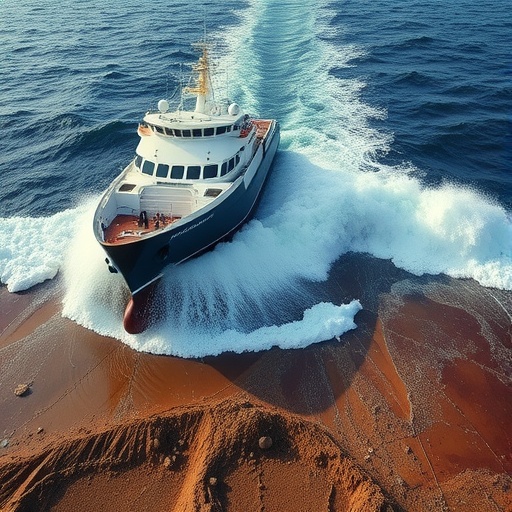
In a groundbreaking new study, researchers have uncovered compelling evidence of how ship wakes contribute to significant water column mixing and seabed erosion within the Baltic Sea, indicating potentially profound implications for marine ecosystems and coastal infrastructure. These findings come at a critical juncture when maritime traffic continues to surge, elucidating previously underappreciated interactions between human activity and underwater environments.
The investigation centered on the physical dynamics generated by vessels as they traverse shallow coastal waters in one of the world’s busiest maritime corridors. Wake-induced turbulence, often observed visually as surface waves trailing behind ships, extends far beyond the superficial, stirring the water column down to the seabed. This enhanced mixing process disrupts sediment stability at the bottom, resulting in measurable erosion at scales previously undocumented in naturalistic settings.
Utilizing advanced in situ measurements combined with high-resolution sediment mapping techniques, the scientific team managed to quantify the degree of seabed alteration linked directly to ship traffic. Their data revealed meter-scale erosive features forming in response to the energy imparted by passing vessels, a phenomenon with cascading effects on benthic habitats. Such localized seabed disturbances threaten the integrity of ecosystems that rely on sediment stability for survival and reproduction.
This research leveraged state-of-the-art instrumentation capable of capturing fine-scale hydrodynamic signatures within the water column. Sensors detected marked increases in turbulence intensity and vertical mixing, phenomena traditionally associated with natural processes like storms but now shown to be exacerbated by anthropogenic influences. The ability to correlate these mixed-layer dynamics with erosion patterns marks a significant methodological advancement in marine environmental science.
The implications of ship wake-induced mixing extend beyond immediate sediment disruption. Enhanced mixing alters nutrient distributions and oxygen penetration within the water column, potentially influencing the productivity of phytoplankton and other foundational species in Baltic Sea food webs. This may trigger broader ecological shifts as the system responds to altered chemical gradients and physical habitats.
Moreover, the observed erosion raises critical concerns about the long-term stability of seabed infrastructure. Pipelines, cables, and marine installations lie vulnerable in these dynamic conditions, where accelerated sediment loss could compromise structural integrity. The findings underscore an urgent need to reassess risk models for underwater assets in regions with heavy maritime traffic.
This study offers a compelling case for the integration of ship wake effects into environmental management frameworks and maritime operation guidelines. Navigational practices might require adaptation to mitigate adverse sediment transport and preserve vulnerable coastlines. Regulatory bodies may need to incorporate these insights into coastal zone management and marine spatial planning to balance economic and environmental interests.
Crucially, the research highlights how anthropogenic factors, even those seemingly benign like vessel movement, can significantly reshape physical oceanographic processes. The Baltic Sea, a semi-enclosed basin characterized by unique hydrographic conditions, serves as a sentinel for the broader consequences of global shipping in other coastal and shelf seas worldwide.
In quantifying the meter-scale erosion attributable to ship wakes, the study draws attention to a previously underestimated driver of sediment dynamics. This class of human-induced environmental change challenges assumptions about the natural baseline of sedimentary processes and prompts reconsideration of human footprints on the marine environment.
The complexity of the water column response observed reflects nonlinear interactions between vessel-generated wave fields and ambient currents, compounded by bathymetric constraints. Such interactions may amplify erosion in sediment-rich zones or conversely stabilize sediments where turbidity currents dissipate. Understanding these nuanced physical mechanisms provides a foundation for improving coastal resilience strategies.
As international shipping continues its upward trajectory, these findings underscore the necessity for interdisciplinary approaches combining oceanography, engineering, and environmental sciences to develop mitigation solutions. Potential interventions include ship speed regulations, route adjustments, or technological innovations in hull design to reduce wake energy and its sedimentary impacts.
This research not only expands scientific knowledge but also carries critical conservation and policy relevance. The Baltic Sea’s fragile ecosystem faces multiple anthropogenic pressures, and adding wake-induced erosion to this list demands immediate attention from policymakers, stakeholders, and environmental advocates committed to sustainable maritime practices.
Future research stemming from this pivotal study may explore temporal variability in wake-induced erosion, effects across various sediment types, and cumulative impacts in heavily trafficked corridors. These directions will refine our predictive models and inform adaptive management strategies tailored to specific regional contexts.
Ultimately, this investigation exemplifies how detailed, high-resolution environmental monitoring can unmask subtle yet consequential human-driven changes in marine systems. By peeling back the layers of interaction between ship-generated physical forces and seabed dynamics, it opens new pathways toward a more harmonious coexistence between maritime activity and ocean health.
In conclusion, the revelation of ship wake-induced water column mixing and meter-scale seabed erosion in the Baltic Sea constitutes a vital advancement in understanding how industrial shipping reshapes coastal environments. It calls for urgent, evidence-based interventions to safeguard marine ecosystems and ensure the longevity of critical infrastructure in an increasingly busy seascape.
Cite Scienmag News
Violet Maxwell. (February 10, 2026). Ship Wakes Drive Water Mixing, Seabed Erosion. Scienmag. https://scienmag.com/ship-wakes-drive-water-mixing-seabed-erosion/
Violet Maxwell. "Ship Wakes Drive Water Mixing, Seabed Erosion." Scienmag, 10 February 2026, https://scienmag.com/ship-wakes-drive-water-mixing-seabed-erosion/. Accessed 4 September 2026.
Violet Maxwell. "Ship Wakes Drive Water Mixing, Seabed Erosion." Scienmag. February 10, 2026. https://scienmag.com/ship-wakes-drive-water-mixing-seabed-erosion/


