


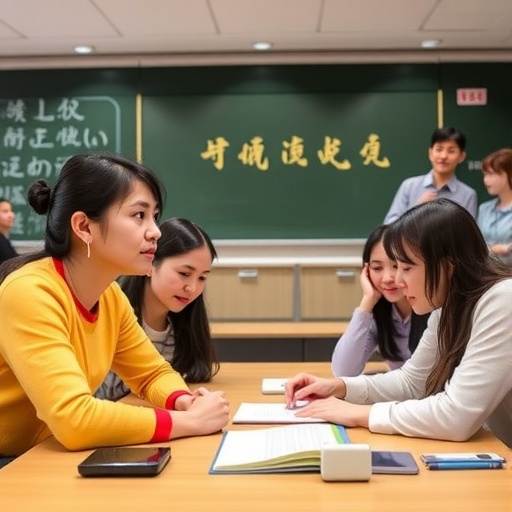
A groundbreaking study conducted in Shanghai has shed new light on the enhancement of teacher-child interactions within early childhood education settings. By focusing on a collaborative, classroom-centered teacher development model known as the Kindergarten-based Instructional Research Model for Teacher–Child Interaction (KIRM-TCI), researchers have provided strong evidence that professional learning rooted deeply in teachers’ own instructional environments can lead to significant improvements in educational engagement and quality.
Published in the prestigious ECNU Review of Education, the research offers rigorous insights demonstrating that KIRM-TCI fosters measurable advances in both emotional and instructional support provided by teachers. These dimensions are critical in shaping positive learning experiences and cognitive development during the formative years of education. Unlike traditional one-off training sessions, this professional development approach emphasizes sustained, context-sensitive teacher growth through iterative practice and reflection.
KIRM-TCI builds on China’s established Kindergarten-based Instructional Research Model (KIRM), which has long promoted school-centered, practice-driven teacher learning. What distinctly sets KIRM-TCI apart is its integration of the internationally recognized Classroom Assessment Scoring System (CLASS) as a foundational framework. This integration enables precise observation, targeted dialogue, and cyclical reflection on classroom interactions, all of which contribute to elevating educator effectiveness in a measurable way.
The model requires teachers to engage in a continuous professional learning community composed primarily of their peers and mentors. This collective undergoes three highly interactive phases: firstly, reviewing and applying CLASS principles that articulate exemplary instructional and emotional teaching behaviors; secondly, engaging in the analysis and discussion of classroom video exemplars to contextualize these principles; and finally, the implementation of newly acquired strategies, followed by guided reflection to ensure the internalization and sustainability of these practices.
A randomized controlled trial was meticulously performed with 51 pre-kindergarten teachers from four public kindergartens in Shanghai. This study design ensured a high level of methodological rigor, controlling for various confounding variables to establish causality between the KIRM-TCI intervention and observed outcomes. Teachers participating in KIRM-TCI exhibited statistically significant enhancements in the quality of classroom interaction, particularly within the domains categorized as Emotional Support and Instructional Support on the CLASS framework.
Delving deeper into teaching behaviors, the improvements were manifested in critical elements such as fostering a Positive Climate—characterized by warmth, respect, and child engagement—and demonstrating heightened Teacher Sensitivity, which includes attentiveness to students’ emotional and academic needs. Furthermore, instructors showed increased Regard for Student Perspectives, validating children’s ideas and encouraging autonomy. Effective behavior management, timely and constructive feedback, and enriched Language Modeling further contributed to transforming the classroom into a more dynamic and responsive learning environment.
This research importantly underscores how grounding professional development within the realities of teachers’ own classrooms allows for a powerful bridging of theory and practice. Teachers become reflective practitioners who do not merely absorb abstract pedagogical concepts but rather operationalize them in everyday interactions that shape children’s experiences. The cyclical nature of observation, dialogue, and reflection promotes ongoing growth beyond the limitations of sporadic workshops or seminars.
The collaborative inquiry approach intrinsic to KIRM-TCI fosters a sustained community of practice. This environment privileges peer support, mutual coaching, and shared commitment to concrete interaction skills. As the study’s authors note, when teachers are engaged in this ongoing, collaborative professional journey focusing on specific classroom interaction competencies, notable and measurable improvements in instructional quality are not only achievable but also maintainable over time.
From an educational policy standpoint, the implications are profound. The KIRM-TCI framework provides a scalable and sustainable model for elevating teacher-child interactions, which are foundational to early childhood education success worldwide. By equipping educators with tools and processes that embed reflective practice and continuous improvement, schools can foster environments conducive to both emotional security and intellectual growth for young learners.
This study also contributes to the growing international discourse on effective teacher professional development strategies. Many existing programs struggle with sustainability and contextual relevance—issues that KIRM-TCI directly addresses through its school-based design and integration of observational data. The contextual sensitivity ensures that interventions are tailored to the unique dynamics of each classroom, thus enhancing the likelihood of translating professional learning into improved pedagogical actions.
In summary, the Shanghai-based research pioneers a compelling model for teacher development that harmoniously blends research-informed frameworks like CLASS with the practical realities of classroom teaching. The demonstrated improvements in Emotional Support and Instructional Support reveal that targeted, collaborative, and reflective teacher growth processes hold substantial promise for transforming early childhood education practices and outcomes on a broader scale.
As education systems globally seek to raise the bar in early learning environments, the KIRM-TCI model presents an innovative blueprint worthy of emulation and adaptation. Its evidence-based approach, proven effectiveness, and emphasis on teacher agency provide a powerful example of how to foster excellence in teaching that ultimately benefits young children’s developmental trajectories and lifelong learning potential.
Cite Scienmag News
Courtney Benton. (May 6, 2026). Shanghai Study Reveals Teacher Collaboration Enhances Classroom Support and Dialogue. Scienmag. https://scienmag.com/shanghai-study-reveals-teacher-collaboration-enhances-classroom-support-and-dialogue/
Courtney Benton. "Shanghai Study Reveals Teacher Collaboration Enhances Classroom Support and Dialogue." Scienmag, 6 May 2026, https://scienmag.com/shanghai-study-reveals-teacher-collaboration-enhances-classroom-support-and-dialogue/. Accessed 4 September 2026.
Courtney Benton. "Shanghai Study Reveals Teacher Collaboration Enhances Classroom Support and Dialogue." Scienmag. May 6, 2026. https://scienmag.com/shanghai-study-reveals-teacher-collaboration-enhances-classroom-support-and-dialogue/


