


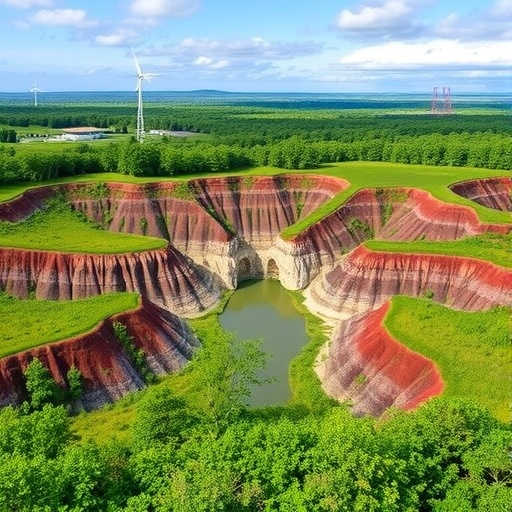
Meeting the soaring future demand for nickel, a critical metal in stainless steel production and the burgeoning clean energy sector, is a formidable challenge fraught with environmental complexity. A groundbreaking international study led by Dr. Jayden Hyman from The University of Queensland’s School of the Environment has illuminated the intricate balance necessary between resource extraction and ecological preservation. This research delves deeply into the spatial distribution of nickel deposits, current mining practices, and future demand trajectories, revealing a stark reality: by the year 2050, nearly half of the nickel mined globally may emanate from landscapes that rank in the top ten percent for global biodiversity conservation importance.
Nickel’s omnipresence in modern infrastructure and technology is undeniable, ranging from structural steel used in construction to cookware extensions in everyday homes. However, its escalating demand is primarily propelled by the urgent pivot towards clean energy solutions, especially electric vehicle (EV) batteries. Dr. Hyman underscores the paradox that the same nickel demand vital for a sustainable energy future could irreversibly impact some of Earth’s most biologically rich and carbon-dense ecosystems if extraction sites are not carefully chosen and managed.
The study presents an alarming increase in mining activities targeting laterite nickel deposits, which account for up to 83 percent of anticipated future supply. These laterite deposits are predominantly found beneath tropical rainforests, requiring extensive land clearing that threatens these complex habitats. Indonesia stands out as a central hotspot where this accelerated deforestation is unfolding, raising international concern given the region’s ecological sensitivity and the consequential disturbances mining poses to terrestrial and marine biodiversity.
Furthermore, the proximity of many nickel deposits to coastal zones intensifies environmental risks. Coastal mining operations threaten the adjacent aquatic habitats, including the globally significant Coral Triangle encompassing waters north of Australia. This marine area is recognized as one of the most diverse ecosystems worldwide, home to intricate coral reefs and a plethora of marine species. Mine runoff and pollution could devastate these fragile marine systems, compounding the ecological footprint beyond terrestrial disruption.
To address these daunting challenges, researchers developed a sophisticated model integrating ecological, geological, and economic data. This model, pioneered by the University of Technology Sydney’s Institute for Sustainable Futures in collaboration with The University of Queensland’s Sustainable Minerals Institute, systematically evaluates where and how nickel could be sourced while balancing ecological priorities and market demands. The framework simulates numerous scenarios, accounting for biodiversity conservation and supply chain dynamics, offering policymakers and industry leaders a powerful tool to anticipate and mitigate environmental trade-offs.
The innovative model incorporates projections derived from authoritative demand scenarios like those of the International Energy Agency, which depict future energy transitions and the consequent surge in nickel needs. According to co-researcher Dr. Stephen Northey from UTS, the model can estimate the quantity and geographic location of new nickel mines required to achieve Net Zero emission targets, underscoring the intrinsic spatial and temporal complexity of meeting global sustainability goals through mineral resource management.
Crucially, the analysis explores scenarios that prioritize biodiversity conservation by excluding the top 10 percent of environmentally sensitive mining areas. While this protective measure substantially minimizes biodiversity loss, it paradoxically risks creating a shortfall of up to 18 percent of anticipated nickel demand by 2050. This gap challenges industry and governments alike to discover new resource deposits or to innovate alternative supply chains to ensure both ecological integrity and resource security.
The findings reaffirm that although advances in battery recycling and the development of low-nickel technologies could attenuate the demand pressures over the long term, these solutions alone will not obviate the need for new mining developments in the near term. Therefore, strategic decisions on mine placement and environmental safeguards remain imperative to reconcile immediate resource demands with conservation ethics.
An intriguing prospect highlighted by the study is the potential exploitation of deep-sea nickel deposits, which may provide a supplementary resource to terrestrial mining. However, this avenue remains fraught with uncertainties regarding its economic feasibility and environmental impact, necessitating rigorous scientific assessment before it can be considered a viable substitute.
This pivotal research advocates for a globally unified approach towards responsibly sourcing nickel, emphasizing the integration of sustainability principles into mineral extraction. Dr. Hyman articulates the necessity for stronger governance and transparency in supply chains, insisting that higher sustainability standards could incentivize environmentally conscientious producers, despite their typically higher operational costs.
The global nickel market currently faces distortions caused by cheaper laterite nickel from tropical areas like Indonesia, undermining producers in countries like Australia who often uphold more stringent environmental standards. Closing this gap through increased transparency about environmental costs and fostering consumer and investor awareness could reorient market dynamics towards more sustainable production practices.
Ultimately, this research sends a clarion call to the international community, emphasizing that sound, data-driven strategies are essential for securing the nickel supplies integral to the clean energy future, without compromising critical global biodiversity or climate objectives. Collaborative innovation in mineral governance, ecological stewardship, and technological advancement is paramount to navigating the complex trade-offs that lie at the intersection of resource development and environmental resilience.
News Publication Date: Information not provided in the original text.
Web References:
– University of Queensland School of the Environment: https://environment.uq.edu.au/
– Sustainable Minerals Institute: https://smi.uq.edu.au/
– Nature Ecology & Evolution DOI link: http://dx.doi.org/10.1038/s41559-026-03068-4
References:
Hyman, J., Northey, S., et al. (2026). Nature Ecology & Evolution. DOI: 10.1038/s41559-026-03068-4.
Cite Scienmag News
Margaret Porter. (May 6, 2026). Global Study Reveals Biodiversity Impact of Clean Energy’s Nickel Surge. Scienmag. https://scienmag.com/global-study-reveals-biodiversity-impact-of-clean-energys-nickel-surge/
Margaret Porter. "Global Study Reveals Biodiversity Impact of Clean Energy’s Nickel Surge." Scienmag, 6 May 2026, https://scienmag.com/global-study-reveals-biodiversity-impact-of-clean-energys-nickel-surge/. Accessed 3 September 2026.
Margaret Porter. "Global Study Reveals Biodiversity Impact of Clean Energy’s Nickel Surge." Scienmag. May 6, 2026. https://scienmag.com/global-study-reveals-biodiversity-impact-of-clean-energys-nickel-surge/


