


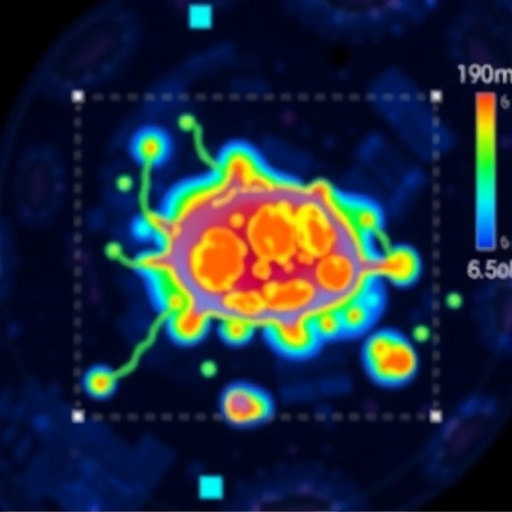
In a groundbreaking advancement poised to redefine cancer diagnostics and personalized therapy, researchers have unveiled an innovative gene-expression deconvolution strategy capable of non-invasively profiling the tumor microenvironment (TME) at unprecedented resolution. This method leverages spatial ecology concepts to dissect the complexity of tumor ecosystems, specifically focusing on spatial ecotypes (SEs), which are distinctive cellular neighborhoods within tumors that profoundly influence disease progression and treatment response.
The study, drawing on single-cell RNA sequencing (scRNA-seq) data across ten diverse cancer types, introduced a novel computational framework based on non-negative matrix factorization (NMF). By simulating 1,000 pseudo-bulk tumor profiles, the team meticulously trained this model to quantitatively decode the composition of SEs on a large scale. Rigorous cross-validation demonstrated the model’s superior accuracy in estimating SE abundances, outperforming previous state-of-the-art deconvolution techniques that struggled with both synthetic and real tumor samples.
The robustness of this approach was further substantiated through analyses involving multi-modal datasets. By examining paired bulk RNA sequencing (RNA-seq) and spatial transcriptomics (Visium platform) data from 42 patients encompassing breast, colorectal, lung, ovarian, and pancreatic cancers, the researchers confirmed significant and consistent correlations for all nine identified SEs. This strong concordance was observed regardless of cancer type or stage, underscoring the method’s adaptability and potential to serve as a universal profiling tool across diverse tumor contexts.
Crucially, the team extended their validation using high-resolution spatial profiling technologies. Through parallel applications of Visium spatial transcriptomics and MERSCOPE multiplexed RNA imaging on adjacent melanoma tissue sections, they demonstrated remarkable alignment in SE spatial architectures over hundreds of thousands of cells. This dual-platform strategy not only cemented confidence in the digital cytometry model’s spatial sensitivity but also highlighted its capacity to capture the intricate microarchitectural patterns that define tumor ecosystems.
Beyond technical validation, the study illuminated the profound clinical implications of SE profiling. Analyzing over 7,000 tumor RNA-seq profiles from 17 cancer types within The Cancer Genome Atlas (TCGA), the researchers unveiled significant prognostic associations. Specific SE abundances correlated with patient overall survival outcomes, revealing both favorable and adverse ecological niches within tumors that could serve as novel biomarkers to guide treatment decisions and risk stratification.
Moreover, the team performed comparative analyses evaluating the predictive power of SE signatures against established biomarkers for immune checkpoint inhibitor (ICI) therapy response. Across 15 RNA-seq datasets, SE-related features not only ranked among the top predictors but also offered unique insights beyond traditional metrics such as tumor mutational burden (TMB) and PD-L1 expression. These findings hint at a paradigm shift, where spatial eco-phenotyping might enhance precision oncology by tailoring immunotherapy strategies to the complex spatial heterogeneity within tumors.
The methodological innovations and comprehensive validations presented in this study underscore an exciting frontier in cancer research. Spatial EcoTyper, as the framework is termed, harnesses the synergy of single-cell data, bulk sequencing, and spatial profiling to generate scalable, high-resolution molecular maps of tumor architecture. This capability addresses longstanding challenges in non-invasive tumor characterization, offering a scalable solution amenable for integration into routine clinical workflows.
Importantly, the framework’s capacity to recover spatial ecotypes from bulk expression data democratizes access to spatially informed tumor biology. By circumventing the technical and cost barriers often associated with direct spatial transcriptomics, this approach paves the way for widespread adoption in translational research and clinical oncology. It enables retrospective analyses on archived bulk RNA-seq datasets, potentially unveiling novel ecological biomarkers that were previously obscured.
The study’s multi-modal strategy also charts a blueprint for future integrative analyses, suggesting that combined interpretations from complementary spatial platforms can amplify biological insights. The correlation of microarchitectural features observed between Visium and MERSCOPE validates the biological authenticity of SEs and encourages adoption of multiplexed imaging alongside computational deconvolution to unravel tumor complexity.
Clinically, the spatial ecosystem paradigm opens exciting avenues for therapeutic targeting. Modulating adverse SEs or promoting favorable ecological states within the tumor microenvironment may emerge as innovative strategies to enhance treatment efficacy. Furthermore, the prognostic and predictive associations uncovered underscore the potential for spatial eco-phenotyping to refine patient stratification in clinical trials and precision medicine initiatives.
This milestone research invites a reevaluation of how tumor heterogeneity is conceptualized, measured, and exploited for clinical gain. By elevating the granularity at which tumor ecosystems are profiled, Spatial EcoTyper heralds a new era where insights from spatial ecology inform the next generation of diagnostics and therapeutics in oncology. The transformational impact of this non-invasive, scalable platform signals a promising horizon for improving cancer patient outcomes worldwide.
As research continues to explore the depths of tumor spatial ecosystems, the methodologies pioneered here will likely stimulate a cascade of investigative and translational efforts. Integration with multi-omics data, expansion into additional cancer types, and refinement of ecological models will further sharpen the predictive power and biological relevance of SE profiling. Ultimately, such advances stand to deepen our understanding of cancer biology and expedite the arrival of more personalized, spatially informed treatment paradigms.
This study epitomizes the convergence of computational biology, spatial transcriptomics, and clinical oncology, showcasing how technological innovation can unravel the intricacies of tumor microenvironments in situ. The authors’ meticulous validation, covering synthetic models, multi-cancer cohorts, and complementary spatial assays, provides a compelling template for rigor and reproducibility in this emerging field. With Spatial EcoTyper, the vision of non-invasive, high-resolution tumor ecosystem profiling moves closer to everyday clinical reality.
Cite Scienmag News
Nathaniel Bowman. (May 6, 2026). Non-invasive Spatial Profiling of Tumor Microenvironment. Scienmag. https://scienmag.com/non-invasive-spatial-profiling-of-tumor-microenvironment/
Nathaniel Bowman. "Non-invasive Spatial Profiling of Tumor Microenvironment." Scienmag, 6 May 2026, https://scienmag.com/non-invasive-spatial-profiling-of-tumor-microenvironment/. Accessed 5 September 2026.
Nathaniel Bowman. "Non-invasive Spatial Profiling of Tumor Microenvironment." Scienmag. May 6, 2026. https://scienmag.com/non-invasive-spatial-profiling-of-tumor-microenvironment/


