


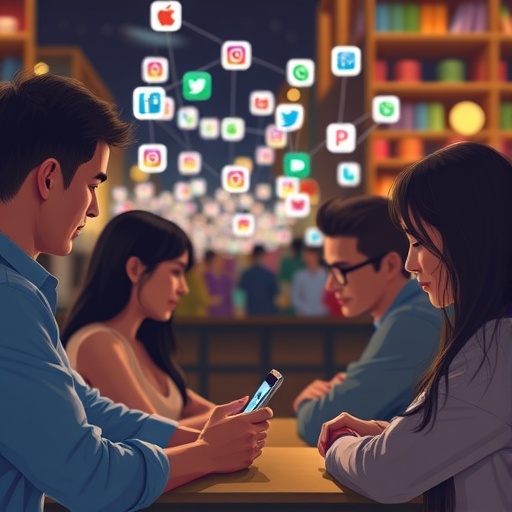
A groundbreaking new study from Oregon State University challenges widespread assumptions about social media’s role in combating loneliness among U.S. adults. Contrary to popular belief that connecting with others online eases feelings of isolation, the research reveals that forming social media relationships with strangers actually correlates with increased loneliness. This nuanced finding emerged from a nationally representative survey involving over 1,500 adults aged 30 to 70, offering fresh insight into the complex psychological dynamics of digital interactions in midlife and later adulthood.
The study uniquely distinguishes between online contacts who are personally known versus those who are strangers, marking a critical advancement over prior investigations that tend to lump all social media connections together. It found that while engaging with familiar individuals on social platforms neither exacerbated nor alleviated loneliness, interacting with unknown contacts significantly heightened it. This suggests that the quality and closeness of an individual’s digital connections critically influence emotional wellbeing, complicating the simplistic narrative that more online interaction necessarily means less loneliness.
Lead researcher Brian Primack, a professor at OSU’s College of Health, highlights the implications of these findings by urging those grappling with loneliness to critically evaluate their social media interactions, especially with online strangers. He advocates prioritizing face-to-face human connections over digital ones, even when social media links appear “close” or meaningful. Such advice runs counter to the digital age’s mantra of relentless online networking as a social panacea, hinting at a need to rethink how technology shapes human sociality fundamentally.
Published in Public Health Reports, the official journal of the U.S. Public Health Service, the study aligns with increasing public health concerns about loneliness gained further urgency after the 2023 Surgeon General’s report on the nation’s loneliness epidemic. That report underscored alarming statistics showing half of American adults experienced measurable loneliness even before the COVID-19 pandemic, with social disconnection posing health risks comparable to smoking. The OSU research thus complements growing evidence that emotional isolation carries significant morbidity and mortality risks.
Medical data consistently link chronic loneliness to elevated risks of depression, heart disease, stroke, dementia, and premature death. Remarkably, lonely individuals face more than double the likelihood of developing depression, a near 30% increased risk of cardiac events, and a significantly heightened chance of both neurological decline and early mortality. By expanding focus beyond teenagers and young adults—who have been the subjects of much previous research—this study highlights that 75% of the U.S. population, represented by adults in middle and late life stages, also experience profound loneliness influenced by their social media behaviors.
One surprising revelation was that approximately 35% of the participants’ social media contacts were strangers — people never met in real life. The researchers theorize that interactions with these unknown individuals may foster misinterpretations and unrealistic idealizations. According to co-author Jessica Gorman, viewing idealized depictions of others’ friendships online intensifies harmful social comparisons, an effect potentially amplified when there is no firsthand knowledge to temper perceptions. This phenomenon exemplifies how social media can distort reality, undermining rather than enhancing psychological wellbeing.
Further complicating the social media-loneliness nexus, the study included users of ten major platforms, including Facebook, X (formerly Twitter), Reddit, YouTube, LinkedIn, Instagram, TikTok, Snapchat, Pinterest, and WhatsApp. By casting a wide net, the researchers ensured a representative glimpse into varied digital environments, emphasizing that the impacts observed transcend any single platform’s culture or user base. This cross-platform approach deepens understanding of the ubiquitous yet paradoxically isolating role of modern social networking technologies.
OSU’s team, comprised of experienced faculty and graduate scholars, conducted this research during the summer of 2023, supported by the National Institutes of Health. Their pioneering work jumps off from prior findings by Primack and Gorman that linked loneliness with the mere quantity and frequency of social media use. This new study advances knowledge by integrating the dimension of contact closeness, pushing the field beyond binary assumptions toward a more granular understanding of how digital social ties influence mental health.
The insights derived also resonate with OSU’s broader scholarly efforts exploring loneliness and its associated health conditions, such as insomnia and recurrent nightmares, which further illustrate the profound ripple effects of emotional isolation. Together, these investigations paint a compelling portrait of loneliness as a multifaceted public health challenge aggravated by certain patterns of digital socialization. Addressing this complex issue requires not only medical and psychological interventions but also a critical societal reflection on the design and use of social media technologies.
In conclusion, this research compels a reevaluation of social media’s role in adult social lives, challenging optimistic assumptions that virtual contacts successfully substitute or enhance real-life relationships. While online platforms undeniably offer unprecedented opportunities for connection, their indiscriminate use, especially involving contacts without prior personal relationships, may paradoxically deepen loneliness. These findings serve as a clarion call for users, health professionals, and platform designers alike to foster digital experiences that genuinely support mental health, emphasizing authenticity and meaningful interaction over mere connectivity.
Cite Scienmag News
Courtney Benton. (May 6, 2026). Research Indicates Social Media Connections Are Unlikely to Reduce Loneliness. Scienmag. https://scienmag.com/research-indicates-social-media-connections-are-unlikely-to-reduce-loneliness/
Courtney Benton. "Research Indicates Social Media Connections Are Unlikely to Reduce Loneliness." Scienmag, 6 May 2026, https://scienmag.com/research-indicates-social-media-connections-are-unlikely-to-reduce-loneliness/. Accessed 3 September 2026.
Courtney Benton. "Research Indicates Social Media Connections Are Unlikely to Reduce Loneliness." Scienmag. May 6, 2026. https://scienmag.com/research-indicates-social-media-connections-are-unlikely-to-reduce-loneliness/


