


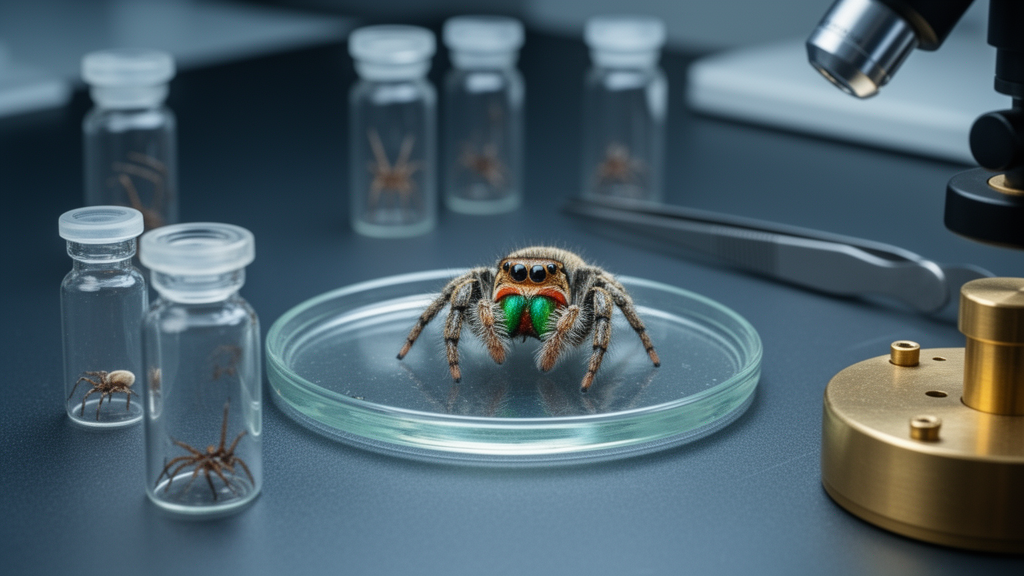
Deep inside the collections of Hunan Normal University in Changsha, small glass vials holding spiders collected decades ago have just rewritten part of China’s arachnological record. A new taxonomic study published in the journal ZooKeys re-examined the type specimens — the original, name-bearing individuals — of seven jumping spider species from the subtribe Plexippina, and the verdict is striking: four of the seven names do not represent distinct species at all. Three new synonymies are formally proposed, collapsing what once looked like seven species into just four valid ones.
Jumping spiders, family Salticidae, are the largest family of spiders, famous for their acute vision and remarkable predatory leaps. Within this family, the tribe Plexippini and its subtribe Plexippina form a large and morphologically diverse lineage comprising more than 600 described species in 37 genera. The group is distributed predominantly across the Old World and includes familiar genera such as Epeus, Evarcha, Hyllus, Pancorius, Plexippus, Ptocasius, Telamonia, Thyene and Yaginumaella. Most members are relatively large-bodied spiders with robust legs, and males are characterised by a generally rounded palpal bulb and a simple, fixed embolus — the intromittent organ used to transfer sperm to the female.
That simplicity is precisely the problem. The genital structures of Plexippina spiders are morphologically conservative, offering few obvious differences between closely related species, which makes delimiting and identifying them notoriously difficult. Taxonomists have long relied on subtle features of the male palp and the female epigyne — the external genital plate — to separate species, but when those features vary within a species, the result is a proliferation of names for what are actually the same animals. Resolving such confusion requires going back to the source: the type specimens themselves, stored in museum collections, sometimes for decades.
This is exactly what the new study did. The researchers located and re-examined type material of seven species belonging to the genera Evarcha, Pancorius, Thyene and Telamonia, all held at the College of Life Sciences of Hunan Normal University, with additional comparisons drawn from the Institute of Zoology of the Chinese Academy of Sciences. Specimens preserved in 75 percent ethanol were dissected, with vulvae cleaned in lactic acid before examination. Using a Leica M205C stereomicroscope and an Olympus BX53 compound microscope fitted with a digital camera, the team produced high-resolution, focus-stacked images of habitus and copulatory organs, allowing direct, side-by-side comparison of structures that had previously only been illustrated in separate publications.
The results split cleanly down the middle. Three species retained their current taxonomy unchanged: Evarcha wulingensis, described in 1993 from Wulingyuan in Hunan; Pancorius goulufengensis, described in 1998 from Hengyang; and Thyene yuxiensis, described in 1995 from Yuxi County in Yunnan. For each of these, the study provides detailed new illustrations of the type specimens, confirming that the original diagnoses hold and that the names remain valid. The male of E. wulingensis, for example, is distinguished by a palp bearing three tibial apophyses — bony outgrowths of the tibial segment — including a wide, short dorsal retrolateral apophysis and a finger-like ventral one, together with a flat tegulum and a sclerotised embolus about half the length of the tegulum.
The other four species fared less well. Telamonia luxiensis, described in 1998 from a single female collected in Luxi County, Hunan, is now considered a junior synonym of Epeus bicuspidatus, a species originally described in 1988 from a male collected on Mount Jianfeng in Hainan. The two type localities are geographically close, and the female genitalia show considerable resemblance: a shallow epigynal depression, inward-facing copulatory openings, and thin, strongly coiled copulatory ducts. Because the male of E. bicuspidatus was already well characterised and its female had been described more recently from Guizhou, the match between the Luxi holotype and the known female of E. bicuspidatus became decisive.
A second collapse involved Thyene triangula, described in 1995 from a male collected in Mengla County, Yunnan. Comparison of its type specimen with high-quality images of Ptocasius montiformis, described in 1991 from a female collected in the same county, revealed no morphological difference between the two. The embolus of the male palp originates at the twelve o’clock position in ventral view, the retrolateral tibial apophysis is longer than the tibia itself, and the female epigyne bears a single M-shaped epigynal pocket — features that together distinguish the species from its closest relative, Ptocasius paraweyersi, but that are shared identically by both T. triangula and P. montiformis. The conclusion: T. triangula is a junior synonym of P. montiformis.
The most complex case concerned Thyene orientalis, a species described in 1985 and already known to be widespread, recorded from Japan, Vietnam and several Chinese provinces. Two other names were found to fold into it. Thyene radialis, described in 1995 from a male collected in Chengbu County, Hunan, had already been synonymised with T. orientalis in a previous revision, and the new examination of its holotype confirmed that decision: the conical retrolateral tibial apophysis, the slender embolus originating at the six o’clock position, and the linguiform tegular flap all match. Minor differences in the origin of the tegular flap, the thickness of the tegulum, and the presence of three or four radial striae on the bulb were judged to be intraspecific individual variation rather than species-level distinctions.
The third synonym in this cluster is Thyene zhangi, described in 1998 from a female collected in Longshan County, Hunan, and originally placed in the genus Plexippoides before being transferred to Thyene. Re-examination of its holotype revealed no morphological differences from T. orientalis apart from a bilateral asymmetry of the copulatory duct — a feature that has itself been documented within T. orientalis populations in Japan. With that asymmetry now recognised as normal intraspecific variation, T. zhangi too becomes a junior synonym of T. orientalis, leaving that single widespread species to absorb three former names.
The study is more than a housekeeping exercise. Accurate species delimitation underpins everything from biodiversity inventories to conservation planning to reconstructions of evolutionary history, and synonymies directly change how many species a region is thought to contain. The work also reflects a broader renaissance in Plexippina systematics. Recent phylogenomic analyses using ultra-conserved elements — stretches of DNA shared across the genome that retain enough signal to resolve deep relationships — have dramatically clarified the group’s internal classification, leading to the reclassification of established genera and the description of entirely new ones such as Chuanattus, Dianattus, Ghatippus, Gratianna, Phenasurya and Tenkana. Combined with continued re-examination of type material, these molecular tools are steadily replacing guesswork with evidence, one museum drawer at a time.
Subject of Research: Taxonomic revision of seven Chinese jumping spider species in the subtribe Plexippina, proposing three new synonymies based on re-examined type material.
Article Title: Re-examination of the type materials of seven species of Plexippina ( Araneae , Salticidae ) from China
Article References: Zhou, Y., & Peng, X. (2026). Re-examination of the type materials of seven species of Plexippina (Araneae, Salticidae) from China. ZooKeys, 1293, 221-239. https://doi.org/10.3897/zookeys.1293.203377
Image Credits: AI Generated
DOI: 10.3897/zookeys.1293.203377
Keywords: jumping spiders, Salticidae, Plexippina, taxonomy, type specimens, synonymy, China, ZooKeys, arachnology, biodiversity, Re-examination, type
Cite Scienmag News
Margaret Porter. (October 17, 2026). Seven Chinese jumping spiders under the microscope: museum specimens reveal hidden synonyms. Scienmag. https://scienmag.com/seven-chinese-jumping-spiders-under-the-microscope-museum-specimens-reveal-hidden-synonyms/
Margaret Porter. "Seven Chinese jumping spiders under the microscope: museum specimens reveal hidden synonyms." Scienmag, 17 October 2026, https://scienmag.com/seven-chinese-jumping-spiders-under-the-microscope-museum-specimens-reveal-hidden-synonyms/. Accessed 17 October 2026.
Margaret Porter. "Seven Chinese jumping spiders under the microscope: museum specimens reveal hidden synonyms." Scienmag. October 17, 2026. https://scienmag.com/seven-chinese-jumping-spiders-under-the-microscope-museum-specimens-reveal-hidden-synonyms/


