


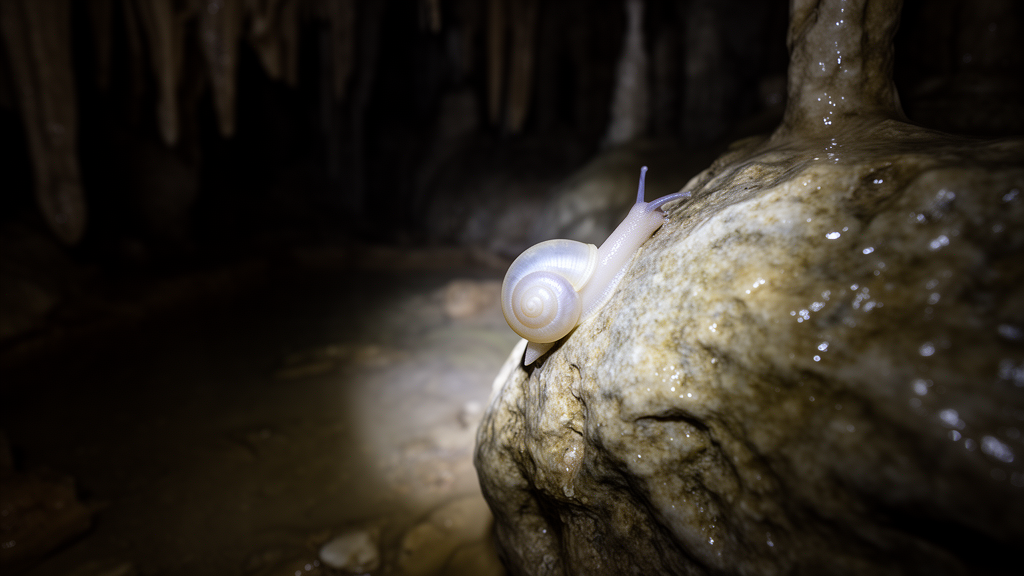
Deep inside a limestone cave in Hongta District, Yuxi City, Yunnan Province, China, researchers have discovered a tiny, translucent, completely eyeless snail that represents a scientific milestone: the first freshwater cavesnail ever formally documented from Chinese territory. The new species, named Erhaia dijiang after a creature from ancient Chinese mythology, belongs to the family Erhaiidae within the superfamily Truncatelloidea, a group of minute gastropods whose East Asian subterranean fauna has remained almost entirely unexplored. The discovery, published in the journal Subterranean Biology, not only fills a conspicuous gap in the map of cave biodiversity but also pushes the known upper elevation limit for cave-dwelling freshwater snails in Asia above 2000 meters, revealing that these fragile animals can persist in karst caves at altitudes far higher than previously assumed.
The story of the discovery begins in August 2025, when a small team of malacologists surveyed a cave in Yuxi City using a fine fishing net with a mesh size of less than 1.5 millimeters. Their haul was modest in number but extraordinary in significance: two live individuals were found inside the cave, while one live snail and one empty shell were discovered less than two meters from the cave entrance. During the rainy season, rapid water flow from the cave’s outlet flushes a small number of individuals out of the cave, and the water temperature within the cave is nearly 20 degrees Celsius. All specimens were preserved in 95 percent ethanol and deposited at the Museum of Biology, Nanchang University, where the holotype, a shell measuring 2.05 millimeters in length and 0.98 millimeters in width, was collected at an altitude of 2062 meters.
Erhaia dijiang is a member of the family Erhaiidae, a group established by Davis and Kuo in 1985 that currently contains only three valid genera: Akiyoshia, Chencuia and Erhaia. Species of this family inhabit high-altitude streams stretching from the Himalayas, including Bhutan and Nepal, to eastern China, with documented occurrences in Yunnan, Guizhou, Hubei and Fujian. Because of their minute size, these snails have received limited research attention. Some cave-dwelling species have been reported within the genus Akiyoshia, which is found only in Japan, but no cave species of the genus Erhaia had ever been recorded until now. The new species bears a resemblance only to certain specimens of Erhaia xiaoboqiani, described in 2025, yet it can be readily distinguished from them by the complete absence of eyes, a thin lip, and a slightly reflexed outer lip.
The morphology of the new species is characteristic of a highly specialized subterranean lifestyle. The shell is small, translucent, conical and thin, with fine, irregular growth lines on its surface. The apex is obtuse, and the apical whorls lack micro-sculpture, giving the surface a rough texture under magnification. The body whorl is slightly swollen, and some individuals display a keel. The lip is thin, with the inner lip slightly thickened and reflexed, and the outer lip slightly reflexed as well. Notably, the species lacks a tooth on the columella, a feature that helps separate it from all currently known congeners. The umbilicus is narrow. Perhaps most strikingly, all individuals examined to date show complete degeneration of ocular structures, with no trace of eyes remaining, while the snout is slender with a slight anterior enlargement, the tentacles are slender and translucent, and the mantle is smooth, translucent and entirely lacking in pigment.
To confirm the species’ identity and evolutionary position, the researchers turned to molecular phylogenetics. Partial sequences of the mitochondrial cytochrome c oxidase subunit I gene, or COI, were amplified using the standard Folmer primers LCO1490 and HCO2198, and the resulting 623-base-pair sequence was deposited in GenBank under accession number PZ310334. Phylogenetic analyses were conducted using both Bayesian inference and maximum-likelihood methods, with Bithynia tentaculata, a closely related species within Truncatelloidea, selected as the outgroup to root the tree. The best substitution models were selected using the corrected Bayesian Information Criterion, with TIM2+F+G4 chosen for the maximum-likelihood approach and GTR+F+G4 for the Bayesian method. Node support was assessed through Bayesian posterior probabilities and 1000 rapid bootstrap replicates.
The results of these analyses provide compelling evidence for classifying the new species as a member of the genus Erhaia. The phylogenetic tree places Erhaia dijiang as a sister group to Erhaia daliensis, the type species of the genus, with an uncorrected p-distance of 10.2 percent based on COI sequences. This genetic divergence, combined with the distinctive shell morphology, supports the assignment of the new species to Erhaia. However, the analysis also revealed that the genus Erhaia does not form a well-supported monophyletic group, a finding consistent with previous research. Numerous taxonomic issues within Erhaia remain unresolved, such as the presence of a thick tooth on the columella in some species, which results in a lack of consistency in shell morphology among many congeners and warrants further investigation in the future.
Ecological observations of the living specimens paint a vivid picture of a species exquisitely adapted to life in perpetual darkness. In laboratory aquaria, the snails displayed clear photophobic behavior, preferring to hide in dark crevices under rocks. They accepted artificially supplied fish food and also grazed on diatoms growing on rock surfaces. In their natural habitat, the snails inhabit gravel and crushed stones underwater in caves, at dwelling depths of less than one meter. Based on the species’ habitat preference, lack of pigmentation, and absence of eyes, the researchers classify it as a troglobiont, a term reserved for organisms that are obligately bound to subterranean environments. Interestingly, another snail species belonging to the family Pomatiopsidae was discovered at the same locality; its body is also highly transparent, yet it possesses normal eyes. However, only a single individual of this second species was found, so no further investigation of it was conducted in the present study.
The discovery carries considerable biogeographic weight. Prior to this finding, freshwater cavesnails of the family Erhaiidae had only been recorded in Japan, and research on cave-dwelling freshwater snails in Asia remains scarce, with recent studies documented only in Laos and Sri Lanka. Due to the lack of corresponding live observations in those countries, it remains unclear whether obvious eye degeneration has occurred in those species. The new report demonstrates that the distribution range of subterranean freshwater gastropods in East Asia is broader than previously assumed and updates the upper elevation limit for cave-dwelling freshwater snails in the Asian region, indicating that these animals can still exist in karst caves at altitudes exceeding 2000 meters. To date, freshwater cavesnails in Asia are predominantly affiliated with the superfamily Truncatelloidea, which may reflect the strong adaptive capacity of this remarkably species-rich group, particularly in Yunnan Province.
Despite the excitement surrounding the discovery, the survival status of Erhaia dijiang is far from optimistic. During field surveys, the population density of the newly discovered species was found to be extremely low, and no juveniles were observed. With only three live individuals and one empty shell obtained, the researchers did not have sufficient specimens for anatomical examination, making comprehensive sampling in the caves of Yunnan a priority for subsequent studies. The team emphasizes that it is extremely important to formulate appropriate conservation measures in a timely manner for these endemic mollusk species in Yunnan, a province that has yielded a large number of new mollusk discoveries in recent years but whose freshwater fauna faces mounting pressures. Extensive surveys of freshwater cavesnails in Chinese caves are required to improve our understanding and facilitate the conservation of these vulnerable cave-dwelling organisms.
The finding also highlights how much remains unknown about subterranean biodiversity in China, a country with exceptionally high species richness of Truncatelloidea but, until now, no records of freshwater cavesnails whatsoever. Empty shells of some species of the genus Gyraulus were found at the type locality, but since no live individuals were discovered, it remains unclear whether these belong to cavesnails. As researchers continue to explore the karst caves of Yunnan and beyond, each new discovery refines our understanding of how life adapts to the darkness, isolation and scarcity of resources that define the subterranean realm. Erhaia dijiang, with its ghostly transparency, its vanished eyes, and its perch at the upper edge of the known elevational range for Asian cavesnails, stands as a vivid reminder that some of the planet’s most remarkable evolutionary stories unfold in places few humans have ever thought to look.
Subject of Research: Biology
Article Title: A new eyeless species in Erhaiidae ( Gastropoda , Truncatelloidea ) from a cave in Yuxi City, Yunnan, China
Article References: He, Y.-M., Xiang, H.-Q., Yang, J.-M., Zheng, H., Yang, S.-Z., Zhou, Y.-F., & Zheng, J. (2026). A new eyeless species in Erhaiidae (Gastropoda, Truncatelloidea) from a cave in Yuxi City, Yunnan, China. Subterranean Biology, 56, 127-136. https://doi.org/10.3897/subtbiol.56.188075
Image Credits: AI Generated
DOI: 10.3897/subtbiol.56.188075
Keywords: eyeless, species, Erhaiidae, Gastropoda, Truncatelloidea, cave, Yuxi, City, Yunnan, China, scientific research
Cite Scienmag News
Gavin Prescott. (October 17, 2026). Eyeless cavesnail from Yunnan cave is China’s first freshwater cavesnail. Scienmag. https://scienmag.com/eyeless-cavesnail-from-yunnan-cave-is-chinas-first-freshwater-cavesnail/
Gavin Prescott. "Eyeless cavesnail from Yunnan cave is China’s first freshwater cavesnail." Scienmag, 17 October 2026, https://scienmag.com/eyeless-cavesnail-from-yunnan-cave-is-chinas-first-freshwater-cavesnail/. Accessed 17 October 2026.
Gavin Prescott. "Eyeless cavesnail from Yunnan cave is China’s first freshwater cavesnail." Scienmag. October 17, 2026. https://scienmag.com/eyeless-cavesnail-from-yunnan-cave-is-chinas-first-freshwater-cavesnail/


