


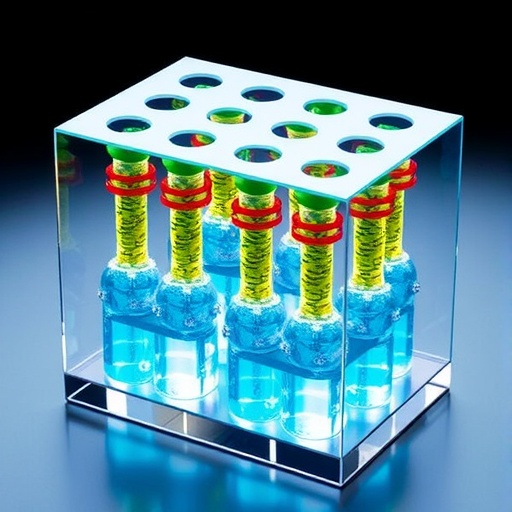
In the relentless quest to sustain the global shift towards clean energy technologies, the efficient extraction of lithium from natural brines has emerged as a crucial challenge. Lithium-ion batteries stand at the heart of this revolution, powering everything from electric vehicles to large-scale renewable energy storage systems. However, the high magnesium content in lithium-rich brines has continuously complicated the separation and purification processes, resulting in inefficiencies and cost hurdles. A groundbreaking strategy recently presented by researchers offers a transformative approach to this problem, harnessing the power of negatively charged membranes with high charge densities to achieve unprecedented selectivity between lithium (Li⁺) and magnesium (Mg²⁺) ions.
Traditional methods of lithium extraction often struggle with the ionic similarities between monovalent lithium ions and divalent magnesium ions. This difficulty arises because magnesium ions, carrying a double positive charge, typically interact more strongly with negatively charged separation membranes, allowing them to permeate membranes more readily than lithium ions. The known physics of ion transport across charged membranes has long suggested that divalent cations dominate permeation profiles in these setups, creating a barrier to efficient lithium recovery. However, the novel approach now unveiled turns this paradigm on its head: lithium ions are now observed to permeate membranes at substantially higher rates than magnesium ions, despite the membranes being negatively charged.
This remarkable inversion of ion permeation selectivity stems from the delicate interplay of selective ion partitioning and uphill transport phenomena. At its core, the technique capitalizes on the membrane’s intrinsic affinity for lithium ions, which preferentially partition into the membrane matrix over magnesium ions. Meanwhile, magnesium ions exhibit an unexpected uphill transport against their concentration gradient, effectively limiting their net permeation and enriching the lithium fraction on the permeate side. The combined effect results in lithium ions efficiently traversing the membrane, leaving magnesium ions behind, and thus neatly achieving a separation that was previously unattainable using similar membrane technologies.
To substantiate these theoretical insights, the research team conducted bench-scale dialysis experiments utilizing a representative brine solution modeled on the extremely lithium-rich and magnesium-laden Atacama brine, one of the most significant lithium sources globally. This experimental validation confirmed the promising selectivity indices, showcasing lithium’s preferential transport through the membrane while magnesium faced significant transport resistance. The findings highlight the potential to efficiently separate monovalent and divalent cations directly from natural brines without the extensive pretreatment or chemical modification that current industrial processes rely on.
One of the key innovations lies in the membrane design itself. The membranes employed possess a high density of negative charges, achieved through advanced polymer chemistry, allowing them to interact selectively with ionic species based on charge and size. Unlike conventional membranes, where divalent ions tend to monopolize permeation pathways due to stronger electrostatic attractions, these high-charge-density membranes create conditions that favor lithium ion partitioning thermodynamically. By manipulating the charge density and functional groups on the membrane surface, the researchers engineered a unique environment where lithium’s smaller ionic radius and hydration characteristics promote its preferential absorption and transport.
Moreover, the uphill transport of magnesium ions is an intriguing and counterintuitive phenomenon. Rather than diffusing down their concentration gradient, magnesium ions are effectively pushed back by a combination of membrane interactions and concentration polarization effects on the feed side. This creates a barrier to magnesium permeation, permitting lithium ions to cross more freely. The precise mechanisms behind this uphill transport encompass a complex balance of electrostatic interactions, ion hydration dynamics, and membrane microstructure, a subject the team explored rigorously through both experimental measurements and computational modeling.
This discovery represents a paradigm shift in how we understand ion transport in charged membranes, suggesting that through careful membrane engineering and operational control, one can manipulate ion selectivity far beyond classical electrostatic considerations. It opens doors to tailor-made membranes for various selective separations relevant not just to lithium extraction but also to wider applications involving ion separations in environmental remediation, water purification, and chemical processing industries.
Looking beyond lab-scale experiments, the implications for industrial lithium production are profound. Current lithium extraction often involves laborious steps with significant environmental footprints, such as extensive chemical precipitation, solvent extraction, or energy-intensive evaporation ponds. Integrating the new membrane technology could substantially reduce the energy and chemical demands of lithium separation by simplifying the process to a selective dialysis step driven passively by concentration gradients. Such an advancement could dramatically lower operational costs while increasing lithium purity and yield, meeting rising demand more sustainably.
Importantly, this technology’s reliance on passive concentration gradients rather than externally applied electric fields distinguishes it from typical membrane separation technologies like electrodialysis. This passive operation mode can translate into lower energy consumption and simpler system designs, potentially enabling decentralized or modular lithium extraction units that could be deployed in remote mineral-rich regions, reducing infrastructure costs and environmental impacts.
The research team also highlighted the versatility of the membrane system by demonstrating its effectiveness across a range of brine compositions and operational conditions. By tuning membrane charge densities and optimizing conditions such as pH and ionic strength, the method can be adapted to various sources beyond Atacama brine, including lower lithium concentration brines or other saltwater matrices where lithium recovery is essential.
The wider scientific community has taken note of this advancement as a turning point in membrane science and battery raw material supply chains. By providing a clear pathway to highly selective lithium recovery, the work addresses both immediate technological bottlenecks and long-term sustainability challenges inherent in the battery industry’s growth trajectory.
Furthermore, the fundamental insights gleaned from this study into ion partitioning and transport mechanisms could catalyze the development of new classes of membranes with tailored selectivities for other industrially relevant ion pairs. The principles demonstrated here—selective partitioning combined with uphill ion transport—may be applicable to separations such as sodium/potassium, calcium/strontium, or even heavy metal remediation, offering broad transformative potential.
The researchers emphasize that future work will involve scaling this separation approach to pilot and commercial levels, integrating the membrane process into full lithium recovery workflows, and exploring advanced membrane materials to enhance performance further. Such efforts will be critical for translating bench-scale success into viable industrial technologies that can support the rapid expansion of sustainable energy storage infrastructures worldwide.
In summary, this novel membrane-based lithium extraction method, leveraging selective ion partitioning and challenging conventional ion transport assumptions, represents a watershed moment for resource recovery science. It promises a more efficient, eco-friendly, and economically viable future for lithium supply chains, directly contributing to the global energy transition.
As the demand for lithium-intensive batteries continues to soar, innovations like this offer a beacon of hope, demonstrating that a sustainable and scalable lithium supply is within reach. By rethinking membrane ion transport phenomena and cleverly exploiting concentration gradient-driven processes, the path toward cleaner energy technologies is now clearer and more attainable.
This exciting development underscores the critical interplay between fundamental scientific discovery and practical technological application in addressing some of the most pressing energy and environmental challenges facing humanity today. As researchers continue to push boundaries, membrane science emerges as a key frontier in shaping a sustainable future.
Cite Scienmag News
Faith Mcneil. (December 10, 2025). Selective Partitioning Enables Efficient Li/Mg Ion Separation. Scienmag. https://scienmag.com/selective-partitioning-enables-efficient-li-mg-ion-separation/
Faith Mcneil. "Selective Partitioning Enables Efficient Li/Mg Ion Separation." Scienmag, 10 December 2025, https://scienmag.com/selective-partitioning-enables-efficient-li-mg-ion-separation/. Accessed 7 September 2026.
Faith Mcneil. "Selective Partitioning Enables Efficient Li/Mg Ion Separation." Scienmag. December 10, 2025. https://scienmag.com/selective-partitioning-enables-efficient-li-mg-ion-separation/


